Metabolic Conditioning: The Bear Barbell Complex Workout

20 minute Workouts, Quick Tips

“The Bear” Barbell Complex is as close to flowing barbell training with a barbell that you’ll ever get, or at least I have ever gotten.

I’ll assume that “The Bear” is referred to as “The Bear” because of how difficult the workout is.

This complex workout leverages barbells.  Barbells are mostly thought to develop pure strength and power.

The barbell was manufactured to work well for moving heavy weight.  Moving heavy weight creates the ideal training stimulus for building strength.  If a person moves the barbell fast enough across a set distance (Point A to Point B), the barbell becomes a tool that enhances an individuals power.  Think cleans, snatches, jerks, etc.

  • Slower moving + heavy weight = Strength Development
  • Fast moving + medium/heavy weight = Force Production = Power Development

Although barbell training might not be an appetizing fitness solution for a lot of people, taking some time to learn and practice the basics of barbell training can pay a person back ten-fold over time.

My guess is a lot of people avoid barbell training because of the intimidation and unfamiliarity factor, or for some, the uncomfortable sensation of iron grinding against the skin.  Barbell work will develop tough hands over time.

The callouses I cannot help you with… but if you want to know more about barbell training, buy Starting Strength by Mark Rippletoe.  Read a few pages, practice, read a few more pages and practice some more.  There is a wealth of knowledge in Starting Strength that can help you establish the emotional confidence and the technique to play around with the barbell a bit more.

It’s important not to be afraid or intimidated by the barbell.  When people think of barbell training they usually picture a 300lb tank-of-a-man squatting 500lbs, yelling like a maniac during every rep while his friends stand around yelling like maniacs during every rep.

You’re partially right if this is your initial mental picture.  But barbells, and how we use them to develop physical qualities has evolved a lot over the years.

Like any other fitness tool, barbells can be leveraged for other purposes also.

In particular, I enjoy using the barbell during work capacity directed training sessions (aka: metabolic conditioning) or at the end of a workout for a short burst finisher.  Think high reps with lower loads, or a highly concentrated amount of work done in a short time frame, or unique mixture of both.

When I re-stumbled onto the The Bear Barbell Complex a few weeks ago, I reintroduced myself to a style of barbell training that I used to use quite a bit, especially when available workout time was limited.

“What is The Bear Complex?, you ask.

Come a bit closer and let’s take a look…

Barrier to Entry

Tools: Barbell and plates (bumper or standard metal work fine), clock timer such as the GymBoss.
Skill:  Working knowledge of the barbell based exercises listed below.

The Exercises

#1: Power Clean

#2: Front Squat

#3:  Push Press

#4: Back Squat

#5:  Behind-the-neck Push Press

Workout Structure

–  Each movement is performed for 1 repetition before immediately moving into the next exercise.

–  1 Cycle =  1 repetition from #1-#5 in alternating/descending order.  After exercise #5’s rep, return back to exercise #1.

–  1 Round = 7 Cycles

–  Perform 5 Rounds

–  Rest 90 seconds after finishing each round.

–  Barbell weight is dependent on:

  • Weakest lift (the weakest lift determines the appropriate load, which should be sub-maximal)
  • Exercise technique and know-how.
  • Reaction to fatigue (which correlates closely with the deterioration of exercise technique)
  • Advanced Women – 95lbs
  • Advanced Men – 135lbs

The Extended Break-Down…

There are 35 reps of every movement being performed throughout all 5 rounds.  Just 35 reps.  If you consider the volume of a more traditional work-rest training session, where a squat is performed for 8 reps x 3-4sets, the volume is not much higher.

The weight used is also much lighter than a more traditional work-rest set and should be determined by your weakest lift in the complex.  For a lot of people that is going to be the push press, possibly the power clean (grip). I’m asking you to perform 5 reps for each round.  The barbell load should be a sub-maximal, which means that you should be able to push press that barbell for 8-10 reps comfortably.

My suggestions on weight for men and women are not the law.  Adjust the weight to what is appropriate for your current fitness level and know-how.

Every exercise is performed for a single rep before moving into the next exercise.  From rep to rep, you’re alternating between different movement pattern throughout each cycle.  It’s important to understand this aspect of The Bear Complex, because it’s one of it’s features that makes it so physically taxing.

Elevation Change

The barbell begins on the floor and travels to chest height after the clean and during the front squat.  After the front squat the barbell moves overhead after the push press.  The barbell then transitions from the front of the body to the back of the body on the descent down from the push press.

At this point, the barbell rests on the shoulders while you perform a back squat.  At the top of the back squat, the barbell is forcefully pressed overhead once more, and caught back into the front rack position at chest height.  The barbell is guided back to waist height and eventually back down to the floor to prepare for the next cycle, starting with a power clean.

The training stimulus elicited by moving the barbell up and down, front to back, movement to movement creates a large metabolic training effect.

Performing single rep of a movement pattern, followed by single rep of a completely different movement pattern, while bundling a bunch of different movement patterns together in a row (creating a “cycle”) is extremely fatiguing.  It’s provides a unique training stimulus for the body to cope with and also laser-like focus for the mind to keep up with since every rep involves a different movement pattern.

‘Single-rep-alternating-movement-pattern-workouts’ have proven to be an effective variation of traditional complex training, where exercises are performed for multiple repetitions before moving on to the next movement pattern.

If you’re accustomed to sectioning off your complexes, doing 6 reps of one exercise here and 6 reps of another there before moving on, alternating movement patterns with every rep will be a shock to your system.

It’s reiterating once again that alternating the movement pattern on every rep requires great skill.  The barbell is constantly changes levels, stopping and starting in different positions.  The transitions can be brutal.  There’s a high level of focus needed here.

The Fatigue is Coming…

During The Bear Complex, the first few reps/cycles usually don’t feel too rough, but the wave of fatigue that bites you in the ass somewhere around cycle 5, 6 or 7 can be overwhelming.  Possibly so much so that executing all 7 cycles for any 1 round is just plain unreasonable if you’re new it.  Don’t be afraid to remove your hands from the barbell to take a break and to gather yourself.

Loaded conditioning is a fantastic method to burn fat and develop high level work capacity which has great transfer into sport and becoming more resilient toward real life labor, but fatigue can break down your exercise technique.  Don’t be a hero here, be smart.  If 5 rounds is too much, do 4 rounds.  Be reasonable.

Movement technique first and foremost, forever and always.

Pay Attention to your grip integrity

Alternating movement patterns and transitioning the bar to different resting positions can fry your grip.  Consider that the bar is moving from the floor, to chest to over head, to shoulders, back to overhead and finally back down to the floor position.  That’s a lot of bar movement.  Don’t be afraid to walk away from the barbell if your grip starts to slip.  A quality grip is needed for the cleans.  Attempting to pull a barbell with a poor grip can be dangerous, and the fatigue that’s been created with slow your reaction/recovery time.  Again, rest for a few seconds, gather yourself, then complete the work with a solid grip.

If you’re a tenacious sweater like I am, also be aware of any sweat rolling down your forearm and into the hand/barbell interface.  Don’t push through this situation either.  Dry all surfaces with a towel and continue on.  Maybe consider using a no mess chalk solution such as HumanX Chalk Balls to help maintain grip.  Chalking your hands has come a long way.
.

This workout is advanced 

Complex training in general is an advanced form of training.

Any exercise scheduled in a complex must be an exercise that you have a familiarity with BEFORE you enter the workout.  You must have experience and proficiency in executing each of the included exercises on an individual level before you attempt a workout like The Bear Complex.  If you don’t know how to perform any one of the exercises, The Bear Complex is not the place to learn.

Explore…

If you’re looking to add in some variety to your training, give The Bear Complex a legitimate shot.  Be honest with your rest periods, your exercise technique and the structure of the reps, cycles, rounds.  Also be honest with weight that you choose to use.  There’s no shame in lessening the load if you need to.

Cheers to The Bear…

Kyle

(Video Coming Soon)

20 Minute Workout| Kettlebell Complex and Air Bike Intervals

Quick Tips

Here is a 20 minute kettlebell complex and air bike workout BURNER.  

This workout uses the same kettlebell complex I used for 90 days straight, just to see what would happen.  

Progression is key to improving performance. 

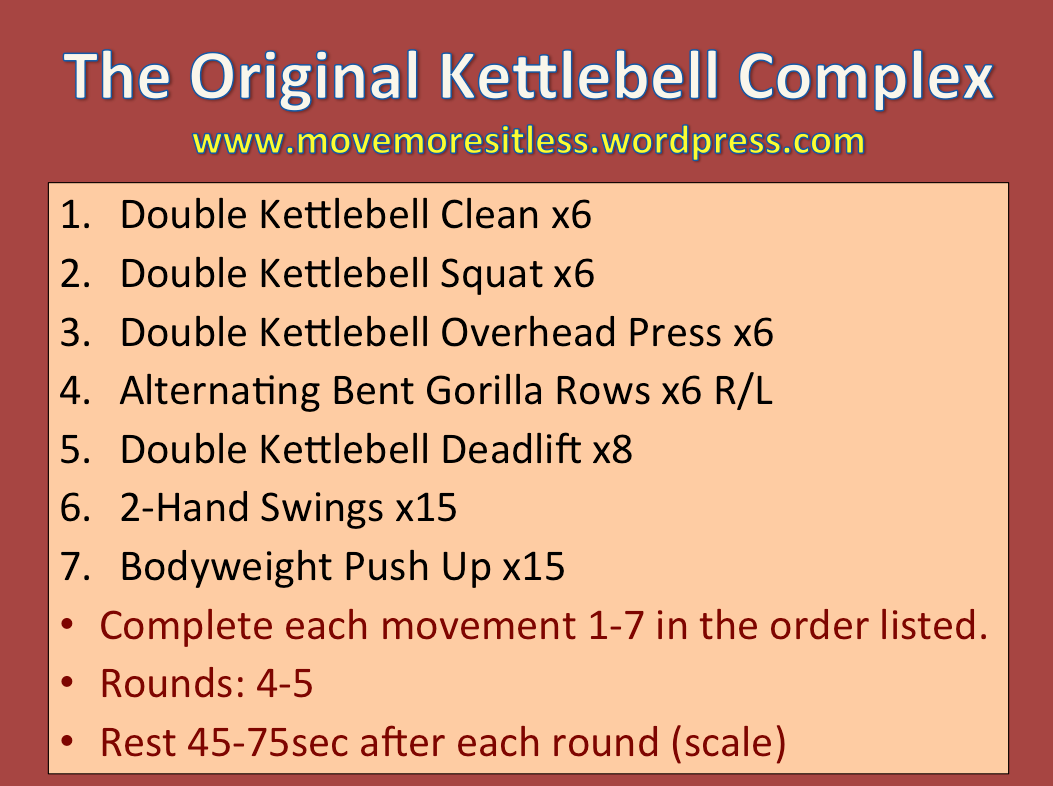
The original complex looked like this:

Original Kettlebell Complex

The goal was to keep the workout brief.  Under 20 minutes.

20 minutes is a sweet spot for me, especially with higher intensity efforts.  

I’m able to get the training effect I want, without losing technique to fatigue or subjecting myself to unnecessary injury.  

Higher quality work in shorter amount of time.

I really like these short burst sessions that address cardio and strength in one shot.  Life doesn’t always allow for 60-90 minute daily workouts.  We wish it did, but it’s turbulent.  

Being able to walk in the gym, warm up quick and get after it is awesome.  

The Workout

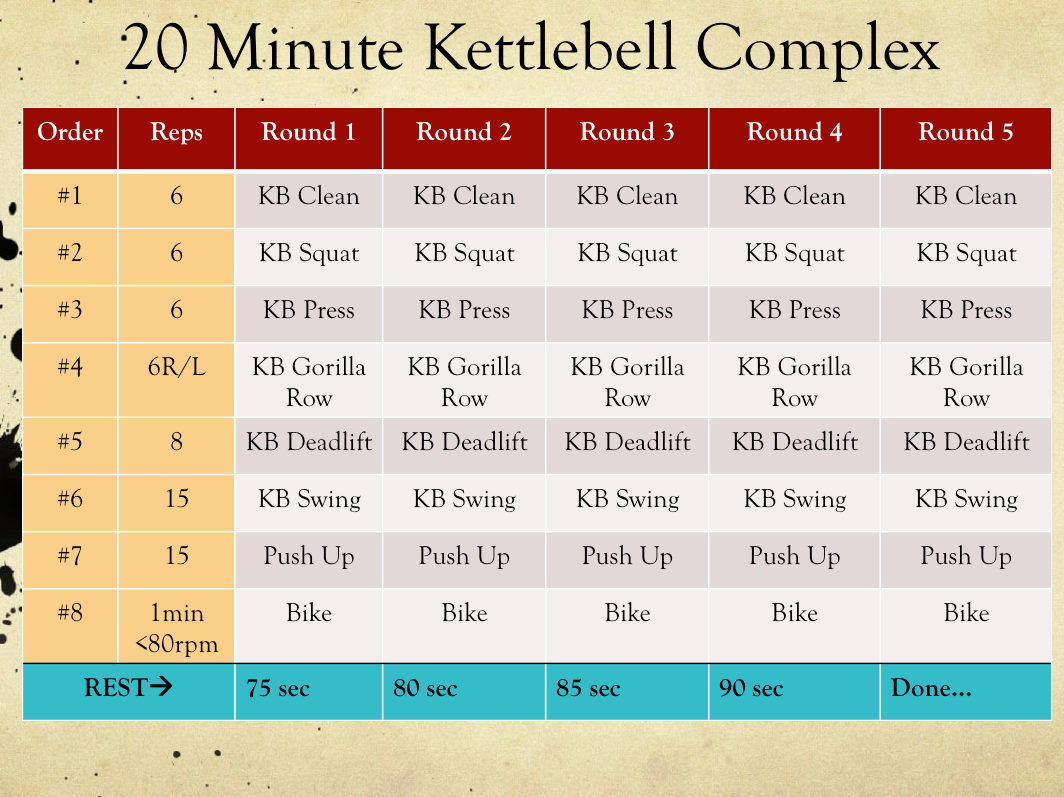
20 Minute Kettlebell Complex

Biking.  The addition of the 1-minute air bike ride at the end of the round shakes things up.  The goal is to keep the RPM above 80.  

The first few rounds were fairly easy, but rounds 4 and 5 were a bitch to keep pace.   

Why bike?

Biking is a low impact activity that requires ZERO skill.  Get on and ride.  Air bikes involve the entire body via turning the pedals over while pushing/pulling the dual action arms.

Biking is a safe way to condition while mitigating stupid workout injuries.  

Fatigue.  The ascending rest period tactic was perfect.  

Ascending Rest Periods

As fatigue accumulates, so does the amount of rest.  

The extra 5 seconds of rest added to each round helped managed my fatigue.

75 seconds of rest will seem long in the beginning.  But again, the fatigue hits you like a slap across the face.  

In rounds 3, 4 and 5… the 85-90 seconds rest passes by quickly.  

During your rest period, focus on breathing.  Deep and full breaths. 

Breathe deep into your BELLY, not your chest and neck.  

Exercise technique.  Metabolic conditioning is designed to stress the muscles and cardiovascular pretty aggressively, but it should NEVER come at the expense of technique.  

Scale the workout for yourself.  Start with longer rest in the earlier rounds.  Use less weight or bike for 30-45 seconds at a lower RPM instead of 1 min at >80 rpm.

Explore and tweak it as you go.  You can expect each “round + rest” to last 4+ minutes, with the later rounds lasting longer because of the increased rest.


Kyle


Be A Perfectly Golden Marshmallow: Toying w/ BJ Gaddour’s Fat Loss Workout

Quick Tips

Screen Shot 2013-07-18 at 8.56.17 AM

BJ Gaddour

BJ Gaddour is the new Craig Ballantyne.

Craig Ballantyne created Turbulence Training back when it was personal trainers were not publishing material on the internet the way that they are now.  Now everyone has a product.

Hey, if you can write and you have the drive to stay motivated after working 9-10 hour days, why the hell not?  Everyone is selling something, product or self.  Doesn’t matter, it’s how we succeed.

BJ Gaddour currently works with Men’s Health as a consultant.  Essentially that means that he made enough noise doing his own thing that Men’s Health contracted him to write workouts, articles and programs for them.

BJ’s claim to fame is fat loss and boot camp style workouts.

A while back he posted a free PDF titled “The Seven Deadly Workout Sins”.

Pretty solid little article.

In it, he describes a general outline on how to design effective fat loss workouts.

When I read the article, it was a wake up call that I should have WAY more confidence in my writing and methods.  It was nearly identical to my training philosophy at the present time.  It was a great moment for me to realize that what I am cooking up here in Eau Claire (the mecca of the Midwest) is well seasoned (nice play on words) and spot on for what’s current in the training world.

Total body workouts, timed efforts and rest, 3-4 days a week.  No cardio.  Cardio is obtained as byproduct from the unique blend of incomplete rest periods and resistance based exercises.  

Again, this is a STYLE of training.  It’s not the law, but this kind of training gets results quickly.  If you buttoned up your eating habits, you would shed unwanted layers in very little time.

I enjoy giving other trainer’s workouts a run through, as it can get a little monotonous writing your own programs all of the time.  Sometimes, it’s nice to have someone else do the designing for you.  I just follow along for once.

BJ’s workout looked something like this:

Image

I talk about movement patterns on this blog all of the time, and a closer look at BJ’s template shows that he thinks along similar lines.  Hip hinging, squat, pressing, pulling, total body movements are all represented in this workout.  It’s a recipe that has endless variations and keeps your workouts interesting and effective.  The systemic effect of a workout like this is fantastic.

Most people will probably find that they are unable to keep moving all of the way through some of the 30 second work bouts with certain exercises.  Chin-ups continuous for 30 seconds doesn’t sound that hard, but talk to me about that in round 3 of the workout when your eyeballs are teetering on your orbitals.  It’s a different ballgame at that point of the workout.  You’re in the eye of the storm in round 3.

What I like about this workout is that is manageable.  The movements can be scaled up or down depending on a person’s training level and age.  Manageable fatigue is the key to successful fat loss workouts.  If you cannot control and OWN every movement in every rep, every round, every workout, you’re putting yourself at risk.  Posture collapses in a matter of a rep.  I’ve seen it in both my own training and others.  That’s all it takes to slip a disc, tear a rotator cuff or and break bones.  It’s a long, painful and expensive ride to the emergency room.

Injury during training is a tragedy.

Overall, this is a great workout.  The rest periods can be frustrating if you have to adjust your equipment in between exercises.  I was using my suspension trainer for a variation of this workout.  I found that adjusting the straps was a nightmare.  15 seconds is not a lot of time to gather yourself and set up for the next movement, especially when your hands are shaking like crazy.  The nervous system is on full alert.

The 60 second rest periods at the end of each round is also well thought out.  One minute gives adequate time to gather yourself, get a drink and towel off before entering into the next round of work.  In the later round, one minute feels like a blink of the eyes.

Successful work capacity based fat loss workouts seem to have peaking point with regard to exertion, whether in the middle of the circuit itself or as gradual accumulating fatigue that reaches a high point at the end of a workout.  The goal is to manage your output, giving an effort that challenges your body steadily in the early and later rounds.  Early burnout makes for sloppy exercise technique in later rounds and a serious lack of enjoyment.  The workout should be challenging but fun and engaging.  Purposeful.

Lately, I’ve been drawing similarities between the perfect “golden marshmallow” and a fat loss driven workout:

The golden marshmallow

When you cook a marshmallow for a s’more, some people enjoy perfectly cooked golden marshmallows and some people like the torched black marshmallows.  Cooking a perfectly golden marshmallow is a campfire art.  If the marshmallow gets too close to the fire it will burn.  If you don’t get it close enough it’s just a warm white marshmallow.

Peaking after the final rep of a workout (while still being able to own your movement) is an art.  We are all at different fitness levels so this is largely a judgment call by YOU, the trainee.  You need to make the decision on when to pull the plug on a set, a workout, or when it’s necessary to add more.

This is what a smart personal trainer can monitor for a client, and why good personal trainer add value to person’s fitness endeavors.  Personal trainers can take a client close to that edge, that fine line, without pushing them over.  The entire workout remains in control, yet impactful in its training effect.

The goal of a great workout is to be a perfectly golden marshmallow at the end.

BJ’s workout accomplishes this.


Cheers to golden marshmallows and better workouts!

KG

Minimalist Fat Loss Training Kicks Ass

Quick Tips

I love working out on the cheap, particularly minimalist fat loss style training that is highly metabolically demanding using short, intense, SAFE workouts.

I can warm up, workout and cool-down in a matter of 30-40 minutes on most days.

Sure, some days are shorter or longer in duration, but in general, it’s about a 30 minute time frame that I need to finish a high quality training session.

Over the years, my views on training have changed quite a bit.  I think it’s been a healthy shift in methods and ideas for me.  There will always be the staple principles of fitness that I may never let go of, but to remain stubborn to the idea of change is career and physical development suicide.  You’ll get what you always got if you do what you always did.  Change can be brutally painful, but sometimes it is necessary.

I’d like to take a few minutes to chat about minimalist fat loss training means to me.

There are two perceptions that people tend to have about working out:

1)  You need a gym membership and expensive equipment (maybe a trainer)

2)  You don’t need any equipment and can get it done at home with no equipment.

Flat out, #1 is false.  I actually despise the gym these days.  Why?  Because I hate waiting for equipment and it hinders my workouts because of it.  I also can’t handle the amount of questions I get when working through a set of Turkish Get Ups.

You can take the most cleverly designed fat loss program on the planet, and if you cannot execute it according to how the author originally designed it, you’ve already effected the results that you’ll receive from any amount of effort that you put in.

Programs are written the way they are for a reason.  If the rest periods say 30 sec between movements, then it needs to be 30 seconds between movements.  What happens when you finish your round of chin-ups, rest for 30 seconds, then you need that ever popular pair of 50lb dumbbells that some guy -who spends more time talking than working out- hogs for 20 minutes while he discusses last Sunday’s NFL results.

If you have ever been in a gym in your life, you have inevitably run into this.  It’s a major headache.

In a nutshell, that was reason enough for me to start training at home (among other things).

AT HOME, I NEVER WAIT FOR EQUIPMENT WHICH HAS ALLOWED ME TO EXECUTE MY WORKOUTS EXACTLY AS THEY ARE DESIGNED.  PRICELESS.

As for #2, I think this is an extreme view-point also.  The minimalist footwear running craze swept the nation a while back, people traded cushioned full support shoes for un-cushioned minimal support footwear, or even barefoot in some instances.  Some people benefited, some found themselves crippled over time from the adjustment.  Attempting to pound the pavement for the same mileage while going cold turkey on footwear caused an extreme overload for the feet.

I share this story because I feel that the minimalist running craze has a relationship to the idea that you need ZERO equipment to burn fat.  While I agree that there are great bodyweight fat loss programs available on the market today, I will also caution you that bodyweight training is JUST A TOOL.  You could train bodyweight style for the rest of your life, but honestly, what fun is that?

On the performance and progression side of things, how much fun could it possibly be to perform 200 push ups and 200 squats and 200 lunges and 200 burpees 4 days a week just to get some kind of training effect?  Good for you for putting up those kinds of numbers, but man o man is that boring!  Lack of variety will hurt your desire to WANT to exercises over time.  No one looks forward to something that is boring.  You’ll start avoiding the daily training session like the plague because you know that it will be boring.

Also, keep in mind that the body adapts quickly and you have got to add load at some point.  Angles and variations are great, but you have got to add load.  If bodyweight training is your end game, your last stop, you may find yourself disappointed in your results sooner than later.

Minimalist fat loss training means maximizing workout/program design with the equipment that you have available to you.  Give me one kettlebell and I can bury myself in a brutal training session.  Give me a suspension trainer or rings, I can do the same with that.  I encourage the purchase of simple equipment.  I highly encourage building a simple gym.  It’s inexpensive and can provide years and years of high quality training in the comfort of your own home.

So, after that long scenario…  Let’s ask a simple question…

What equipment should a newbie to home training have on hand???

1)  Suspension Trainer ($100)

2)  Kettlebell of a challenging weight ($65-$100)

3)  Interval Timer (Free-$20)

I am going to beat this equipment concept into the ground on this blog, so strap in for that.  It will come up time and time again until I feel I no longer have nothing more to say about building a quality home gym.

If you own a treadmill, elliptical or universal home gym, sell that crap on Craigslist and purchase the equipment I listed above, 1 through 3, with money you receive from your sale.  I am serious here.

If you own a gym membership, consider canceling it.  Money, time and travel are great reasons to cancel it.  On the low end, your membership will probably cost you around $300-$400 a year, which will buy you a bunch of home training equipment that will accelerate the fat loss beyond what you ever get out of being a member to a commercial big box gym.

IMG_0562

Suspension trainers are such a dynamic piece of fitness equipment, it is hard not to encourage the purchase of one.  A suspension trainer should be strung up from the ceiling in every single home in America.  Well, at least the homes of those who have aspirations of getting fit. The suspension trainer is a logical step up from simple ground based bodyweight training, with endless variations of movements and the angles of those movements, they really are a revolutionary training device.  It’s amazing the amount of uses you’ll find for a suspension trainer once you have a suspension trainer as a resource.

Image

Kettlebells weight, resistance, external load.  I don’t care what you choose to refer to a kettlebell as.  A kettlebell in the arsenal means the opportunity to build strength and power. Strength and power are the new modern day language for “skinny”.  Strength doesn’t mean bodybuilder-like bulk, it means strength.  Don’t confuse the two.  Kettlebells provide the opportunity for free-flowing 3-dimensional movement.  Functional strength is desirable strength.  Also, who could pass up the opportunity to integrate high-powered moves like kettlebell swings, snatches, presses and the almighty Turkish Get-Up in one’s program.

Assuming you properly educate yourself on how to execute these movements, you’ll feel great and look great.  I love kettlebells not because they are kettlebells and they are a trendy piece of fitness equipment right now, but because of  the number of doors that open once you adopt them into your training regimen.  Very unique piece of fitness equipment.

Gymboss Interval Timer

Interval Timer.  An interval timer should be called an “honest timer”.  Just as people grossly under-estimate the amount and quality of food that they consume daily/weekly, so do they grossly air ball on the amount of time spent resting between exercises.  The first time that you work through an entire training session paying strict attention to your rest periods, you’ll realize that you have been slacking on that front.  The “honest timer” keeps you focused on your training.  There are multiple FREE online interval timers… just type free online interval timer into Google and you’re golden.  If you want a portable timer, I HIGHLY HIGHLY HIGHLY recommend the Gym Boss.  Simplicity and effectiveness of monitoring your work sets and rest periods for what should be a one time fee of $20.

Like I said, I am going to ignite a home training movement.  People are already promoting it and have been for years, but I am going to perfect it.  The benefits outweigh any possible negatives.

Soon, I will be posting a “Day Old Workout” series and I want you all to follow along.  I practice what I preach and I would never ask you to do something that I haven’t already done. Period. End of story.


2013 is the year of connecting with people for me, so let’s do this.


Cheers from “Party Central USA” Eau Claire, WI,


KG

Pressed for Time: When are Bicep Curls, Triceps Extensions and Deltoid Raise Acceptable?

Pure Fat Loss, Quick Tips

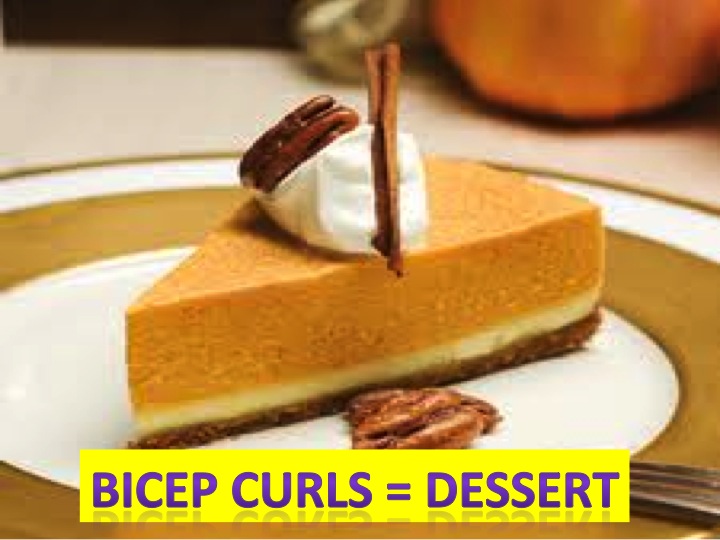
Ahhhhh, the “dessert” movements of the training world.

I will be blunt with this post.

Exercises like bicep curls, triceps extensions and deltoid raises provide very little bang for you buck.  I don’t care how many different angles, rep schemes and loading patterns you choose for a bicep curl, you are NEVER going to lean out by performing bicep curls alone.

I used to have a rule at the sports performance complex in Detroit, my athletes could do all of the curls, triceps, and shoulder work they wanted AFTER we finished taking care of business with our regularly scheduled program which consisted of:

–  Squats (one and two leg variations)

–  Hip dominant lifts (deadlifts, swings, etc)

–  Horizontal pressing (push ups, etc)

–  Vertical Pulling (Chin-Ups, etc)

–  Horizontal Pulling (Inverted Rows, etc)

–  Turkish Get-Ups

–  Energy System Development (aka: Anaerobic, aerobic, shuttle run conditioning)


The rule was simple.  You give me what I want, and I will let you go play around by the dumbbell rack and work all of the muscles that you think the girls love.

Most times, the guys were too tired to complete any “dessert” type movements like bicep curls, but occasionally they would find the energy to bang out a few reps/sets.


Does this rule apply to the general population seeking fat loss?

Hell yes it does.  I want you to change your view about training.  Bicep curls, triceps extensions and deltoid raises need to be considered “dessert”.  There is very little return on investment when performing these exercises.


Unless you are competing in a physique competition anytime soon, ditch them.

Replace them with total body movements, multi-joint movements that challenge your body as a single synergistic operating unit.

Run fast, lift heavy things from the floor, throw a medicine ball, work with a suspension trainer, use battling ropes, squat, push up, chin up, pull up, inverted row, push a heavy sled, pull a heavy sled, jump, run a long staircase, use a heart rate monitor to eliminate guesswork.


Image Credit: Core Performance

Do some of those things I just listed above, organized in a systematic way that prevents staleness, stagnation and keeps you progressing with weight, rest periods, exercise progression, mobility and flexibility, recovery until the next bout, etc…

Sooner than later you are going to see some results as a byproduct of your consistent development of strength, power and overall athleticism.


End timer…