Workout Finisher: Kettlebell Swings, Push-Ups and Rowing

Motion

A workout finisher is a short burst bout of high(er) intensity positioned at the end of a workout. It usually consists of 2-4 exercises, using minimal equipment (or no equipment).

There are thousands ways to design a workout finisher, and I intend to share them all!

Kettlebell swings, push-ups and rowing are timeless exercises. They also happen to make a perfect workout finisher.

Push Ups

Push-ups are an upper body horizontal pushing exercise. They work the chest, arms and core. Push-ups are easy to modify for any level of fitness. Beginner? Elevate the hands, reduce the weight and limit the challenge to the core. Advanced? Add weight to move on to single arm variations. A set of push-ups is seamless to start and end, making them a great option for a workout finisher.

Kettlebell Swings

Kettlebell swings are an explosive hip hinging exercise. I’ve been swinging kettlebells for 13 years and it’s still one of my favorite movements. Swings are a great choice for workout finishers because they are easy to set up, start/stop and train the entire body. Walk up to the kettlebell, grab the handle, swing. Plus when you’re using weights for cardio, I prefer swings because they are more forgiving with technique (compared to barbell cleans, etc).

Rowing

Rowing is one of the best cardio activities a person can do. Rowing is taxing for the entire body. Rowing isn’t as quick to get set up (compared to push-ups and swings). Put your butt on the seat, strap the feet, grab the handle and row.

Push-ups and kettlebell swings make a fantastic pairing. Upper body push with a hip hinge. Grip is preserved for the swings, pushing muscular is preserved for the push-ups, lots of muscle being taxed with two basic exercises.

You could (and I have) combined push-ups and kettlebell swings in an alternating fashion and created one hell of a training effect in about 5 minutes.

Workout Finisher| Swing-Push-Row

Aim for completing 5 rounds using an 8 minute time limit.

In other words, you get 8 minutes to complete 5 rounds, and if you fall short, the workout finisher ends.

Is this workout finisher too aggressive?

Cut the push-up and kettlebell swing reps down to 5. Lower the rowing distance to 150-200m.

Do not be afraid to tweak workouts to suit your fitness level.

You don’t need permission to do this.

Flow and Non-Competing Exercises

The best workout finishers have a good flow/transition between exercises.

Remove as much set up fiddle factor as possible.

The goal of a workout finisher is constant movement. Transition from one exercise to the next until it’s over.

Don’t waste time with exercises that have a long set up time.

Choosing non-competing exercises allows you to give more energy to each exercise and take a total body approach to the finisher.

3-4 exercises is perfect for a workout finisher. Remember, workout finishers are supposed to be the icing on the cake, not the meal.

Non-competing exercises can help with safety. You’ll be tired, but not overly tired in any one movement pattern or muscle group.

Here are a two simple non-competing exercise strategies:

  • Upper and lower body exercises
  • Push and pull exercises

Non-competing exercises:

  • Squats + pull-up
  • Lunges + overhead press
  • Push-Up + kettlebell swings 😉
  • Crawling + loaded carries

⚠️ CAUTION ⚠️

A workout finisher should be brief. By definition, a workout finisher is the ending to a workout, meaning you completed other activities leading up to it.

What might those “other activities” be? 👉 mobility, resistance training, ground based movement, etc.

If a workout finisher drags on for 15-20 minutes… it tells me it’s over-engineered, didn’t do enough quality during the middle of the workout, and set yourself up for unrecoverable fatigue in the coming days.

People make the mistake of biting off more than they can chew. They step up to workouts that don’t account for the days ahead or their current fitness level.

Fitness is a long-term play.

Hundreds of workouts (and diet) will create the body and performance you desire. This is the #truth, depressing for some, but realistic and honest.

Like this workout finisher??? It’s just the tip of the iceberg for options.

Here are some other workout finishers to try.

Just a Turkish Get Up and Rowing Workout

Motion

Two exercises, 1 workout. Rowing and Turkish Get Ups.

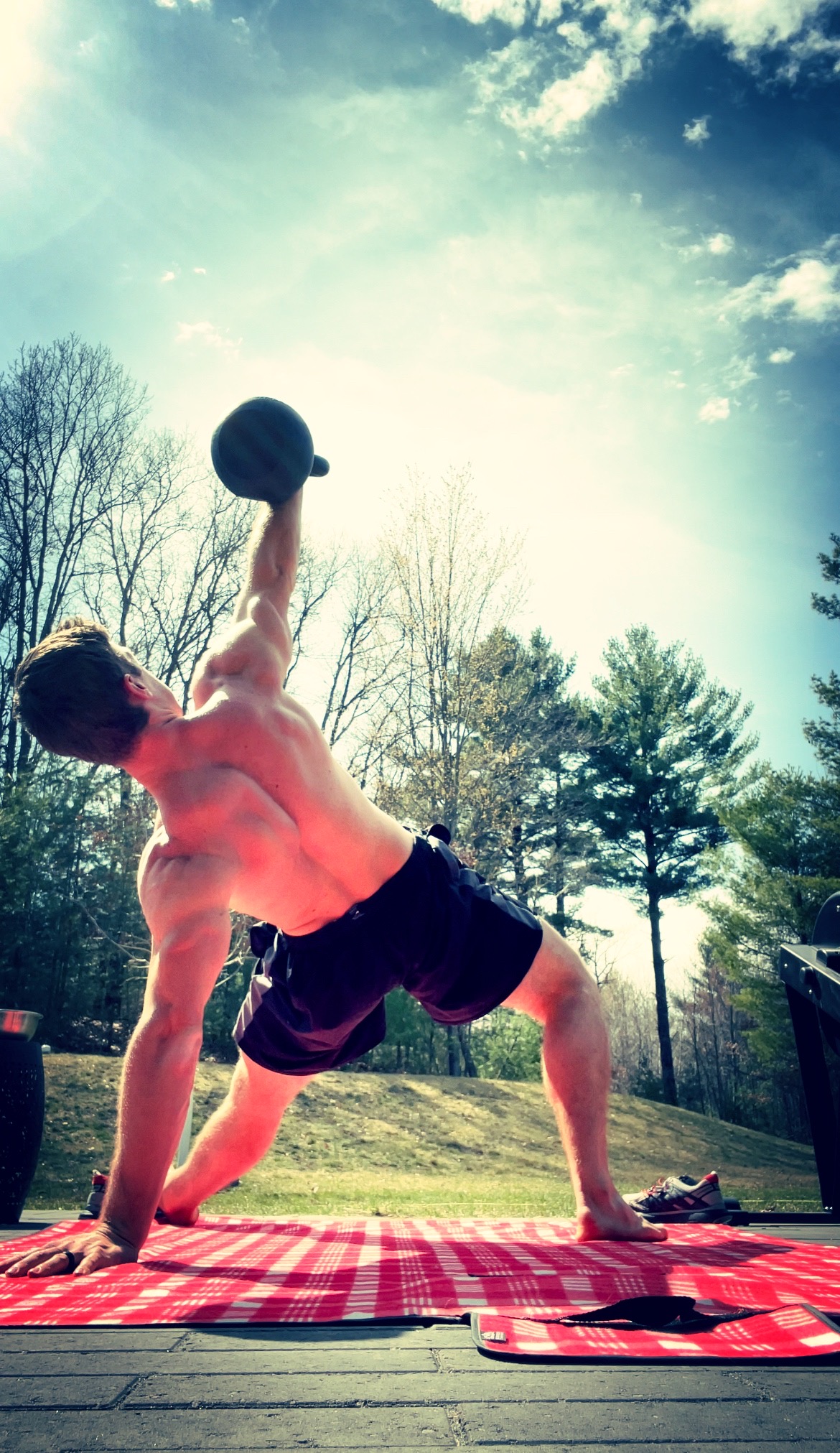
Today’s workout incorporates my favorite cardio machine, the rower, and an exercise which has become one of my all-time favorite total body strengtheners, Turkish Get Ups.

The rowing machine is a cardio machine that I have a true love-hate relationship with. Rowing provides a tremendous low-impact, high reward workout, regardless of the distance or intensity, therefore I love the training stimulus. I also hate rowing because it sucks my soul out of my body each and every time I use it.

Rowing is hell wonderful.

Turkish Get Ups show up on the Meauxtion blog in a lot of other posts. I love Turkish Get Ups. You should learn to love Turkish Get Ups.

The gist of Turkish Get Ups is to move from a laying position to a standing position, returning to back to the original laying position. While you’re moving, a shoe or weight (kettlebell, dumbbell, etc) is being supported using one arm. The weight starts out over the chest, but eventually ends up vertically overhead.

Turkish Get Ups build tremendous total body movement strength, and are great for reinforcing shoulder stability.

(At the bottom of this post I’ll share a link to other challenging Turkish Get Up variations worth exploring.)

Combining Turkish Get Ups and rowing into the same workout creates a total body training stimulus that is time efficient (30 minutes and you’re toast).

Note: The great part about mixing rowing with Turkish Get Ups is that it fills in a gap. Upper body pulling. Pulling is one motion not included in a traditional Turkish Get Up. One of the main features of rowing is the pulling. Match made in heaven.

Turkish Get Ups tax the legs to some extent, but not horribly. The lunge to stand up and down is the primary lower body movement in a Turkish Get Up (along with lifting the hip lift), and the overall volume of lunges performed is really low. If you’re performing 10 Turkish Get Ups on each side for a workout, that’s 10 reps of lunges per side.

For most people the lunge is not going to be the weakest link in the chain when selecting weight for Turkish Get Ups. The lunge is going to be challenging, especially stabilizing the weight overhead, but a sub-maximal effort. You can likely lunge quite a bit more weight compared to what you’ll use for TGUs (slang for the in-crowd).

Rowing is lower body intense, yet low impact. It’s low impact in comparison to activities like running or jumping rope. Low impact does not means it’s easy. Each stroke requires a big effort from the legs as you unhinge at the waist, extending the knees and hips (along with upper body pull). You’re driving hard with the legs to push away from the flywheel, creating powerful strokes.

Rowing experts might cringe at this statement, but I like to think about rowing strokes as being similar to a repetitive horizontal barbell clean, if such an exercise existed.

Anyways…

The main message is: Turkish Get Ups and rowing make a great pairing for a total body workout, without needing much time.

Cardio and strength in 30 minutes.

The Workout

Set a timer for 15 minutes, start performing Turkish Get Ups, alternating each side. Do not stop until the timer sounds. Of course, grab a drink and towel off the sweat, but keep moving.

Next, hop on the rower. You have a few options with the rowing portion of this workout:

  • 10 sets of 250m distance
  • 6 sets of 500m distance

No matter what distance you choose (or a mix of both) follow a 1:1 work to rest ratio for rest periods. If it takes 1:45min/sec to row 500m, you’re resting the same amount of time before starting the next round. If it takes you 55sec to row 250m, you’re resting 55sec before starting the next round.

Make no mistake, a 1:1 work to rest ratio is intense. Round 1 might easy, but rounds 4-5 definitely will.

Fatigue breaks people in half.

  • Note: If you need to take more rest in between rounds, you make that call and you take the rest that you need. I am only making the suggestion of 1:1, this is not the law.

Bonus Points: Vitamin D 🌞

Doing this workout outside, under the sun, will earn you bonus points.

Much has been written about the importance of maintaining adequate Vitamin D levels.

I live in Wisconsin. We are a translucent, see-through, pale skinned people coming out of Winter. The first 50+ degree day, we flock outside like it’s Summer. Brats, beer and completely underdressed, yet feeling comfortable and happy.

Warmer temperatures and the sun lifts moods in the Spring.

Moving the workout outside, limiting the clothing you’re wearing to allow the sun exposure to as much skin as possible is a nice little bonus.

Attempting to kill too many birds with one stone can create headaches, but this is a seamless tweak to the workout. Just get outside.

In general, if you can transition a portion or all of your workouts from inside to outside, you have an opportunity to reap the benefits of sunlight and the benefits of exercise.

That’s powerful stuff.

Equipment-wise, Concept2 is my rower of choice. It’s bulletproof and used by Olympians, so it’ll be good enough for the average Joe/Jane.

What I’m about to say regarding kettlebells isn’t completely true, but to some extent, weight is weight. Especially now, with the pandemic decimating most of the fitness equipment inventory, find what you can and buy it. I also have a responsibility to be sensitive to everybody’s financial situation. These kettlebells bridge the gap between cost and quality.

Remember, companies will charge you for shipping weights. So now your $1.50 per pound kettlebell is suddenly $2.75 per pound after shipping. Even heavier kettlebells (up to 70lbs) from Amazon bypass shipping costs with Amazon Prime.

Explore: Turkish Get Up Variations

Earlier in the post, I promised you Turkish Get Up Variations.

Get after it today… win the day. 💪 👊

Interval Workout| Lizard Crawl + 500m Row

20 minute Workouts, Ido Portal, Workouts

Mixtaping different disciplines of fitness to create unique workouts is a hobby of mine lately.  

Yesterday, I found myself short on time.  I had roughly 20 minutes to make some workout magic happen.  Assessing the previous day’s workout, I decided on two modes of exercise:

  • The Lizard Crawl
  • Rowing

The goal:  total body training effect (in under 20 minutes)

Short burst workouts are a perfect solution to time-restricted days.  Days where I’m tight on time, but high on motivation.  “Short”… not be confused with “easy”.    

Generally, shortening a workout means the intensity gets cranked up to offset the decreased volume and duration.

Lizard Crawling is a locomotion pattern popularized by Ido Portal’s movement catalog.  


It involves crawling forward (or backward) in a low prone position, much lower than a traditional bear crawl.  The Lizard Crawl is a total-body exercise, well worth learning and working through the progressions.  

Most people will feel limited by their upper body strength when Lizard Crawling.  The strength needed in this particular range of motion may need some acclimation. 

That being said, there are plenty of Lizard Crawl variations to accommodate any skill level.

Here’s an example:


The Lizard Crawl, though graceful and rhythmic when performed by great movers, sucks the life out of you across even moderate distances.  It’s a very complex and demanding pattern.

Rowing, on the other hand, is, well, rowing.  

The rowing erg is beautiful in its simplicity,  yet brutal in its ability to break a person’s soul at higher intensities.  Though machine-based, rowing is one of those near total body activities that I cannot recommend enough. Rowing is primarily a posterior chain, upper body pull/lower body push action.

A quality rowing erg will cost you some cash, but across the long-term, it is well worth the investment.  

Turns out, the Lizard Crawl and rowing compliment each other perfectly.  

I’ve created workouts in the past using short distance Lizard Crawls and 250-meter row intervals, but never beyond that distance.  The 250-meter is a fantastic distance for an all out sprint.

Today I increased the challenge a bit, bumping the row up to 500-meters.

Here’s how the workout was structured…

Lizard Crawl for 20 yards

+

500 meter Row

  • Repeat for 6 rounds.  
  • Rest for 60-90 seconds in between each round.  

That’s it.  Two movements and roughly 18 minutes of time to work with.

Warm-up with something, anything.  A jump rope or some simple dynamic movements will work fine.  I do not advocate skipping warm-ups all of the time, this situation is unique, an outlier.

A cheetah doesn’t ask a Gazelle for a chance to warm-up before pursuing it for nearly a mile, it’s worth considering a human may not always have adequate time to warm-up.  

Many times, doing less things, but doing those things better makes for the best workouts.

Aesthetics and performance are built incrementally, piece by piece, workout by workout.   

Thoughts and Suggestions…

Find a pace on the rower a few levels below your personal best.  I aimed for a 1:35 min/sec pace for the 500-meter intervals, knowing that my best 500 meter was roughly 1:27 min/sec.

Why do this?  Because you will not be able to maintain a personal best pace for 500-meters across 6 rounds, with incomplete rest periods and lizard crawling before hopping on the rower.  Setting a challenging pace just below your best will get the training effect you’re after and allow room for progression in the future.

After standing up out of the rower, expect your heart rate to be sky-high.  60 seconds of rest will not feel long enough, and it shouldn’t.  It’s incomplete rest by design.  Use every second to collect yourself before the next round.  Walk around slowly, stay upright and slow your breathing.  

Keep in mind, a 500-meter row is not an easy distance to row on its own.  Adding pre-fatigue in the form of a Lizard Crawl will zap you.

When rest comes to an end, force yourself into the Lizard Crawl.  You’ll want to rest longer in later rounds but don’t.  Stay strict.  When rest is over, settle your breath and start crawling immediately.  

Anticipate the first few rounds of Lizard Crawling to feel great, followed by a steep drop off.  

If the full Lizard Crawl is too aggressive, scale it back.  Head over to my YouTube page and search “Lizard Crawl”.  You’ll find a bunch of different Lizard Crawl options I’ve played around with. 

Or, simply go with a crawling pattern in higher, more manageable body position, such as Beast (Animal Flow).  

If you found this post while surfing the inter-webs, thank you for stopping by.  

Do me a big favor and try this workout today, tomorrow or the next time you’re in a pinch for time.  


For more about Ido Portal and some his training methods, check out this post:


Cheers to you, 

Kyle