A Glimpse of a Sample Staircase Interval Workout

Quick Tips

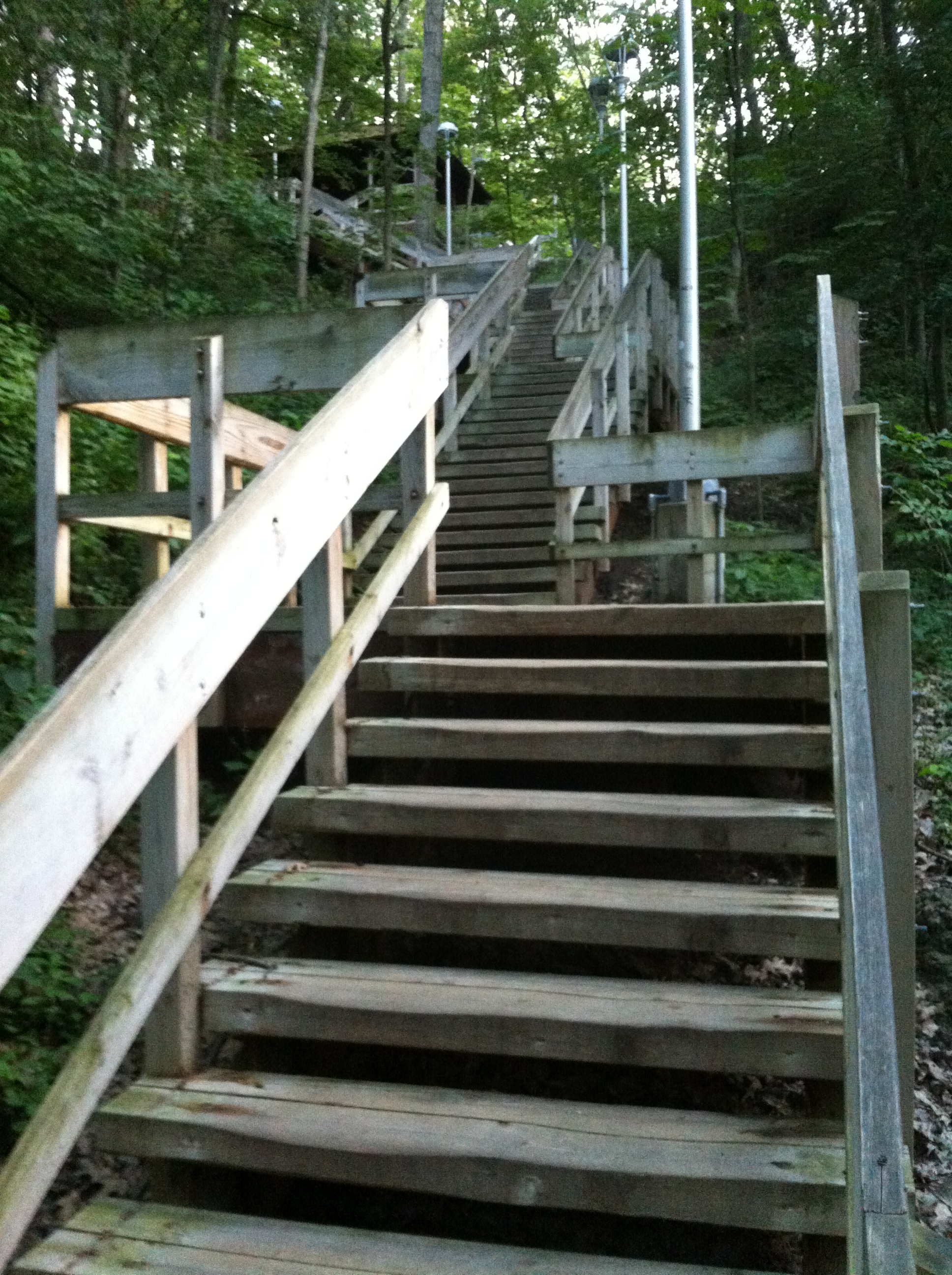
There is really nothing like sprinting up and down a long staircase.

If you’re fortunate enough to have a staircase near you that is of decent length, congrats, you’re in luck.

By decent length, I am referring to a staircase that takes about 30 seconds or longer to run up at a brisk pace.

If you’ve never treated yourself to a staircase training session, you’re going to find that running vertically is nothing like running horizontally.  Every step/stride requires brute force and attention to detail.

Why attention to detail?

Because the split second that you get lazy or lose focus on what you’re doing, you’re going to miss a step and leave shin skin on the staircase.

Staircase running requires hip extension.  You can fake to make it for a little while, but you’ll find that opening up the hips and driving “down and back” with every stride is going to get you to the top faster and with a higher efficiency.  The hips are the powerhouse of the body, so you might as well use them if you have them, right?

Besides, your quads are overworked.  Let’s build a backside.

If you are finding that you cannot comfortable achieve hip extension, I would suggest regressing and addressing these issues quickly…

Here are some videos that might help…

Thanks KStarr.

Now on to the workout…

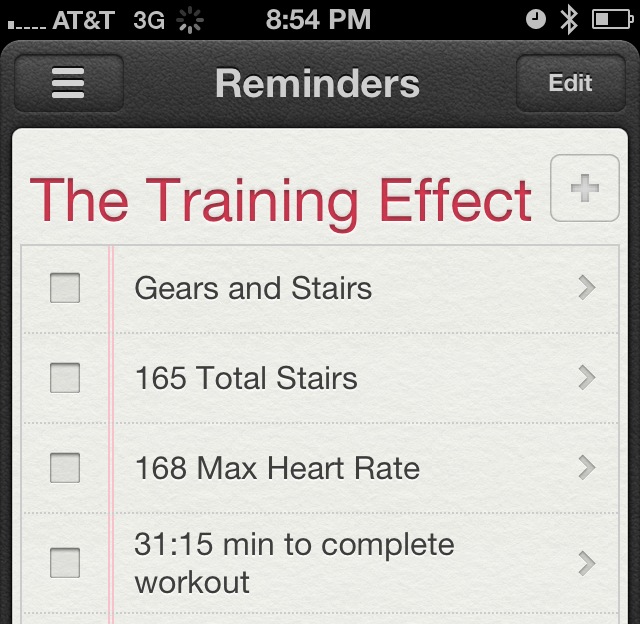
Staircase Interval Training165 glorious stairs

Staircase interval training

Total time from start to finish for this workout.

Staircase Interval Training

This is the break down of the workout.  30 minutes of work was my initial target.  I hit that.

My heart rate peaked at 168bpm, which I thought was surprising.  I thought that it would have been much higher.  I’ve seen it 175bpm while running trails.  Interesting.  I suspect that had the staircase taken me longer to run, I may have seen higher heart rates.

I have to disclose that I probably whipped through 12-13 rounds.  2 of these round were loaded up with kettlebells.  I brought my trusty 24kg LifeLine kettlebells with me for some fun carrying variations.  After looking at the length of the staircase and evaluating what I wanted from the workout, I decided that I would only use one kettlebell for these carrying drill.

I worked overhead, racked position and farmer carries, switching hands using a single arm swing hand transition + KB clean + Press.  I can explain this later, but I prefer using this method for switching hands during single kettlebell workouts.  Always loaded this way.

The general structure of the workout look like this:

  • Running the stairs took around 60 seconds (I think)
  • Rest periods were 1.5x-2x the length that it took to climb the stairs (or recovery to 130bpm)
  • Upper body focus was placed on arm action (elbow drive and hands to face) and keeping posture vertical versus slouching once fatigue set in.
  • Lower body was all about putting force into each stair and extending the hips aggressively, picture your feet as springs… explode!

Men’s Health ran an article almost a year and a half ago that I thought I would share because they included a research study out of the British Journal of Sports Medicine which concluded that stair climbing was pretty bad ass, even at relatively low output (just walking up).

Here is that article

One interesting thing to think about here.  Keep in mind that the speed with which you run the stairs is not the only quality we are aiming to build here.

We are also aiming to reduce the time it takes for you to recover, and repeat that effort.  Faster recovery is a sign of improving conditioning.

If you’re a weekend athlete or a movement enthusiast, increasing your ability to recover quickly from multiple bouts of vigorous activity is beneficial for performance and your body composition.

Runners, I would consider this an amazing supplement to improving your running endeavors.  You’re essentially lifting yourself with every stride while running a staircase, and focusing on explosive hip extension is what most of you could benefit from.  Get the hips involved people.


Cheers to training where other people aren’t…


KG

Over-training for Performance and a Brief Word on Exercise Addiction

Quick Tips

Good morning kids…

It’s a beautiful Friday morning here in Wisconsin, and for once, the sun is out and it looks like it could break 70 degrees.  Thank the big man above for that, because we have just about had all of the rain, snow and flooding that we can handle up here.  I was starting to think that movies like “End of Days” or “The Day After Tomorrow” was movie from the big screen to reality.  Yikes.

Summer in Wisconsin

Summer in Wisconsin 2013

Anyways, I wanted to touch a few things this morning, most of which have to do with over-training, working out excessively and body image.

Over-training.  I cannot be certain, but I think I walked a fine line this week between taking my training to the edge of over-training (but not crossing) and doing a cannonball into the over-training swimming pool.  Yesterday was a struggle for me fatigue wise, and my mood was up and down all day.  Without any real noticeable stress to attribute to this, it is plausible to think that I may have pushed it too hard in the days prior.

What caused it?

Well, the workout that sent me over is one that I have leveraged for quite some time. Let’s just say that it involved a couple of 10 minute sets, a lot of squats, chin ups, lunges and kettlebell swings.  I don’t blame the workout itself because I have been using this particular workout for 4-5 years. It’s a staple in my training regimen.

What I do blame, is my lack of judgement leading into the workout.  The days leading up to this workout were filled with tough training sessions.  Over-training is a cumulative scenario.  I always picture it like a traffic jam of volume, intensity and a lack of sufficient recovery.  What starts as a traffic jam ends up being a 50 car pile up.

Screen Shot 2013-06-14 at 7.16.14 AMThe over-training 50 car pile up.

I’ve over-trained only a handful of times in my life.  All of those times, I felt ridiculously lethargic, tired and real drifty mind-wise.  Physical movement of any kind seemed like a real chore.  I’m talking about simple physical tasks like walking out to get the mail.  It seemed like climbing a mountain to climb stairs or lift basic household objects.

I recently read a neat little article about over-training on Runner’s World website.

To be honest, I don’t know what I was doing on Runner’s World, but I enjoy getting information from a wide variety of sources, not just kettlebells, fat loss and strength training.  Running is a major part of the body transformation equation.  My past comments about running on this blog were not taking shots at running itself.  There were intended to state that running delivers poor results to people who are seeking fat loss.  It’s a classic example of using the wrong tool for job.

—>  Check out this article from Rachel Cosgrove to help make my point:  The Final Nail in the Cardio Coffin

Alex Hutchinson is the writer over at Runner’s World, and I would encourage you to read through some of his older posts.  There are quite good.  He’s one of those writers that can break down research into terms that everyone can understand.  He also adds a bit of his own knowledge to his articles which makes his writing that much more applicable.

In the article, Alex describes a study where researchers took two groups:

1) a normal training group

2) an over-training group

… and measured their heart rates in the morning along with their performance measures based on scheduled training of different intensities and duration.

The “functionally over-trained” group had a big drop off in performance throughout the 3 week  training phase, but after a taper in training, they produced far better performance in the run-to-exhaustion test than the normal training group did.

A study like this shows that purposely over-training or over-reaching might have some performance benefit if you can get a handle on when and how to apply it to your own training.

Personally, I say that something like “functionally over-training” is a slippery slope.

Image

The last two sentences are the most important pieces of information to be passed on to the general public.  Go ahead and read or re-read them… I’ll wait.

My fear after an article like this is that Johnny Dad or Susie Mom (both are new or relatively new to running) is going to read an article like this and try pushing it to the limit unsuccessfully.  I like that Alex makes mention that functional over-training like this may be best reserved for elite athletes.  The interesting thing is that the amount of physical effort that it takes to over-train- at least in my opinion- will vary from person to person.  The amount of effort that takes me to enter an over-trained state is different from my next door neighbor, which is different that the neighbor on the other side of them.  We all react to the effects of training in different ways.

I’d like to think that one quality that I have is an ability to get a handle on what’s going on with my body.  Pre-workout, peri-workout and post-workout I am good at staying in touch with the effects of my physical efforts.  I’ve rolled out of bed on some days and known instantly that it was not going to be a day to train hard (or at all for that matter) but rather spend the day focusing on sufficient hydration, good nutrition, rest and recovery.

My fear is that I don’t think that everyone has a gauge to determine when it is right to push, and when it is not.  Some people come off of the assembly line with only gas pedals installed, no brakes and no speedometer.  Some people only have brakes and no gas pedal.  The latter probably doesn’t need to read much further. 🙂

Over-training for the sake of body image.  Just like we have addicts with food and drugs, we have addicts with exercise.  The difference is that exercise addicts often get the benefit of the doubt because a lot of people perceive excessive physical effort as a positive thing.

“Oh, Johnny Dad, you exercise so often.  You’re just so healthy and fit!  I admire your effort! Amazing!”

Little to most people know that Johnny Dad is flat-out addicted to exercise because he has a deep fear if he doesn’t burn off every single calorie that he consumes, that he will get fat.  Body image.

There are a lot of people who feel that they need to push their exercising to the limit in order to look good in a swimsuit, look good with their shirt off or fulfill some magazine model fantasy look.  Some feel that excessive exercising will help fight age.

If you’re one of these people, guy or girl I do not care… take a moment and read this article:

—>  It’s Hard Out Here for a Fit Chick

If you’re a person that just cares about increasing their 5K, 10K or “Fran” time, my simple advice to you is this:

Spend some time getting to know your body inside and out and BE CAREFUL.

Over-training is really not well understood compared to other studied sectors of fitness, but it is real.  I believe this based on experience, so I am not sure that anyone could convince me otherwise.  There definitely is a point in time where excessive physical exertion creates a long-lasting fatigue, series of mood swings, shift in appetite and decrease in performance.

The effects of over-training are not fun.  If you’re planning on pushing your daily workouts to the limit, make sure that at the very least you are consuming adequate amounts of water and post-workout nutrition.  If you’re over-training and not eating, you’re heading for a dark place.  A very dark place.

That is all.  I’m off to fish the Great Lakes…

Cheers to managing your workouts and feeling comfortable in your skin!

KG

The Shark Tank, Results and How Both Can Impact You

Quick Tips

Image

Photo Credit:  stressfreekids.com

I love the television show “Shark Tank”.

I love everything about it.  

Here is how it works:

1)  The entrepreneur enters the “shark tank” (a room to present to five different successful millionaires) seeking to gain valuable business partners and investment capital for their business.

2)  The entrepreneur makes their product/idea pitch.

3)  Post-pitch, the sharks give feedback and ask questions about the business/idea.

  • The feedback is either sharp and harsh, or encouraging and curious.
  • The questions heavily pertain to past revenue, experience, growth potential, evaluation of the business, etc.

4)  The Sharks decide whether the idea is valuable enough to earn them profit on their investment.

I am absolute fascinated by people who find their calling and begin creating and designing gadgets, apps or services that can solve everyday problems, improve old products or pave the way for a new way of doing things.  I have such a respect for an entrepreneur that can sacrifice everything for their passion, refusing to give up through thick and thin.  It takes amazing courage to build a dream from scratch and see it through to the end.  

Many of these people have given everything to pursue the American dream.  

That’s passion.  

Another aspect of Shark Tank that I love is the negotiations.  Sure, the pitches that introduce the entrepreneur’s idea to the Sharks (who are millionaire/billionaire investors themselves) are great, but the negotiations after all of the glitz and glamour is what I get sucked into.

The questions from the Sharks are direct and typically no non-sense.  The Sharks want to know if the investment opportunity has gotten results in the past and what the plan is to grow on those results (the forecast).  The entrepreneurs that do the best on the show tend to answer the questions with sharp, crisp and clear answers.  They have a plan and they have results to show positive growth and execution of that plan. 

Those who respond with wishy washy answers get crucified on national television.

You’re probably wondering why I am talking about the Shark Tank on a active/fitness related blog…

… and to that I say: settle down and let me get there.  It might be choppy.

Here is an un-organized collection of my thoughts that I had earlier today…

As I briefly touched on above, shortly after the entrepreneur shares their product or idea, the Sharks take their gloves off and begin poking and prodding into exactly what they- the entrepreneurs- need (money and connections to influential networks), why they need it, what they will do with it when they get it, and most importantly, their past efforts and the results of those efforts.  

I have seen countless entrepreneurs lose out on investments by the Sharks just because they didn’t have results (sales/income/revenue) from their product or idea.  Maybe the product is being treated too much like a hobby, or maybe the entrepreneur has got some serious flaws and gaps in their business and how they have been going about growing it and scaling it.  

Either way, the Sharks always crack me up because they can sniff out flaws in a matter of minutes, and a few simple questions.  The numbers add up.  The numbers make the flaws glaringly obvious.

What have I learned from Shark Tank is the difference between an entrepreneur who is rejected out of the board room and an entrepreneur who makes a deal, and acquires one of the Sharks as a business partner…

Results matter.

If the entrepreneur hasn’t sold jack-squat in years, the reception of their product/idea pitch is typically lauded at.

In the fitness world, I hear and read a lot of people talking about how “results based” fitness is a scam.

Really?  How?  

How is getting the results that you seek a scam?  

How is stripping fat, running your first 5k, followed by your first 10k, followed by your first half-marathon, restoring function and posture, etc… a scam?  

We measure success in anything based on results.

I can see how getting the results that you seek at the expensive of bodily harm might be a scam, but I would call that recklessness, absent minded or possibly neglect.  

There is plenty of that going around for sure.

If you set out on a journey to build a body (and I don’t mean stage show bodybuilding) and you are getting great results… Why would you change anything that you are doing until you observe that change is necessary?  Don’t stay in your comfort bubble forever, but stick to the plan if it is working for heavens sake.

Again, you have to be getting results to maintain your same course of action.  

If you’re a person that is interpreting this as pass to continue the same ineffective workout habits that incorporate the same weight for the same amount of time for the same days per week…

… you are mis-understanding what I am trying to say, and maybe it’s an error in my ability to communicate effectively.

I wrote an article a while back where I described a 90 day kettlebell complex training program where I basically leveraged the same kettlebells (24kg Lifeline KB’s) for a full three months, making gains the entire time.  If you read back into some of my older posts, you’ll find that I love acting as the guinea pig.  

I will always try something on myself before I ever recommend anyone else to do it.  Not everyone can say that.  I am willing to put myself through the gauntlet prior to suggesting someone else try it.  I take pride in that.  That’s how I formulate my opinions on certain things, one of those being some aspects of Cross-Fit.  

That being said, I always caution everyone that what I do while training is not always a good fit for what they should be doing, and what their colleagues are doing in the gym might also not be what they should be doing.  Do what you can do, not your what your network can do or the random fit guy at the gym can do.  You’re not him, you’re you.

Sidenote:  I actually know a cosmetic surgeon in town locally who tries all of her techniques on herself first, prior to offering it out to her paying customers.  How bad ass is that?  She puts herself through the gauntlet before bragging about it to her customers just to make a buck.

I have a deep respect for that.  This surgeon’s face is constantly puffy and inflamed from all of the new treatments, but hey, at least she can say that it works or it doesn’t, which makes her far more credible to the patients who come to her for solutions.  Again, I love that.

Back to it…

During the 90 days of kettlebell complex glory, I leveraged the same general movements while I continued to tweak the reps, time under tension, sets, recovery time, etc.  

My results graph was steadily climbing in a positive direction , so why would I alter anything.

I know that staying in the vortex of the same workout for 90 days might sound crazy, and I definitely could have bumped up weights during that time, but I couldn’t resist giving it a go.  

What is the worst that would happen?  Maybe I would simply flat line and maintain my current fitness and body composition levels?  So what?  I was lean going in and the experiment wasn’t going to make me less lean or less strong.

Tweaking the variables can really take a program a great distance, and I think manipulating the variables of exercise is far less scientific than most people think.  Often, the point of improving your body, both performance and aesthetically, is to simply add or subtract.  Add weight, add time under tension, add reps… or… subtract rest period time, subtract volume, subtract paralysis by analysis.  

The last subtraction point is a huge hold up for most people’s results.  What are you waiting for?  The next big study?  We lean on studies and research like crutches.  It drives me nuts.  It’s like we can’t take action until we can justify it with a massive study.  That my friends, is an excuse in disguise.  You can call it being educated and precise, but in my world, someone who doesn’t take action and bases it on lack of research is an excuse maker.  

Trust me, you don’t need a landmark study to justify swapping an hour of TV time for a decent sweat.  And if you’re a person that wishes that you could shrink down, swap fat for muscle and become more athletic, then your results are sitting on the couch right next to you.  

Exercise + eating properly + H20 hydration = Authentic Health.

It’s that simple.  Screw complexity.  Follow the above formula for four weeks without falling off the wagon and see what happens.  You won’t be disappointed that is for sure.

Results require action, and the right kind of action.  On Shark Tank, the interesting part about some of the products/ideas (and the people that are behind them) is that they aren’t bad products/ideas and the business owners are putting in massive amounts of effort and time. The business plan/strategy is just plain wrong.

In these situations the Sharks have the jam to call these people out when they have sold less than $10,000 in 4 consecutive years of being in business.  That’s a red flag that something isn’t right.

Then you’ll get people that have sold $10,000 in their first month after launch, and they just don’t have the capital to take things to the next level.  Very interesting to see those situations.

Sidenote: In the case of building fitness, you don’t need capital.  That’s the beauty of it.  You can honestly get amazing results by buckling down and doing the work with your own bodyweight.  Heck, if you’re on a tight budget, I will even recommend going for a run.  

Running isn’t all that bad really, we sort of blow that out of proportion, just don’t expect to build much muscle by running.  Many times, running along with other long duration represents the entrepreneur who is willing to put forth the effort and time for their results, yet always ends up disappointed because they are operating off of the wrong business plan.  

Is that you?  I bet that statement connects with some of you out there… no doubt about that.

If you’re just starting to get serious about being purposefully active and building your fitness… and you’ve got decent mobility and stability where you need it while being proficient with the lifts, you are probably good to go.  In fact, you’re more than good to go.  Start with a simple strategy and build out from there.  Once you lay a solid foundation, the rest of the house can be built over time without crumbling.  

For example, building strength is simple, it really is.  It isn’t always the most comfortable process and it takes effort to continue added weight over time, but it is simple.  Building cardiovascular endurance is simple.  It isn’t always enjoyable to shave time off of your efforts, but it is simple.  

Sidenote:  Exercise professionals often overreact and preach about the details a little too much for my liking (I am guilty of this).  Sometimes I feel like it might be because they are dry on content or looking to stir up the pot somehow.  I love attention to detail as much as anyone, but it gets old after a while.

Segue…

So as the Sharks on Shark Tank seek investment opportunities that have seen results in acceptable periods of time, so should the person who seeks fitness.  Results are damn important.  If you aren’t seeing results, something is not right with your plan.  Your strategy isn’t working for you.  

People who are fit despite busy careers and family, while working in a much needed social life also, have effective plans.  

Go back to the drawing board, analyze your strategies and get back to it.  

But remember, results matter.  


Cheers to results and The Shark Tank!


KG

(Sorry for being away for so long)


Redemption: The Matthew McConaughey Ninja Bodyweight Workout

Quick Tips

Ninja Workout

I have to start by offering an apology for misleading many of you on my previous article about Matthew McConaughey’s training philosophy.

All I did in that post was mention that “he sweats”, which I suppose made complete sense to me as the main point of the article, but left many of you readers wanting to know some specifics.  After reading it, I feel that the message was received, but it was lacking in “how-to” knowledge.  That is my error.  I hope to redeem myself by sharing a decent little bodyweight workout with you today.

In honor of Spring of course.

Hopefully I can redeem myself here.  I’m nervous.

Wisconsin Mecca

The Mecca of the Midwest

As the weather warms up here in “God’s Country”, Eau Claire, WI, the doors begin to open to all sorts of opportunity for engaging in physical activity outside.

Training outside is the greatest.  It’s freeing.  The air is fresh (depending on where you live), the sun is beaming, and quite honestly, when you train outside the workout seems less monotonous than training indoors.  Training inside year round can make you feel like a rat in a laboratory.

[Segue…]

Alright, let’s talk about Matthew McConaughey’s workout, because that is why we are gathered here today.

Screen Shot 2013-04-05 at 6.54.52 AM

Super awkward that I had to post this pic, but needed the visual.

Let’s face it, guy has the kind of body aesthetics that women drool over and men want, yet his theory on physical activity and what it takes to maintain his physique is so incredibly simple.  I love that.  Why complicate matters?

Performance-wise, I’m not entirely sure how strong the guy is, if he has aches and pains or any sort of endurance.  But aesthetically he is doing alright.

Just sweat everyday… doing something.

I received a lot of interest in the previous article, so I should probably man up and post a workout of his… ahemmmm… or at least a workout that I believe he may enjoy participating in.

Well, ok… maybe it’s just a workout that I designed with the thought that if he and I were hanging out, he would enjoy working through it with me.  Based on some of his older interviews in Men’s Health, he tends to avoid the gym whenever possible in favor of training outside in a more natural environment.

Workout structure

Equipment:  None (although a heart rate monitor is highly encouraged)

Time commitment:  30 minutes-ish

Difficulty:  3/5

Screen Shot 2013-04-02 at 7.01.47 AM

*** Warm up***

Start with a 5 minute run at 70-75% of your HRM (heart rate max)

  • Run #1)  2 minutes at 80-85% of your HRM (heart rate max)

—>  Recover to 130 bpm

a)  20 Push Ups (no rest leading into the run)

  • Run #2)  2 minutes at 80-85% of your HRM (heart rate max)

—>  Recover to 130 bpm

b)  20 Reverse Lunges (no rest leading into the run)

  • Run#3)  2 minutes at 80-85% of your HRM (heart rate max)

Recover to 130 bpm

c)  20 Bodyweight Squats (no rest leading into the run)

  • Run#4)  2 minutes at 80-85% of your HRM (heart rate max)

–> Recover to 130 bpm

d)  20 Burpees (no rest leading into the run)

Finish with a 5 minute run at 70-75% of your HRM (heart rate max)


Fitness thoughts

Buy a heart rate monitor.

If you are going to take your cardio training seriously, you need to be monitoring your work bouts and your recovery time with a heart rate monitor.  Buy the cheapest version Polar sells if you are concerned with cost.  It will work just fine and help guide your training.  The heart rate monitor will give you insight into your progress.

On the 2 minute run, which is the “work” portion of the session, you’ll notice that I suggest running at a pace that is 80-85% of your heart rate max.  The easiest way to figure out your heart rate max is to get on a treadmill, crank it up to a ridiculously high speed and incline, and sprint until your vision becomes blurry.  The test ends when the treadmill spits you off.

JUST KIDDING!

Seriously, don’t do that.  However, there are some equations that you can use.  Most heart rate related formulas have some flaws in them.  They are just formulas, estimations, so this makes sense.  The Karvonen formula is “the best of the worst” when it comes to finding max heart rate.  No matter which formula you choose, remember that your heart rate “training zones” are going to be ESTIMATED.  I’d rather you use these formulas than the really old school method of finding heart rate, which is nothing more than 220-(Your Age).  220-your age is quick, but there is a lot of room for error.

Recover to 130 bpm after each run prior to working through each bodyweight exercise.  Recovering to 130bpm will keep your training efforts aerobically challenging and also provide an beats per minute (BPM) mark to green light the next work bout.  Recovering based on time is ok in a pinch, but recovering based on when you heart is ready to go again is preferred.  Your body will let you know when it’s time to go back to work.

The bodyweight strength movements that follow the rest periods are integrated to break up the monotony of running and provide a low load resistance based training stimulus.  Don’t expect to build great amounts of strength from just 20 reps of any of those movements.  If fact, let me re-phrase that last sentence… You will not build strength from those exercises.  Not at that rep count, with bodyweight load, etc.  Unless you are relatively reconditioned (which isn’t a bad thing) or new to purposeful exercise.  You may experience some strength gains, but I would rather see you work through a dedicated strength program at that point.

Scale the workout.  Run for less time if you need to.  Decrease the reps on the bodyweight moves if you need to.

Or, if you are battle hardened, increase the running time, add a few more rounds of bodyweight moves, etc.

Take your training outside and get some fresh air.  It will change the training experience.


Cheers to breaking up the monotony of running!


KG

Minimalist Fat Loss Training Kicks Ass

Quick Tips

I love working out on the cheap, particularly minimalist fat loss style training that is highly metabolically demanding using short, intense, SAFE workouts.

I can warm up, workout and cool-down in a matter of 30-40 minutes on most days.

Sure, some days are shorter or longer in duration, but in general, it’s about a 30 minute time frame that I need to finish a high quality training session.

Over the years, my views on training have changed quite a bit.  I think it’s been a healthy shift in methods and ideas for me.  There will always be the staple principles of fitness that I may never let go of, but to remain stubborn to the idea of change is career and physical development suicide.  You’ll get what you always got if you do what you always did.  Change can be brutally painful, but sometimes it is necessary.

I’d like to take a few minutes to chat about minimalist fat loss training means to me.

There are two perceptions that people tend to have about working out:

1)  You need a gym membership and expensive equipment (maybe a trainer)

2)  You don’t need any equipment and can get it done at home with no equipment.

Flat out, #1 is false.  I actually despise the gym these days.  Why?  Because I hate waiting for equipment and it hinders my workouts because of it.  I also can’t handle the amount of questions I get when working through a set of Turkish Get Ups.

You can take the most cleverly designed fat loss program on the planet, and if you cannot execute it according to how the author originally designed it, you’ve already effected the results that you’ll receive from any amount of effort that you put in.

Programs are written the way they are for a reason.  If the rest periods say 30 sec between movements, then it needs to be 30 seconds between movements.  What happens when you finish your round of chin-ups, rest for 30 seconds, then you need that ever popular pair of 50lb dumbbells that some guy -who spends more time talking than working out- hogs for 20 minutes while he discusses last Sunday’s NFL results.

If you have ever been in a gym in your life, you have inevitably run into this.  It’s a major headache.

In a nutshell, that was reason enough for me to start training at home (among other things).

AT HOME, I NEVER WAIT FOR EQUIPMENT WHICH HAS ALLOWED ME TO EXECUTE MY WORKOUTS EXACTLY AS THEY ARE DESIGNED.  PRICELESS.

As for #2, I think this is an extreme view-point also.  The minimalist footwear running craze swept the nation a while back, people traded cushioned full support shoes for un-cushioned minimal support footwear, or even barefoot in some instances.  Some people benefited, some found themselves crippled over time from the adjustment.  Attempting to pound the pavement for the same mileage while going cold turkey on footwear caused an extreme overload for the feet.

I share this story because I feel that the minimalist running craze has a relationship to the idea that you need ZERO equipment to burn fat.  While I agree that there are great bodyweight fat loss programs available on the market today, I will also caution you that bodyweight training is JUST A TOOL.  You could train bodyweight style for the rest of your life, but honestly, what fun is that?

On the performance and progression side of things, how much fun could it possibly be to perform 200 push ups and 200 squats and 200 lunges and 200 burpees 4 days a week just to get some kind of training effect?  Good for you for putting up those kinds of numbers, but man o man is that boring!  Lack of variety will hurt your desire to WANT to exercises over time.  No one looks forward to something that is boring.  You’ll start avoiding the daily training session like the plague because you know that it will be boring.

Also, keep in mind that the body adapts quickly and you have got to add load at some point.  Angles and variations are great, but you have got to add load.  If bodyweight training is your end game, your last stop, you may find yourself disappointed in your results sooner than later.

Minimalist fat loss training means maximizing workout/program design with the equipment that you have available to you.  Give me one kettlebell and I can bury myself in a brutal training session.  Give me a suspension trainer or rings, I can do the same with that.  I encourage the purchase of simple equipment.  I highly encourage building a simple gym.  It’s inexpensive and can provide years and years of high quality training in the comfort of your own home.

So, after that long scenario…  Let’s ask a simple question…

What equipment should a newbie to home training have on hand???

1)  Suspension Trainer ($100)

2)  Kettlebell of a challenging weight ($65-$100)

3)  Interval Timer (Free-$20)

I am going to beat this equipment concept into the ground on this blog, so strap in for that.  It will come up time and time again until I feel I no longer have nothing more to say about building a quality home gym.

If you own a treadmill, elliptical or universal home gym, sell that crap on Craigslist and purchase the equipment I listed above, 1 through 3, with money you receive from your sale.  I am serious here.

If you own a gym membership, consider canceling it.  Money, time and travel are great reasons to cancel it.  On the low end, your membership will probably cost you around $300-$400 a year, which will buy you a bunch of home training equipment that will accelerate the fat loss beyond what you ever get out of being a member to a commercial big box gym.

IMG_0562

Suspension trainers are such a dynamic piece of fitness equipment, it is hard not to encourage the purchase of one.  A suspension trainer should be strung up from the ceiling in every single home in America.  Well, at least the homes of those who have aspirations of getting fit. The suspension trainer is a logical step up from simple ground based bodyweight training, with endless variations of movements and the angles of those movements, they really are a revolutionary training device.  It’s amazing the amount of uses you’ll find for a suspension trainer once you have a suspension trainer as a resource.

Image

Kettlebells weight, resistance, external load.  I don’t care what you choose to refer to a kettlebell as.  A kettlebell in the arsenal means the opportunity to build strength and power. Strength and power are the new modern day language for “skinny”.  Strength doesn’t mean bodybuilder-like bulk, it means strength.  Don’t confuse the two.  Kettlebells provide the opportunity for free-flowing 3-dimensional movement.  Functional strength is desirable strength.  Also, who could pass up the opportunity to integrate high-powered moves like kettlebell swings, snatches, presses and the almighty Turkish Get-Up in one’s program.

Assuming you properly educate yourself on how to execute these movements, you’ll feel great and look great.  I love kettlebells not because they are kettlebells and they are a trendy piece of fitness equipment right now, but because of  the number of doors that open once you adopt them into your training regimen.  Very unique piece of fitness equipment.

Gymboss Interval Timer

Interval Timer.  An interval timer should be called an “honest timer”.  Just as people grossly under-estimate the amount and quality of food that they consume daily/weekly, so do they grossly air ball on the amount of time spent resting between exercises.  The first time that you work through an entire training session paying strict attention to your rest periods, you’ll realize that you have been slacking on that front.  The “honest timer” keeps you focused on your training.  There are multiple FREE online interval timers… just type free online interval timer into Google and you’re golden.  If you want a portable timer, I HIGHLY HIGHLY HIGHLY recommend the Gym Boss.  Simplicity and effectiveness of monitoring your work sets and rest periods for what should be a one time fee of $20.

Like I said, I am going to ignite a home training movement.  People are already promoting it and have been for years, but I am going to perfect it.  The benefits outweigh any possible negatives.

Soon, I will be posting a “Day Old Workout” series and I want you all to follow along.  I practice what I preach and I would never ask you to do something that I haven’t already done. Period. End of story.


2013 is the year of connecting with people for me, so let’s do this.


Cheers from “Party Central USA” Eau Claire, WI,


KG

We Are So Messed Up (Movement VS. Aesthetics)

Human Performance Discussion, Injury Prevention

Aesthetics, not athletics.

It is important to make the distinction and not allow your eyes to trick you.  Why?  Because true athletes know how to move and care very little about aesthetics.

However, have you ever noticed that most athletes are about the leanest people on the planet?  The leaness  that an athlete has is simply a by-product of their training efforts, and the demands of their sport.  Sport is movement.  Athletes move more than average people.  You get it, right?  Movement and being lean have a strong connection.

Ahemmm… and nutrition.

There is a massive shift coming in the way that we look at fitness.  In fact, this shift has been going on in the “underground” for quite some time.  The shift is this:

Get people moving at a higher level.

By higher level, I am talking about a higher level of quality.  Pouring high volumes of exercise onto low quality movement is like driving your car until your oil is depleted and your engine blows up.  Trust me, it is going to happen.  Injury lurks around us all day everyday.  Some is accidental, but most is completely preventable.  Taking the proactive approach keeps your healthy.  Injury will show its ugly face to those who ignore their aches/pains and poor movement quality.

Nice introduction, right? Ha.  My mind is a blender of thoughts, so as always, be patient with me as we waddle through another article.

Let’s see if I can’t make some kind of point to you all…

Movement versus Aesthetics.

I have slowly watched as the fitness industry takes a turn for the better.  Fixing movement before fixing body fat (aka: aesthetics)

If you want to talk about sustainability, this is a sustainable model to follow, and I encourage all of you to drop your current habits and follow it.  Movement first, exercise second.

Gray Cook led the charge, years ago.  Mike Boyle helped to bring his theories to other trainers who believe Coach Boyle is sub-human (he really is a pioneer) in this training industry.  And Boyle is sub-human, he is the perfect blend of common sense, reality and knowledge.

The basics are this:  Don’t put fitness (exercise) on top of pre-existing movement dysfunction.  

In even simpler terms:  Don’t ignore your poor functioning hips, ankles, knees, back and shoulders while still attempting to force an intense workout, just for the sake of aesthetics (aka:  looking good in the mirror).

Because that is why most of us workout right?  Aesthetics?  I mean, we have piles and piles of research showing the internal and external health benefits of exercise, but come on… get real… are you actually running to increase your body’s rapid circulation for disease prevention?

Or are you running to keep yourself fitting in those jeans you’ve had since entering college?

I really don’t care why you choose to exercise, whatever is going to get you to take action is what I am interested in.  If you have a solid “why” behind your daily training regimen, keep it.  I like it.

But, now that you have the motivation to take action, let’s shift your thinking to quality of movement over just… exercise.

Let’s get your movement patterns dialed in, THEN AND ONLY THEN… let’s go and have one hell of a workout.

You see, our view of fitness is skewed these days.  We have come to associate someone with low body fat and six-pack abs as someone who is truly fit.  Sure, it is definitely aesthetically appealing to be lean and muscular.  To have that athletic look so to speak.

But at what cost?  How are you achieving those results?  Are you piling tons and tons of dysfunction on top of your movement quality?

Are you 2 weeks into Insanity with your anterior knee pain at a 10 out of 10? (anterior=front)  What are you really achieving at that point?  Pain?  Should exercising hurt?

I am getting you to think here.  I will even answer my last question for you.  No, exercising should not hurt.

(Note that the burn felt from a muscular contraction and pain are quite different sensations)

Working hard and working smart are very different.  

We need to start looking for sustainable, life long methods for maintaining physical and mental health.  Maintaining physical health requires a person to stay active and remain injury free.  Injuries crush people in this life.  One bad injury can set a person off course for years, maybe even for a lifetime.  It is a sad occurrence that happens all too often.  We all know someone who is virtually disabled due to injury (think lower back here).  Do I even need to talk about the $$$cost$$$ of an injury?  Yikes.

The shift to the movement based model is the solution.  I believe this.  I have listened and read enough work from guys like Gray Cook and Mike Boyle. Cleaning up your joint mobility, improving the balance and  function between your left and right sides, your front and back, along with the upper and lower parts of your body is the ticket.  Every. Single. Time.

Balance.

The elimination (“improvement” might be a better choice of word) of asymmetries (differences) between these halves of the body will catapult your performance, I guarantee it.  Most folks don’t know they are operating a body at about 75% of their potential.

The difficult part about all of you to start assessing and correcting your movement patterns is that it has very little entertainment value.  I know this.

Humans these days need entertainment or we become bored.  We enjoy complex over simple.  We have adult ADD.

It isn’t as fun to roll around on a foam roller or lacrosse ball to smash your hip musculature, mobilize your thoracic (mid-spine) or perform cable chops and lifts until you’re blue in the face.

I’m no dummy.  I know that you would rather pay your sign up fee at a Cross-Fit gym and have someone put you through a puke producing training session.  That is what your friends are doing, and they are dropping pant sizes, right?  I know the influence of peers on decision-making.  I get that.

But, trust in me, just invest that 10-15minutes to find the information about why you can’t perform a body weight squat, or step over a hurdle, or reach your arms overhead without going into dangerous lumbar extension.  Then, invest 10-15 minutes more daily to work through your corrective movements, and re-test your problem areas.  Re-test your squat.  Re-test your lunge.  Re-test.

Just take a few minutes, that’s all.

In closing, make your movement last a lifetime.  Yes, age is inevitable.  But we have the choice to continue moving freely and without restriction well into our life.  Don’t be fooled by the instant gratification that some programs and people are promising.

—> Healthy movement for a lifetime is more important than a six-pack for next summer.

KG

***  Today is 9/11.  I hang my hat to everyone that has given me the chance to sit at my computer in peace and write something like this.  You are true heroes in every sense of the word. Thank you. ***

A 10 Minute Non-Traditional Treadmill Workout

10 minute Workouts, 15 minute Workouts

If I absolutely had no choice but to run on a treadmill, which I have been forced to do before, I have a plan.

But there are some important things I would do before, rather than just jumping on cold.  They are:

1)  I would self massage using a foam roll and lacrosse ball on my feet thoroughly.

2)  I would work my corrective exercise and pre-hab

3)  I would mobilize the hell out of my joints to deliver nutrients.

4)  I would turn on (activate) on musculature that will be engaged in my running efforts.

5)  I would work through a series of dynamically oriented stretches.

6)  I would make sure my inexpensive heart rate monitor is properly placed around my torso and the watch is reading the signal clearly.

7)  I would begin at  a slow running pace focusing on arm swing, breathing and smooth strides.

8)  I would begin jogging on the treadmill, progressively increasing the speed of the treadmill until I reached about 80-85% of my max run speed (about 5 min), then I would step off and get ready for the following workout…


Heart Rate Based Treadmill Conditioning:

Details/Rules

  • Set the treadmill at speed and incline that requires a full stride (7.5-9.5mph @ 2.0-8.0 incline)
  • I prefer increasing incline over speed.  Reason? Increased heart rate and forced knee drive and emphasis on arm mechanics.
  • Practice stepping off a couple of times, face plants are hurt and are embarrassing.
  • Get a heart rate monitor. I use the Polar FS1, the most simple/inexpensive model they make.
  • Stay tall when you sprint.  Core engaged and vertically tall.
  • “Cheek to cheek” on arm swing (butt cheek to face cheek).


Procedure

*  Complete 8-15 rounds depending on your current conditioning & peri-workout fatigue level.

  • Sprint 30 seconds.
  • Step off and rest until your heart rate recovers to 130 bpm (beats per minute).
  • Sprint 30 seconds.
  • Step off and rest until your heart rate recovers to 130 bpm (beats per minute).
  • etc…

Why so much emphasis on heart rate?

Let your heart rate monitor, your body’s natural physiology, tell you when you are ready to go again.

How hard are you working?  Let your heart rate monitor tell you.


A few words on treadmills…

I have to admit that I am not completely anti-treadmill.

What bothers me about treadmills is that they remind me of hamster wheels, and people use them like hamster wheels.  Same workout, same speed, same incline, same distance, same music, reading the same magazine… Same same same.  “Same” is the enemy of progress.  Trust that.

image credit: movnat


Also, recognize that there is an incredible difference between:

1)  Running on a treadmill where you are simply keeping up with the speed of the belt and

2)  Running on a real world landscape where you are having to put true force into the ground to create movement.

If it is nice outside, and right now it is, get your ass outside and perform a similar workout.

If you do head outside, be prepared for the intensity to be jacked up ten-fold if you are shooting for the same structured workout as I described above.  Real world sprinting is fatiguing, especially when organized as a timed effort combined shorter than normal rest periods.


Is aerobic training bad?

There is nothing wrong with aerobic training assuming you are progressing, moving toward your goals and avoiding overuse injuries.

But why not challenge yourself a bit, melt some fat, preserve the lean healthy tissue you worked so hard to develop, and increase aerobic AND anaerobic pathways all in one shot?

Did I mention how time effective this type of training is?

Here is a great visual depiction to support my case…


What is so non-traditional about my workout you ask?

Well traditionally, a)  Most people don’t use heart rate monitors (they guess) and b)  Most people coast or “relax” on the hamster wheel for a few miles for a light sweat.

That being said, my workout is non-traditional.  I am asking you to let your heart be your rest/work indicator along with requesting that you put forth an effort that is unfathomable for a lot of the population.


See you soon…


Just getting warmed up.


(P.S. As an end thought… if you are able to read any book or magazine comfortably while training, you aren’t working nearly hard enough)