A Quick (and effective) Kettlebell Swing + Bodyweight Movement Workout

Quick Tips

I’ve started to trend some of my posts toward topics that people are searching for in Google, which I am informed of on my blog.  You cannot see these stats and search terms, but I can, so advantage to me!

I won’t sell out and write what I think will drive more traffic to this blog (a lot of fitness bloggers do), but I am interested in what kind of traffic numbers will arrive if I direct some of my posts toward the needs of the people.  My goal has always been to write authentically and reach as many people as possible.  We will see how it turns out.

Ha, listen to me… “The needs of the people”.

Photo Credit:  tv.com

Photo Credit: tv.com

I sound like I should run for city office, or city treasurer on Boardwalk Empire.

Anyways, I put myself through what I would consider an intermediate workout tonight.

This workout was heavily centered around kettlebell swings, and supplemented with various other bodyweight movements.  I feel like “supplemented” is the proper terminology in this particular situation, as you’ll see from the workout below.

The bodyweight movements that separate the kettlebell swings are nothing more than filler exercises used to keep my heart rate elevated in between bouts of swings.  More muscles worked, more calories burned during and after training.

I tend to choose both upper and lower body bodyweight movements to disperse the training stress to  more of a total body approach.  Splitting the movements to upper and lower allows for a brief period of training stress directed at a specific movement pattern (horizontal push, squat, vertical pull, etc) without exhausting that pattern completely.  This allows for intelligent fatigue management during other bodyweight movements and more importantly during kettlebell swings.

When fatigue sets in, technique gets ugly, people are exposed to bad habits and injury.

So, without blabbing any further, here is the structure of the workout, please notice that it is very similar to the multi-method cardio approach:
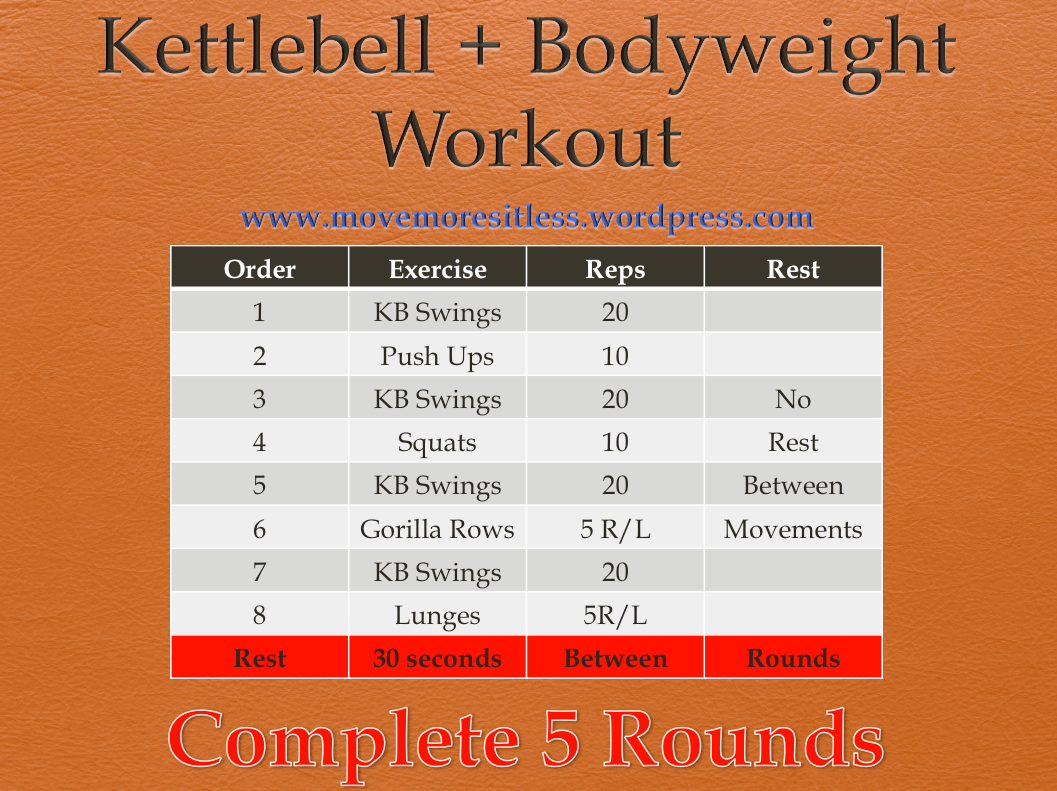
sample kettlebell and bodyweight workout

A couple of points…

First, there is a lot of work being done here, as you can see.  There is a lot of muscle being stressed and the rest is light.  A workout like this could be a complete training session for a beginner or an intermediate, or scaled up for an advanced lifter.  Scaling up for an advanced trainee might involve a bump up in bodyweight exercise progression or adding a weight vest to those movements.  It’s all a matter of tweaking the variables based on your unique situation and needs.

Second, I kept the reps to even numbers, 10’s and 20’s.  Why?  Because it is annoying having to check your notebook after every movement.  I want you to be focused on what you’re doing during the training session not counting reps like people count food calories.  Focus on your movement, your breathing, your recovery.  Forget about complicated rep schemes… I have plenty of those that I will post in good time.

Third, go sub-maximal but not too light on your kettlebell swings.  Grab a bell that you could swing for 30 reps and focus on hip snap during those suggested 20 reps.  Guys you might grab a 24kg or a 28kg, gals you might grab a 16kg or a 20kg.  Both guys and gals, you’re allowed to grab more or less than that, but on average, males and females will use those weights.

Remember, don’t gauge your energy expenditure on the first set of swings because you’ve got 3 more sets of swings and 4 different bodyweight movements lying ahead.  Manage your fatigue appropriately.  If you have a heart rate monitor, I would suggest using it to check you heart rate.  Of course, you’d want to already have an idea of the beats per minute that separate you from exhibiting crappy movement technique.  When you reach that heart rate, you can back off, rest for a few seconds, then get back into the workout once you can control and OWN the movement.

Why 20 reps of swings?  Because I personally feel that anything more than that really doesn’t provide much benefit other than poor technique (lack of finishing in full hip extension, slouching, etc) and a rising risk of losing the bell on the backswing or at the highest point of the arc.  One slip will kill your pet or put a hole in your wall, and the other will destroy your brand new LED TV.

20 reps (or less depending on your conditioning level) seems to allow for a sufficient elevation in heart rate without making the swings pointless from lack of load and endless volume.  There will be plenty of work performed in this training session, it doesn’t all need to be accomplished with kettlebell swings.

If you’re bored with your typical cardio routine, I would highly recommend giving a workout like this a real shot.  You will be pleasantly surprised at how hard your cardiovascular is taxed during a training session like the one described below.  20 minutes seems to be the sweet spot for me.  I have tested up to 30+ minutes of work like this, and it just doesn’t work for a couple of reasons…

1)  I feel like I am just going through the motions with regard to loading (aka weight used).

2)  I feel like I am adding  volume for an unjustified purpose.

These days, workouts like this serve as a great follow-up to my 2-day on/1-day off training schedule.

Day 1 is a heavily focused on strength work with a splash of jump rope or Airdyne cardio work, while day 2 (this workout) is dedicated to sub-maximal movements strung together to work cardio-strength (traditional strength moves with incomplete rest periods).

Ultimately, the goal is to stay physically prepared until I shift my training toward a particular goal.

Also, although the 20-25 minutes of work being completed in a workout are definitely stressful and draining, I feel as though it’s a short enough bout that allows for adequate recovery between training sessions, avoiding over-training.  The full 24+ hours of rest is also a motivating factor to work hard during this type of training session.  The rest day is just that… a rest and recovery day.

Be a perfectly golden marshmallow at the end, not a crusted black scabby marshmallow.

Give it a shot and let me know how you make out!

Cheers to short effective bouts of exercise!

Kyle

A Time Based Bodyweight Workout for Boosting Fitness and Fat Loss

Quick Tips

Let’s face it, time is a commodity.  It’s our most precious commodity.  The clock will continue to tick no matter what we do.

I used to think that people who claimed that they “have no time to work out” were just dishing out lame excuses.  I might be conditioned though.  I have heard this time and time again from people who ask me for fitness advice.  Once I give them a rough outline of what they need to be doing in the gym or at home workout-wise, they raise their eyebrows and throw out the “I have no time for that” card.

What did you expect?  Hahaha.  It makes me laugh every time.

Enter:  Time based training.  

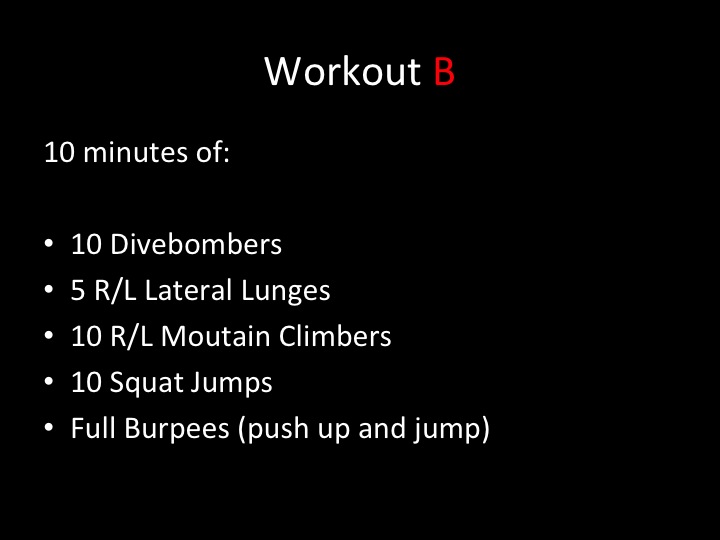
What follows is a simple time based workout program that is an immediate solution for anyone leery of investing decent time in a workout or for people who are legitimately short on time (because I know that you are out there folks).  

You’ll be able to progress this training plan for about four weeks while avoiding stagnation and adaptation.  The body tends to get really efficient at activities that we repetitively engage in, so don’t be silly and try to ride this program out for a year or something crazy like that.  

Building fitness demands that you constantly keep tweaking the variables.

Here you go… 

ImageImageImageImageImage


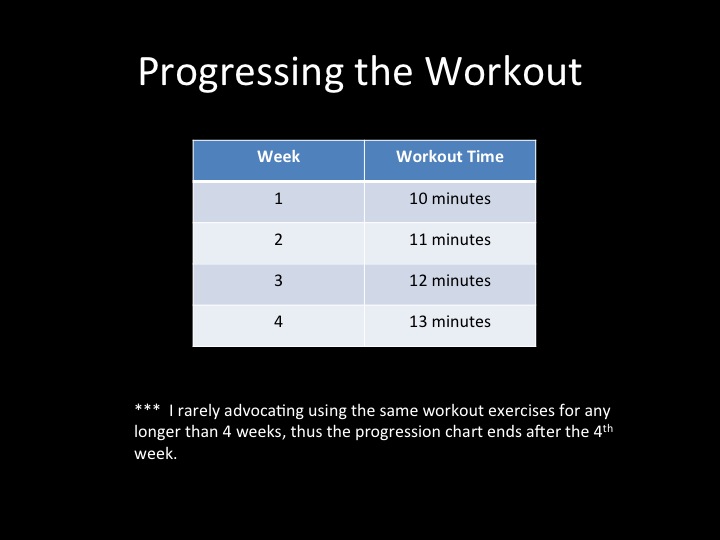
Essentially you are increasing the volume of your training sessions by adding one minute per week for four weeks straight.  I like workouts like this for beginners or advanced individuals alike because everyone can move at a pace that is appropriate to them.  Beginners can grab a breather and some water if need be, and advanced trainees can whiz through at break neck pace to get their training effect from the workout.

Best of all?  You can do this type of workout anywhere.  

Worst of all?  No pulling and no hip hinging movements.  Without equipment, it’s really hard to work upper body pulling movements into a workout.  Suspension trainers like the Jungle Gym XT really help this issue.  

Hip hinging is the motion you’d make if you were butt bumping a car door shut.  You’re hinging at your hips.  Without weight, it’s hard to train this movement pattern, which really sucks because hip hinging is one of the most beneficial movement patterns that we humans can train.  

You’ll find that every style of training sacrifices something.  Nothing is perfect.  

The key with short workouts like this is leveraging the training effect of the session.  Short training sessions like this need to be high tempo since you are cramming a lot into short duration. 

If you’re not willing to buckle down on your eating habits, well, prepare to be awfully disappointed by every workout program ever created.  Physical activity is a supplement to eating food worthy of fat loss.  The changes that take place post-workout are just as important if not more important than what takes place during the workout.

Sure, you can reduce body fat and increase performance without any dietary intervention (yes it is possible), but you’ll sell yourself short in the long run.  Sooner or later you’ll reach a plateau.  Eating crap food and training like a crazy person only gives off the perception of health.  Food is the key to the body aesthetic universe and long-term health and wellness. 

Any honest personal trainer or fitness advocate in the world will tell you that nutrition makes up the bulk of the foundation of any athletic or fit-looking body.  We cannot train hard enough or long enough to offset poor eating habits.  Unless you are an Iron Man athlete, in which case you are training for 3-5+ hours per day, almost daily and you have no real world career other than your sport.

Less than 1% of us fit that description, so lets just be big boys and girls and eat nutrient rich foods.  Ok?  Make the food that enters your pie hole primarily veggies and plants mixed with some animal protein and nuts.  Perfect little diet solution that will work wonders.

Plus, it would be so stressful to think about having to workout so ridiculously hard to combat all of the junk food eaten.  

If the food grew from the earth or has a mother, eat it. That’s your checklist to decipher through the food trickery that has saturated our restaurants and supermarkets.  

Rock this workout plan for at least 2 weeks.  Training for any period of time shorter than that isn’t even worth lacing up your shoes for the first training session, and it really shows that you aren’t prioritizing to make some changes.  Stay committed and trust yourself and your program.  

All in good time.


Cheers to leveraging our body’s natural ability to burn fat…


Kyle

Turkish Get-Up and Kettlebell Swing ONLY Workout

20 minute Workouts, Kettlebell Training

This workout includes two foundational kettlebell exercises (Turkish Get-Ups and Kettlebell Swings) and is perfect for a home gym workout.

Who doesn’t love a home gym workout these days?  Time-efficient and minimalistic workouts are PERFECT proving the superiority of the home gym workout experience.

Clearly, I’m an outspoken advocate for creating a home gym space.

In the kettlebell training world, turkish get-ups and swings are two of the best exercises a person could learn, practice, and improve on.

I stand firm on this statement.  Call it “my truth” or whatever.  I’ve spent years working these two movements and the benefits of my efforts include sustained power, strength, and a consistently lean and muscular physique.

Aesthetics might seem superficial, but no one trains hard to stay fat.

There are HUNDREDS of other great exercises, I support them all, but going full-on minimalistic mode, I know that attacking turkish get-ups and swings would make a lot of people happy with the time investment.

It’s a powerful combo.

Kettlebell swings are a ballistic hip hinging exercise that’ll improve power, train fast-twitch muscle fibers and if organized accordingly, build conditioning in a really unique way.

Turkish Get-Ups are a pure loaded movement-rich exercise.  Few other exercises are as humbling, addicting, total body, and rewarding as practicing turkish get-ups on a regular basis.

You feel less like a Lego exercising while doing turkish get-ups, and more human.  

Equipment needed:  Timer and kettlebell

15 minutes Alternating Turkish Get-Ups

+

2-Hand Kettlebell Swings (24 rounds of 15sec on/15 sec off)

The TGU’s

15 minutes of continuous turkish get-ups is a lot of work, so if the duration needs to be decreased a bit, please do it.

Start with 5 minutes, see how you feel.

If 5 minutes is a breeze, add 2 more minutes and see how that feels.

There are very few secrets to fitness.  Actually, there are none.  Only what you know, and what do you don’t know… and how consistently and effectively you are at practicing what you know.

The key to building fitness safely, is auditing and be honest with your fitness level, and adjusting any pre-formatted workouts (like this one) to match your abilities.

Turkish get-ups, like any other exercise, are not supposed to be sloppy.

A full turkish get-up is a marathon of an exercise, multi-segmented, with many steps/moves/transitions on the way up and down.

The technique, timing, hand and foot placements, breathing and coordination are just a few key things to pay attention to while performing Turkish get-ups.

Poor technique… can result in tweaks, strains and injuries, which is not the point of exercising in the first place.

We exercise to improve our lives, not make it worse.

Regressions may be necessary, and the person who acknowledges they need to scale back a workout is a person I RESPECT!

The Swings

24 rounds of 15 seconds on (swinging) and 15 seconds off (rest) equates to 12 total minutes.

6 out of 12 minutes are spent performing kettlebell swings.

Pausing to think about how potent kettlebell swings are for fat loss (among other benefits), it’s pretty amazing a measly six minutes can have such a dramatic impact on body composition over time.

When I first started shaping this workout years ago, I used a 24kg kettlebell.

Today, I like to use a 32kg or my 40kg for the swings.

Exercise Variations for the Workout

Establish familiarity with both turkish get-ups and kettlebell swings BEFORE diving into a workout like this one.

Here are the recommended variations of each exercise:

Turkish Get-Ups

Kettlebell Swings

Give this workout a shot and leave a comment.