Crushing Your Workout’s Comfort Zone

Quick Tips

Image

Aaaaahhh comfort.  What a great word.  It brings such a heart warmed feeling just thinking about it.  We all love comfort.  The comfort of home, the comfort of socializing with long time friends and family, the comfort of driving the same route to work everyday and the comfort of knowing that everything is going to be alright.

Image

… and here come the black clouds… 😦

Let’s do a u-turn and get real for a few minutes…

… because this post is about identifying and breaking comfort to strive for more.

Comfort is the enemy of building fitness:  getting stronger, running farther/faster, stretching longer, assessing smarter, conditioning harder or choosing to eat wiser.

When you get comfortable in your pursuit body transformation or performance enhancement, you are essentially saying that your work is done.  You slip, lose control, let important things fall to the wayside.

But your work is never done because you are always are work in progress, always.  You have to be, otherwise you have submitted.

I read a Facebook post by Scott Sonnon where he describes himself as being “always a white belt mind”.  If you aren’t familiar with Scott’s background, he is a world champion martial artist turned strength and conditioning innovator.  I don’t agree with everything that he teaches, but he does push the boundaries of what we consider to be “functional” in the training world.  He’s got a bunch of other accolades and awards under his belt (no pun intended) that you can Google if you’re interested further.  He’s extremely bright guy and I enjoy reading this work.

It’s been said that exercising and eating properly is a “lifestyle choice”, and well, as shitty as it is for me to admit this, it really is.  I really don’t like dropping that line because everywhere you walk some donkey is preaching that same old song and dance.

Image

Got lost there for a second… sorry… back to comfort…

Getting comfortable leads to all kinds of silly workout habits that can become hard to break:

  • Lifting the same dumbbells over and over.
  • Never switching your training variables… same reps, sets, etc.
  • Skipping reps and sets, or even entire workouts.
  • Resting for the same amount of time after each effort.
  • Running the same mph, for the same amount of time, for the same distance.
  • Biking for the same amount of time, at the same RPM, for the same distance.
  • Refusing to evolve and try new movements or methods.
  • *** Refusing to change or FEAR of change.

***  This is a big one.  There are a lot of people out there who are scared of the unknown.  They fear the thought of working to improve themselves.  They fear the anticipation of how difficult it will be to lift more weight, condition harder or uncover weak points in their movement.  We end up tricking ourselves into thinking that we are “doing the best that we can”, but there is always another level that we can get to.  Check out this post regarding success, it has a lot of carryover into breaking through the comfort zone in your workouts.

—>  My own story

I’ll step up here… I was scared to put myself out to the world, start a building an audience (again) and take my writing seriously.  I cared too much about what people thought, or how my message would be received, so I threw away nearly 100 pages of written material.  Now I realize that I am on the right track, my writing does serve a purpose and all of this “practice” will force me to break through my own comfort zone.  I learn something new every single day and I love it.

Fear is paralyzing… and it is also just a feeling.  I repeat, fear is just a feeling.

So the next time you step foot in the gym, bring that new strength program with you and give it a shot.  What is the worst that could happen?  You get tired and realize that you’re a little weaker, unstable, immobile than you thought you were?  Who cares.  People care a lot less than you would think.  Go for it.

Most of the bulleted points above are representative of a person who has already committed to fitness at one point in their life and are now stuck in the rut.  They get stuck in a rut and it gets tough to wake up and dig out.  Waking up only happens when you become aware that your current workout habits are no longer serving you well.  You’ve got to realize that your body is really good at adapting to the stresses that are constantly placed on it.  Especially if those stresses never change.

Screen Shot 2013-03-29 at 7.09.46 AM

Experts of developing bad habits.

We become experts are what we repeatedly do, which in some cases is a good thing (good habits), but in a lot of cases, we have become experts of carrying through with poor habits.  Less than optimal habits. (I’ll be the first to stand up here too).  Breaking habits is a billion dollar industry.  Look at guys like Tony Robbins.  He’s built his entire career around teaching people how to break bad habits and develop habits that are more conducive to achieving success.

Change it, don’t be afraid to change it.

But not all of you have begun your pursuit of fitness yet.  Some of you don’t know where to start.  You’re searching for that beginning point to build from. For you folks, you can learn from the mistakes of the folks who are currently stuck in their comfort zone.  Avoid it.  Learn how to progress your exercises, add reps, sets, weight and difficulty of movement.  Train on one leg, two legs, sprint up hills, jump over hurdles, pull your body up to a bar, push your body away from the floor, hold a core demanding static position for time, take joints through a full range of motion even when they feel “locked” up, smash your tissue with a foam roller and then take a lacrosse ball to your feet for a few minutes

Keep progressing, keep pushing forward.

You get the point.

Image

In my own training, I have plateaued.  It is time to move on.  I would’t say that I was in a “comfort zone”, but I definitely reached a point of no return where going longer and harder was foolish… I need to increase the poundage.  Making myself increasingly tired by adding volume during my sessions isn’t accomplishing anything, other than making me… more tired.  Those double 24kg Lifeline Kettlebells have officially become too light.  It sucks to say it, because we had a great run, but it is time to move on to bigger and better kettlebells/barbells/etc.  My conditioning has never been better (except in my hockey playing days) but my backside is weak as hell (article about that coming soon) and my upper body pulling strength is lacking.  It is time to upgrade the gym and increase the demands of my training.  I made it last a while, and it was a great experiment.

Getting comfortable in anything in life can have disastrous outcomes.  Whether it’s career, working at building relationships or making your time worthwhile in the gym, if it is worth pursuing, it is worth pursuing aggressively.


—>  The irony of “having no time” and the comfort zone…

If you’re a person that’s pressed for time and you’re caught in the black hole of a workout comfort zone, you’re committing the ultimate sin.  Do you see the irony in not having any time to workout and then when you do finally workout it is same generic routine that you always use?  No wonder people are depressed and confused from their progress in the gym.

You’re going through the motions… stop now.


—>  Here are 5 quick tips to crushing comfort zone syndrome:

1)  Increase the load of your lifts, now.  (add roughly 2.5-5lbs to each lift every couple of workouts)

2)  If engaging in aerobic:  decrease the time to cover the same distance (move your ass!), increase incline or resistance, monitor your heart rate (effort) or ditch aerobic training altogether and throw down with some interval training sessions.

3)  Trade machines for free weights.  (Machines are for rehab patients and the elderly)

4)  Find someone that trains harder than you do.  (You become who you hang around)

5)  Set a goal with a date and read that goal 2-3 times a day.

If you felt like I was calling you out at any point, you’re guilty.  I feel the same way when I read articles about taking actions to the next level, especially the link I shared early in the article related to success.  There is always room for improvement, room to grow, another gear…


Cheers to crushing comfort in your workouts!


KG

I Am Physically Prepared: Reasons Why I Stay in Shape Year ‘Round

Quick Tips

Screen Shot 2013-03-26 at 8.19.56 AM

Life of a personal trainer.  

It’s funny, between the ages of 18-22 years old, I didn’t really value my fitness.  The fitness that I did have was a byproduct of being an athlete in a sport that places high demand on conditioning and the ability to repeat those high intensity efforts, therefore I really didn’t know anything else.  Having strength and being conditioned was a part of life, as it is for so many athletes.

Screen Shot 2013-03-26 at 8.17.22 AM

When you play a college sport, you quickly find that you have to stay in shape damn near year ‘round.  For hockey, there is a period of down time between the end of the competitive season and the beginning of off-season training, but it is quite short.  Maybe a week or two at the most.

When you’re not on the ice, building aerobic/anaerobic capacity along with hockey specific skills, you’re in the gym building qualities like strength and power.  The efforts put forth in the gym are designed to boost to on-ice performance, as is any off-season training program for any sport.

After I graduated from college, the byproduct of fitness that I had enjoyed from athletics also left.  Training was no longer mandatory for the rest of my life, it was optional.  Many of you know what this feels like.  It’s strange, because everything is so regimented for so many years, and all of the sudden it just stops.  I no longer needed to keep myself even remotely close to the sort of shape that I did when playing, however I chose to keep up with it.

I trained smarter once I was done with college than I did when I was under the supervision of a full-time paid strength coach at the University. 

I learned that there was a whole other world of training methods available that we athletes had not be exposed to.  It’s still frustrating to think that our programs were a tweaked variation of the basketball or football team’s strength and conditioning program, but in reflection doing something in the gym was better than doing nothing.

Screen Shot 2013-03-26 at 8.24.01 AM


Fast forward a few years, about six to be exact, and I still train hard 3-5 days per week.  My training frequency (days per week) varies depending on my professional career schedule and other activities, but for the most part I am able to workout as much as I would like.

I love it.  I am grateful that I have taken care of myself post-college athletics.  It has allowed me to run races with buddies or skate with current college hockey players without stressing about my physical abilities.  If you think this sounds silly, I would bet that many of you have turned down the opportunity to run a race or play a sport because you thought that you weren’t fit enough, saving yourself some sort of embarrassment.  I’ve pulled that one myself.

I call it being “physically prepared”. 

Being physically prepared is nothing special.  In a recent post about aerobic conditioning, I shared a pie chart showing how my workouts are divided up between strength, aerobic and anaerobic interval training.

The chart is accurate at the present time.  But if for example, a friend called me up and asked if I wanted to pedal a Century Ride (100 miles) with him, I feel confident that I could do it with very little additional training.

Why?  Because I am physically prepared.

If I travel to Colorado to join a buddy in climbing a 14’er (14,000 ft mountain) I am confident that I can handle it no problem.

Why?  Because I am physically prepared.

I think you get the point.

Screen Shot 2013-03-28 at 6.56.23 AM

For most of the year, my training has no other purpose than to:

1)    Keep my body capable of handling short or no notice physical stress.

2)    Keep me lean and mentally self-confident (there is a large mental component to why we workout in the first place).

3)    Keep pushing myself to avoid giving in to the stereotypical  activity levels that supposedly come with adulthood, career and family.

4)    Make a small time commitment for a large ROI with my day-to-day health and ability to fight off sickness throughout the year.

Subconsciously, I also train with the motivation to do my best to avoid Orthopedic issues later in life.  I don’t want to find myself lying on the operating room table (having a joint replacement) because I was lazy.  That’s an expensive mistake that will hit you hard financially and physically.  Our bodies are sophisticated but at the same time we are also a bunch of pulleys and levers, and keeping the right amount of tension on each pulley and lever will help avoid going under the knife.

I also never want to be a statistic on the nightly news that shows deaths from completely preventable disease.  I won’t be that person either.

Bottom line:  You’ve to strengthen and condition yourself with the future in mind.  Always in mind.

Screen Shot 2013-03-26 at 8.29.39 AM

Yikes.

All of us are going to have a different opinion about the amount of fitness that we should keep.

Constantly making an effort to improve your strength and power, cardiovascular capabilities, joint range of motion and stability in those joints will keep you moving for the long-term.

Fitness should be tailored to each individual.  You should maintain a fitness level needed to successfully move through life pain-free and safe-guarded against injury while meeting the physical demands of day-to-day life without worry or hesitation.

But in my own case (and many others I am finding) keeping a lifestyle that is full of movement whenever and wherever makes the journey a lot more exciting, and I call it being physically prepared.

Cheers to joining the physically prepared!

KG

Is Aerobic Training Bad? (a completely non-evidenced based discussion)

Quick Tips

Screen Shot 2013-03-23 at 1.30.41 PM

Aerobic Training!

Aerobic training was a hot topic a few months ago, and it will continue to be talked about topic for years to come.

First it’s bad, then its’s good, then it’s bad, then it’s good.  Back and forth, back and forth.

There is a thought process among many fitness professionals- mainly strength coaches and personal trainers- that striving to improve aerobic conditioning is a bad thing.  Actually, some magazines and websites have almost labeled it as sinful.

—>  The Most Useless Exercise Ever for Fat Loss

Activities like biking and running are the probably the most popular methods used to improve aerobic fitness, with running taking the cake for popularity it would seem.

I’ll just come out and say it:  Aerobic training is not bad.

It isn’t!  It’s just not the optimal choice for certain goals.

In my humble opinion, fat loss is one of those goals, along with sports performance.

There are other methods, depending on your goals, that would be a much better fit for moving your closer to those goals, especially if you are in the market for dropping useless tissue like fat and uncovering your abdominals.  If you’re aiming at fat loss, there are better methods to choose from than just steady state cardio.

A simple (but smart) strength training routine will crush aerobic training if you’re shooting for body transformation.

You may have seen this side by side comparison between these two athletes.  One athlete races in an aerobic dominated sport and the other races in a sprint (anaerobic) dominated sport:

sprinter versus a marathon body

Some time ago, aerobic training was labeled as a junk method of conditioning for athletes who play fast-twitch sports.  The premise was that if you train slow, you’ll be slow.  There is some truth to this I must admit.  For athletes that need to be fast, aerobic training should make up far less of the off-season training pie than other more effective training methods like strength and power training, sprinting, anaerobic conditioning.

—>  Admirable goals, wrong vehicle 

Again, the problem is that most people say that they want to lose weight (or fat) and put on some lean muscle, then all they do is participate in aerobic activities in an effort to burn calories.  Over time, they see the weight scale move, but quickly become confused because they still don’t like what they see in the mirror.  Frequently aerobic training will cause an “atrophied” look over time.  If all you did was train aerobically, you’d get skinny, decrease muscle mass and lose strength.  I’ve seen it happen time and time again.

Confused by the image in the mirror, these people then panic and jack up the duration and frequency of their aerobic training, pushing harder and harder in hopes of seeing positive changes in the mirror.  It still doesn’t happen.  Weight is dropping, but they look like they haven’t eaten in days.

When all they see is weight loss and muscle atrophy, they become discouraged and render exercise ineffective.

It’s not aerobic exercise’s problem that you didn’t achieve your goals, it’s your problem.   You chose the wrong vehicle to get you to your destination.  So choose another vehicle.  It’s not the end of the world, but you’ve got to adjust your training habits to get your body back where you want it.  Just don’t point the finger at aerobic training.  The bodily changes that occur from high frequency, long duration steady state exercises are quite predictable.

Here is a great article from Jason Ferrugia about why he avoids aerobic training:  10 Reasons Why I Don’t Do Aerobics

—>  Aerobic training has a place in my workout regimen, absolutely…

Personally, I engage in an aerobic training session- usually riding the Schwinn Airdyne or jumping rope- about 1-2 days per week.  It fluctuates depending on my workout schedule, but aerobic training is still very much a part of my training routine.  I throw on my heart rate monitor to keep my efforts measured- not too high and not too low on the bpm- and I get to work.  The aerobic effort will last anywhere from 30-45min depending on how I feel.  The goal is to flush my body from the previous days of hard training, increase blood circulation and just sweat.

In all honesty, sometimes I train long and slow just to sweat.

Schwinn Airdyne

Awkward lady not included.

I never try to set records, although I have ridden the Airdyne frequently enough to know how far I should be riding (mileage-wise) for a give time period.  If I am training aerobically, I am ALWAYS wearing a heart monitor, keeping my BPM (beats per minute) within my aerobic range.

This is what my typical training week looks like right now:

Aerobic, Anaerobic, Strength Training

This chart changes depending on what my goals are…

Remember, I can change these efforts based on physical needs for races/events/hockey season, the time of year (Summer, Winter, etc) or if I am simply interested in pursuing a different body appearance.  I am my own guinea pig.  Self-experimentation with physical effort has always been an interest of mine.

One of the biggest concerns I have with aerobic training is overuse.  Especially folks who run or bike for hours and hours every week.  The risk for overuse injuries skyrockets for those people who long duration exercisers.  These injuries can develop for a number of reasons, including:  impact of activity (running is high impact), muscular imbalances, poor fitting footwear (causing compensations), poor cycling mechanics (poor set up, posture), pre-existing imbalances that begin to surface as chronic pain, etc.

There’s an old saying:  You can’t run to get fit, you have to get fit to run.

Consider what that means for your situation.  Is your body fit enough to begin training for long durations?  Are your joints primed to withstand the ground impact forces from activities like running?

It’s well known that running is great for increasing bone density, yet conversely running with poor form (aka: slapping the pavement) is nothing more than repeated high impact stress.

Check out this snippet from a comparative running study:

Screen Shot 2013-03-26 at 8.47.52 AM

“During each foot strike the body is exposed to repeated impact forces of estimated to be two to three times the body weight of a runner”.

Again, I am not singling out running or saying that it’s a sin, I just want you to consider your training vehicle.  It might be something that you need to consider seriously, especially those of you who are battling aches and pains like shin splints, hip strains and or knee pain.

Aerobic Training Sucks!

Before you bash aerobic training, consider what results you want from your training efforts.  At the very least, aerobic training initiates rapid circulation in the body, which is a benefit that you cannot put a price on.  Rapid circulation helps promote proper internal functioning of your body.  It’s a really great thing to get the blood pumping as much as possible.

Screen Shot 2013-03-26 at 8.52.41 AM

Rapid circulation is a crucial reason to exercise in the first place.

Is this a bird’s eye view of aerobic training?  Yes, but you have to keep an open mind.  Training should be customized to you and you only.

While a lot of people do have the same training goals, you should take the time to investigate if your workout methods are in fact the right fit for your goals.

If they aren’t, switch them.  Easy as that.

Don’t over-complicate something that should be kept simple.

Cheers to accepting the red headed step child of fitness… aerobic training!

KG

*** Coming up next:  Creating stakes to create incentives for getting into shape…

How to Choose Exercises for a Time Efficient Total Body Circuit Training Workout For Strength and Fat Loss

Quick Tips

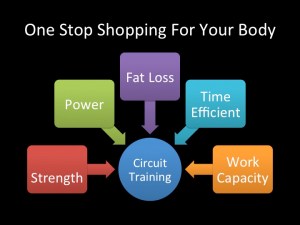
If you’re in the market to lose a little fat, circuit training is for you.  The bonus is that you’re going to build some strength and work capacity in the process.  Or maybe it is the other way around, maybe the bonus is that you’re going to burn some fat while you make an effort to build strength and work capacity?

Benefits of Circuit Training

Either way you look at it, you’re circuit training is going to kill multiple birds with one stone.  This is time leverage for a workout.  If you’re going to make the time to workout, you should really be utilizing a training method that is going to continue to work for you even after you finish the last rep.  That’s smart training.

When I say “circuit training, I’m not referring the kind of training where you move from one machine to the next.  There will be no use of machines- at least not how they were designed to be used- on this blog.  I can confidently say that.  An able-bodied human needs to move about their joints freely, not sit on a machine.

I guess I don’t mind fitness machines… for hanging my jacket on them when I arrive to the gym.

Total body circuit training should fatigue just about every single muscle in your body by the end of the training session.  That’s why we call it “total body”.  In fact, I will make the argument that just about every circuit training workout should be total body.  I guess am just not a fan of training the upper body on one day and the lower body on the next, or splitting sessions up by body parts.

The total body approach builds athleticism.  Circuit training using the total body approach will allow you to perform more work using heavier loads for each movement pattern while remaining as fresh as possible.

That’s a mouthful.

The most effective circuit training in the world involves strength based (or resistance based) multi-joint movements.

If you aren’t familiar with the terms “multi-joint movements”, I am referring to exercises like:

  • Squats
  • Lunges
  • Push-Ups
  • Chin-Ups
  • etc…

All of these movements require freedom of movement about multiple joints and recruitment from multiple muscles.

Total body muscular fatigue.

Just because I keep saying total body, doesn’t mean that you’ll be performing 20 different exercises in a training session.  Don’t confuse that.  The goal with exercise selection is to keep it simple and focused.

When selecting exercises to incorporate prior to the workout, there is a simple format that you can follow to help you along.

You can literally plug any exercise into the following categories and whammo!… You’ve got yourself a quality training session.

Here are the movement patterns that I would like you to address during the session:

1)  Total Body Explosive  (Kettlebell swings, thrusters, etc)

2)  Upper Body Vertical Pulling (Chin ups, pull ups, etc)

3)  Lower Body Pushing (squats)

4)  Core/Pillar (ab wheel rollouts, body rocks, suspension trainer pendulums)

5)  Upper Body Horizontal Push (Push-Ups, bench press, etc)

6)  Lower Body Hip Dominant (Lunge, deadlift, hamstring curls, etc)

7)  Cardio Filler (Schwinn Airdyne, mountain climbers, jump rope, etc)

Exercises for Circuit Training

Seven categories of movements that will build you a lean athletic body: burn fat, develop strength and power, improve performance and save you time in the gym or at home.

Here is how the exercise would be ordered for the training session:

Effective Circuit Training

A workout like this is what I call a leveraged training session.  Time is leveraged and the training effect of the workout is leveraged.  Just about any workout is to elicit a metabolic response, but an aggressive workout like this done 3-4 times per week will really shake up your system.

A workout like this combined with some sensible food choices will send a body transformation into overdrive.

Where people fail, is they fail to take action.  Or, if they take action, the motivation to stick with the program begins to fizzle out.

Stay with it for at least 4-6 weeks and you’re going to see some amazing changes take place.  Trust me here.

But you have to stay with it.


Cheers to DIY circuit training!

KG

3 Time Efficient Methods To Squeezing in a Workout While Building a Career

Quick Tips

One thing that I have learned about writing and consulting on topics related to fitness is this:  Not everyone thinks about training, eating and health as much as I do.

Not everyone cares about how great a kettlebell swing is, how bear crawling can restore function or jumping rope is 10x better for conditioning than a recumbent bike.

I think sometimes as professionals we forget that we care about fitness far more than any other people on the planet.  Hell, we made a career out of it.

One issue with training that comes up time and time again is time, or lack their off.

As I mentioned in a recent post, I completely understand the time issue.  I currently have a full-time career, write, train and am currently building an internet based fitness company/culture to help transition out of my existing career.  Time is short, just as it is for so many other career professionals.  I am in your shoes, which is why I feel so at home writing on this blog.  You and I are in the same boat.

We’ve got to find solutions to working out when time is really tight.

Here are a few ideas that can put you back on track for working out around a career…

1)  Strength-Cardio Circuits

Interval training using strength based movements are amazing for building adequate levels of strength and power while stripping fat.  These workouts leverage our body’s natural ability to continue to burn fat for hours after the training session has ended.  Strength cardio circuits, sometimes referred to as metabolic training, involve short burst efforts and minimal rest periods between movements.  You’ll want the training session to be a total body experience, alternating exercises between upper body and lower body to increase performance by avoiding fatigue. By alternating movements, you’ll be able to hit more muscles in less time without sacrificing exercise technique.

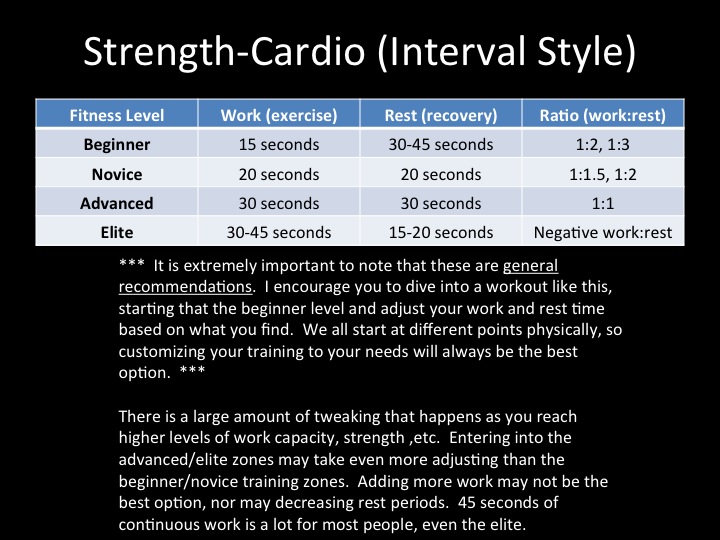
Although the amount of time designated for work and rest during a strength-cardio workout will vary depending on your fitness and skill level, you should be able to find a sweet spot for yourself.

Here is a simple table to reference:

Strength Cardio Interval Training

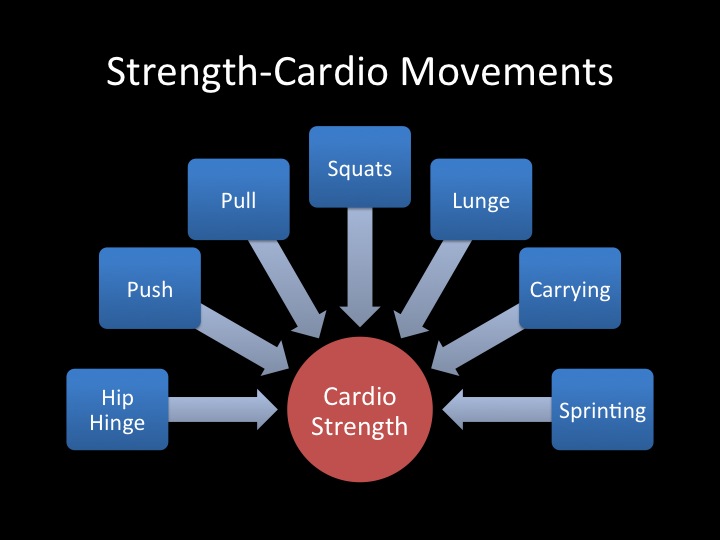
Choose from these simple movements…

Strength Cardio Movements

2)  Train on the weekends.

Nothing ground breaking here, but I just want you to start thinking about where you can fit in a training session.  The weekend usually provides some relief from the time commitments of the workweek, so look toward Saturday and Sunday for squeezing in a couple solid training sessions.  This will work wonders for your attitude as you enter into Monday and Tuesday.  You’ll have the confidence knowing that you put forth a solid physical effort that you can leverage for 24-48 hours.

I train on the weekends all of the time.  During this time, I feel no need to rush through the workout like I do during the week.  The training session becomes enjoyable.  Often times, I will spend a significant amount of time working on my mobility and addressing any muscles that feel overactive with knots.  It’s a time for training aggressively and regenerating my body.

Weekend Training Solutions

3)  Two Sessions Per Day

This might sound crazy, but incorporating two smaller training sessions into your day might provide some relief to your training efforts.  Rather than spend 60-90 minutes exercising once a day, try splitting the day into two smaller training sessions that last anywhere from 15-20 minutes.  The smaller window of time will keep you focused on moving forward throughout the workout and also motivate you to do more in less time.  Stoking your metabolism twice a day will work wonders.

Check out this recent post about that would help you coordinate a couple short training sessions:

—> Time Based Training

Having a career and committing to a life of physical fitness should be able to coexist with each other.  They have to.  Wealth without health is completely pointless, just as health without any wealth is stressful.  Find the balance that fits your situation, integrate the suggestions above and make an effort to not only maintain your body, but improve it.  Succeeding in career and physical performance will elevate your attitude and take your confidence to new heights.


Cheers to earning the $$$ and engineering a high functioning body in the process…

KG

Red Table Round Table #1

Quick Tips

Good Saturday morning from the little Red Table in Eau Claire, Wisconsin.

Part of the fun of keeping a blog is being able to write whatever you want, whenever you want to write it.  It’s your own personal space to release thoughts and ideas on this massive beast we call the Internet.  That is a pretty cool thing.

I decided that I really wanted to develop a blog posting series where I could just discuss whatever topics happened to come to mind during that writing session.  

Basically, I am talking about just putting my fingers on the keyboard and having at it.  

Creatively, I think this will help me regurgitate some of the interactions, questions and experiences that I had from the previous week.  

A recap of sorts from the past week.

Here we go…


—> Fat loss isn’t an ongoing process, it ends eventually<—

The concept of losing fat has to end at some point.  You cannot forever be in “fat loss” mode with your training and your eating.  You have got to have some kind of end goal to attain.  Whether you choose a certain body fat % or a performance related goal, it doesn’t much matter to me.  Although I suppose that if you are partaking in a full-fledged fat loss program you should probably be measuring the amount of fat you lose.  Skin calipers are a simple and relatively effective way to do this, otherwise hydro-static weighing or a BodPod will give some fairly accurate numbers also.

I was talking with my girlfriend Amanda about the whole concept of fat loss.  I told her that in my experience, sometimes people end up taking the fat loss concept to the extreme.  They literally attempt to walk around with 0% body fat.  They engage in extreme eating habits (calorie restriction and the like) and sign up for extreme workouts.  It becomes just as addictive as eating sugar or smoking cigarettes.  

At some point, you have to realize that you are going to enter a maintenance phase.  You’ve reached  your goals and you’re content with your body figure and your physical abilities and now you’re in what we call:  Maintenance. 

Fat loss ends at some point and maintenance begins.  You decide when that happens.  

Fat loss is a war and it is a lot more mental than physical in my opinion.  Habits need to be broken and new habits need to be hardwired.  Mentally you’ve got to prepare yourself for fighting off your old self-talk.  You’ve also got to get your head in the right place to endure your training schedule.  Physically, the human body is incredibly resilient.  You can handle a lot more physical stress than you think.  (Just keep it manageable physical stress)


I often go back and forth between favoring two approaches fat loss, and I think both depend on the personality of the person.  

Here they are:

  • Aggressive training and eating for 4-6 weeks, followed by a tapering process.
  • A consistent, not overly aggressive effective training regimen paired with a smooth transition into concepts of clean eating.


The first bullet point is an approach that is my definition of a fat loss war.  It’s pedal to the metal. You go crazy in your training and you stay brutally strict with your diet.  You get results quickly and then you turn back the dial a bit and continue pushing on at an effective yet much more manageable pace with regard to training and nutrition.  

The second bullet point is an approach that is quite popular also.  This is the “lifestyle” approach.  I am sure you’ve heard that a million times… “It’s not a diet… it’s a lifestyle”.  Puke.  

Anyways, this approach is a gradual climb.  There is a lot of acclimation to this approach.  I enjoy this approach to losing fat because fat loss is inevitably going to happen if you are eating clean and training purposefully.  I love the research and the highly technical information that the experts put out, but they complicate topics in an effort to sell products.

Eat clean and drink water, learn how to lift weight using big movements, ramp up your cardiovascular training from aerobic to higher effort intervals, then move into a more cardio-strength style training regimen and you’re going to experience a reduction in overall bodyfat.  

Measure your fat loss progress on the cheap.  Use a snug fitting pair of jeans and a tighter fitting shirt to gauge your progress.  Remember, you’re after fat loss and lean tissue gain… not weight loss. (I lose up to 3-5lbs just from sleeping, it doesn’t tell me anything useful).

 —> Again, I encourage you all to set your sights a goal.  A goal is a target.  Once you have the target, set the timeline.  Once you have the timeline, you can assess what kind of effort is required to achieve that goal in that timeline.  It’s simple.  We over-complicate what should be simple.   


Cheers to keeping it simple…


KG


You Gotta Lift With Your Legs!

Quick Tips

Walk into a loading dock at any department store, hospital or industrial factory and you are going to see- maybe in plain sight or maybe laying next to the garbage- a sign that resembles the following:

Image

Caution:  Use Proper Lifting Mechanics


I probably hear something similar to the following quote 3-4 times a week while lifting decent sized plastic bins… “Kyle, lift with your legs bud!”, people say as I throw one bin on top of another.  

Ok, first things first…

1)  Take a look at the picture above.  How many people do you know that have proper mobility in their hips to get their ass that low?  Do you?  Most people don’t, so right away you’re putting yourself in a sketchy body position.  You’ll compensate big time to get that object off the floor.

2)  Lifting with the legs isn’t enough.  It’s all about technique.  Lifting the object by hinging your hips and driving your butt to the floor in an effort to primarily use your legs during the grunt of the lift is ideal.  Also, we deadlift barbells with massive loads in the gym…  Your back muscles are highly involved in that process, so don’t forget that having the back muscles helping out is a good thing, just don’t make them the only thing taking on the brunt of the load.  You’re moving a heavy object from a resting position on the floor to waist height (or higher).  You’ve got to pressurize your torso region to help protect your spine during the grind of the lift.

3)  Lifting odd-shaped objects is… well… odd.  The rules of lifting still apply to lifting odd objects.  Stay rigid, pressurize your torso to help protect your spine as I mentioned above, etc.  However, lifting something other than a designated weight training tool is awkward at best.

4)  Thankfully, most people who are probably lifting heavy stuff like the picture above are probably doing it for a living.  The reason that I say thankfully is because these people are probably conditioned to lifting heavy odd shaped objects, but more importantly they probably aren’t sitting in a chair all day.  You’ll hear me preach about how sitting is wrecking our posture and ability to move (it’s also unavoidable with our occupations), our metabolism, etc.  It’s horrible and unavoidable in today’s working world.  Take a person that sits all day and ask them to lift a 75lb-85lb box and you might have just dealt the camel the final straw (if you know what I mean).

5)  Programmed resistance training and attention to movement quality will protect our bodies from injury and aid in performance, even it that performance is lifting a heavy box off of the floor.  This is the foundational thought process behind establishing and enhancing strength, power, mobility and stability in your training sessions.  Physical preparedness is everything.

You’ll never appreciate your ability to move more than you will once you DO NOT HAVE THE ABILITY TO MOVE.

You gotta lift with your legs! haha…

Cheers

KG

Dr. Oz… And Here Comes the BackLash

Quick Tips

I always perk up when I hear or see popular figures like Dr. Oz on television.

Why?

Because I know that he has won the hearts of so many television watching addicts that are in search of “the next great tip”.

Last night’s piece on NBC Sunday Night programming surely didn’t disappoint.

I have to admit that his advice last night was decent.  But it’s the same old song and dance for me and many others…

–  Eat more vegetables.

–  Stop eating processed junk.

–  Exercise moderately for no more than 30 min a day.

–  Include the walk into the Mall, place of work or grocery store as part of that 30 minutes.

Huh?  Re-read the last two points that he made about exercise.

Now, one might say, “Kyle, these are great points, anyone can start with this!”  You’re right and you’re also missing a much more important point.

You’re right in the fact that advocating people to just get up and move in some way shape or form is a really positive tip.  You should move whenever possible, no doubt about that.  Add a little bit more everyday and the accumulation will equate to big things.  You know the drill… take the stairs, park farther from the front door, take a short walk in the morning or after dinner.

But understand that this is the absolute bare minimum needed to get by.  These are recreational activities.  This is not “exercise” in my opinion.  Walking is a skill that an able-bodied human should be able to do for miles upon miles, not just for the minimum 50 yards from the car to the front door of the area shopping mall.

I have seen the studies showing the correlation between minimal amounts of moderately intense exercise (roughly 30 min per day) and its positive effect on life.  I get it.  I read it and I get it.

While this information is definitely interesting, how about we demand a little bit more from ourselves?  Walking for 30 minutes a day is great, but let’s get serious about changing or improving our physical abilities, trading unhealthy tissue for healthy tissue, increasing range of motion at important joints, etc.

Set some goals… Aim to run a 5K or a 10K.  Squat your bodyweight on the barbell.  Swing a kettlebell for 20-30 minutes.  Slam a medicine ball.  Go to war with some battling ropes or try to improve the maximum number of push ups or pull-ups that you can do in a 5 minute time-frame.

Become an athlete later in life, that’s something worth pursuing.

As I mention in my training book(s), we have become a nation afraid of work.  I am talking about legitimate physical labor.  The kind that fatigues your body quickly from effort, causes sweat pour down your face and eventually soak into your shirt.  The kind that causes your lungs to “burn” from a short and intense bout of conditioning.

We always seek the path of least resistance.  Our joints do it, our muscles do it and now our brains are doing it.  We crave what is easy.  We scour the internet, magazines and newspapers for the quickest possible route to health glory while enduring the least amount of physical agony.

Let me tell you something… resolving to dominate your training sessions, whether you are a beginner just learning or an advanced trainee seeking a new path, builds character that spills over into all other areas in your life.  If you can do it physically, you can do it mentally.

Back to the backlash…

I predict a massive backlash from Dr. Oz’s comments, even though I think that he is very intelligent and probably didn’t intend for his comments to be twisted the way that they inevitably will.

It was funny to listen to him talk.  He said that he has to choose his words so carefully when he talks about health concepts and strategies because:  “People will hear what they want to hear”.  I respect that comment.

What he is means is that people are always going to take his advice and twist it to fit their situation.  Some will use common sense and add his tips to the greater whole (exercise and nutrition), but most won’t.  They want the least painful quick fix.

If he says that raspberry ketones are a great supplement for helping to initiate weight-loss, consumers are going to be buying mass quantities of raspberry ketones and consuming at an alarming rate.  When no weight is lost because all that person did was over-dose on raspberry ketones, they render that intervention useless and ineffective.

I also respected his comments about NEVER endorsing a product.  That’s cool.  He said that anything on the shelves that mentions his name or shows his picture is a scam.  That particular company has chosen to use his fame as leverage to sell their product.

Beware of this.  The supplement industry is a billion dollar industry with so many horrible scams out there.  It is difficult to regulate the supplement industry and even more difficult to identify the supplements that are worth taking.  You’re spending your hard-earned cash on these products and most of them don’t work!  Ouch.

Anyways, prepare yourself for the backlash.  Don’t be afraid to push yourself into new realms of fitness.  I don’t care if you’re interested in kettlebell training, powerlifting or endurance-related activities.  Go after something and be WAY MORE THAN AVERAGE in doing so.

Make it happen this week, alright?  I will do the same.


Cheers on this Monday…


KG

Is a 15 Minute Workout Realistic???

15 minute Workouts

60 minute workouts for fat loss are old news (so it seems).

Heck, in some circles, 45 minute workouts for fat loss are considered yesterday’s methods.

I have thought long and hard about my position on the judging a workout’s effectiveness or quality based on the time it takes to complete it.

While I was in Detroit, Michigan working with high-end athletes, our training sessions would take AT LEAST 90 minutes.

Why 90 minutes?

That is the amount of time it took us to from start to finish, working through this simple template:

1)  Foam Roll

2)  Static Stretch/Mobility

3)  Activation

4)  Dynamic Warm-Up

5)  Explosive (Plyometrics/Jump Training)

6)  Olympic Lifts/Power

7)  Strength/Core (Tri-sets)

8)  Conditioning/ESD (Energy System Development)

Total Time: 90min

This athletic based template was fast paced and continuous.  The breaks between each section were for water or timed rest periods.  Building an athlete requires focused development of a number of different qualities, and this template proved to be rock solid when it came to getting things done in a timely fashion, and most of all… getting results.

Now,  I know that most of my readers are not current athletes.  You may have been an athlete at one time (as I was), but reality is creeping up on you with regard to time available to workout.  It’s ok.  Life happens and we have to make adjustments to accommodate our daily activities.

Some fitness fanatics think that life should be built around your workouts, however, I tend to believe based my own testimonials and my own personal experiences… that your workouts should be designed to fit your lifestyle.

I know that some people are going to take advantage of my last statement, trying to bend the rules to the point where they begin to develop habits of never working out and letting themselves go, but I would hope that most of you choose to maintain a strict training regimen.

In my effort to adapt my workouts around my career and other business ventures, I began to look hard a Javorek’s complex training for fat loss and all around strength and conditioning.

I liked the idea of performing a large volume of work in a small window of time.  Javorek’s complex training is perfect for this as it is ridiculously effective for stripping fat in record setting time (15min or less).

Here are some of the training tools that I have used in the past for a complex:

–  Kettlebells

–  Barbells

–  Dumbbells

–  Suspension Trainers and Weight Vests

KB’s, BB’s and DB’s are what I have found to be the most effective.  You can adjust the loading easily with these training tools to fit your strength and conditioning and experience level and quite honestly… the movements just feel more natural using KB’s, BB’s, and DB’s.  Sometimes you have to go with your gut when you are designing workouts/programs.

Nothing against suspension trainers or weight vests, but trying to adjust the length on a suspension trainer or remove a weight vest while your eyeballs are popping out of your head from oxygen debt isn’t ideal.

For 3 months straight, I tested the idea that I might be able maintain my body composition and performance levels using just one simple complex template.  In the back of my mind, I wondered if I could actually improve my body composition and performance, but I didn’t want to set my hopes too high.

Here is the basic total body workout template overview that I used…

3 months is a long time to use the same general training format, workout after workout.  I have to admit that I worried about developing faulty movement patterns or flat out overtraining from the repetitive nature of the self-experiment.