Crushing Your Workout’s Comfort Zone

Quick Tips

Image

Aaaaahhh comfort.  What a great word.  It brings such a heart warmed feeling just thinking about it.  We all love comfort.  The comfort of home, the comfort of socializing with long time friends and family, the comfort of driving the same route to work everyday and the comfort of knowing that everything is going to be alright.

Image

… and here come the black clouds… 😦

Let’s do a u-turn and get real for a few minutes…

… because this post is about identifying and breaking comfort to strive for more.

Comfort is the enemy of building fitness:  getting stronger, running farther/faster, stretching longer, assessing smarter, conditioning harder or choosing to eat wiser.

When you get comfortable in your pursuit body transformation or performance enhancement, you are essentially saying that your work is done.  You slip, lose control, let important things fall to the wayside.

But your work is never done because you are always are work in progress, always.  You have to be, otherwise you have submitted.

I read a Facebook post by Scott Sonnon where he describes himself as being “always a white belt mind”.  If you aren’t familiar with Scott’s background, he is a world champion martial artist turned strength and conditioning innovator.  I don’t agree with everything that he teaches, but he does push the boundaries of what we consider to be “functional” in the training world.  He’s got a bunch of other accolades and awards under his belt (no pun intended) that you can Google if you’re interested further.  He’s extremely bright guy and I enjoy reading this work.

It’s been said that exercising and eating properly is a “lifestyle choice”, and well, as shitty as it is for me to admit this, it really is.  I really don’t like dropping that line because everywhere you walk some donkey is preaching that same old song and dance.

Image

Got lost there for a second… sorry… back to comfort…

Getting comfortable leads to all kinds of silly workout habits that can become hard to break:

  • Lifting the same dumbbells over and over.
  • Never switching your training variables… same reps, sets, etc.
  • Skipping reps and sets, or even entire workouts.
  • Resting for the same amount of time after each effort.
  • Running the same mph, for the same amount of time, for the same distance.
  • Biking for the same amount of time, at the same RPM, for the same distance.
  • Refusing to evolve and try new movements or methods.
  • *** Refusing to change or FEAR of change.

***  This is a big one.  There are a lot of people out there who are scared of the unknown.  They fear the thought of working to improve themselves.  They fear the anticipation of how difficult it will be to lift more weight, condition harder or uncover weak points in their movement.  We end up tricking ourselves into thinking that we are “doing the best that we can”, but there is always another level that we can get to.  Check out this post regarding success, it has a lot of carryover into breaking through the comfort zone in your workouts.

—>  My own story

I’ll step up here… I was scared to put myself out to the world, start a building an audience (again) and take my writing seriously.  I cared too much about what people thought, or how my message would be received, so I threw away nearly 100 pages of written material.  Now I realize that I am on the right track, my writing does serve a purpose and all of this “practice” will force me to break through my own comfort zone.  I learn something new every single day and I love it.

Fear is paralyzing… and it is also just a feeling.  I repeat, fear is just a feeling.

So the next time you step foot in the gym, bring that new strength program with you and give it a shot.  What is the worst that could happen?  You get tired and realize that you’re a little weaker, unstable, immobile than you thought you were?  Who cares.  People care a lot less than you would think.  Go for it.

Most of the bulleted points above are representative of a person who has already committed to fitness at one point in their life and are now stuck in the rut.  They get stuck in a rut and it gets tough to wake up and dig out.  Waking up only happens when you become aware that your current workout habits are no longer serving you well.  You’ve got to realize that your body is really good at adapting to the stresses that are constantly placed on it.  Especially if those stresses never change.

Screen Shot 2013-03-29 at 7.09.46 AM

Experts of developing bad habits.

We become experts are what we repeatedly do, which in some cases is a good thing (good habits), but in a lot of cases, we have become experts of carrying through with poor habits.  Less than optimal habits. (I’ll be the first to stand up here too).  Breaking habits is a billion dollar industry.  Look at guys like Tony Robbins.  He’s built his entire career around teaching people how to break bad habits and develop habits that are more conducive to achieving success.

Change it, don’t be afraid to change it.

But not all of you have begun your pursuit of fitness yet.  Some of you don’t know where to start.  You’re searching for that beginning point to build from. For you folks, you can learn from the mistakes of the folks who are currently stuck in their comfort zone.  Avoid it.  Learn how to progress your exercises, add reps, sets, weight and difficulty of movement.  Train on one leg, two legs, sprint up hills, jump over hurdles, pull your body up to a bar, push your body away from the floor, hold a core demanding static position for time, take joints through a full range of motion even when they feel “locked” up, smash your tissue with a foam roller and then take a lacrosse ball to your feet for a few minutes

Keep progressing, keep pushing forward.

You get the point.

Image

In my own training, I have plateaued.  It is time to move on.  I would’t say that I was in a “comfort zone”, but I definitely reached a point of no return where going longer and harder was foolish… I need to increase the poundage.  Making myself increasingly tired by adding volume during my sessions isn’t accomplishing anything, other than making me… more tired.  Those double 24kg Lifeline Kettlebells have officially become too light.  It sucks to say it, because we had a great run, but it is time to move on to bigger and better kettlebells/barbells/etc.  My conditioning has never been better (except in my hockey playing days) but my backside is weak as hell (article about that coming soon) and my upper body pulling strength is lacking.  It is time to upgrade the gym and increase the demands of my training.  I made it last a while, and it was a great experiment.

Getting comfortable in anything in life can have disastrous outcomes.  Whether it’s career, working at building relationships or making your time worthwhile in the gym, if it is worth pursuing, it is worth pursuing aggressively.


—>  The irony of “having no time” and the comfort zone…

If you’re a person that’s pressed for time and you’re caught in the black hole of a workout comfort zone, you’re committing the ultimate sin.  Do you see the irony in not having any time to workout and then when you do finally workout it is same generic routine that you always use?  No wonder people are depressed and confused from their progress in the gym.

You’re going through the motions… stop now.


—>  Here are 5 quick tips to crushing comfort zone syndrome:

1)  Increase the load of your lifts, now.  (add roughly 2.5-5lbs to each lift every couple of workouts)

2)  If engaging in aerobic:  decrease the time to cover the same distance (move your ass!), increase incline or resistance, monitor your heart rate (effort) or ditch aerobic training altogether and throw down with some interval training sessions.

3)  Trade machines for free weights.  (Machines are for rehab patients and the elderly)

4)  Find someone that trains harder than you do.  (You become who you hang around)

5)  Set a goal with a date and read that goal 2-3 times a day.

If you felt like I was calling you out at any point, you’re guilty.  I feel the same way when I read articles about taking actions to the next level, especially the link I shared early in the article related to success.  There is always room for improvement, room to grow, another gear…


Cheers to crushing comfort in your workouts!


KG

I Am Physically Prepared: Reasons Why I Stay in Shape Year ‘Round

Quick Tips

Screen Shot 2013-03-26 at 8.19.56 AM

Life of a personal trainer.  

It’s funny, between the ages of 18-22 years old, I didn’t really value my fitness.  The fitness that I did have was a byproduct of being an athlete in a sport that places high demand on conditioning and the ability to repeat those high intensity efforts, therefore I really didn’t know anything else.  Having strength and being conditioned was a part of life, as it is for so many athletes.

Screen Shot 2013-03-26 at 8.17.22 AM

When you play a college sport, you quickly find that you have to stay in shape damn near year ‘round.  For hockey, there is a period of down time between the end of the competitive season and the beginning of off-season training, but it is quite short.  Maybe a week or two at the most.

When you’re not on the ice, building aerobic/anaerobic capacity along with hockey specific skills, you’re in the gym building qualities like strength and power.  The efforts put forth in the gym are designed to boost to on-ice performance, as is any off-season training program for any sport.

After I graduated from college, the byproduct of fitness that I had enjoyed from athletics also left.  Training was no longer mandatory for the rest of my life, it was optional.  Many of you know what this feels like.  It’s strange, because everything is so regimented for so many years, and all of the sudden it just stops.  I no longer needed to keep myself even remotely close to the sort of shape that I did when playing, however I chose to keep up with it.

I trained smarter once I was done with college than I did when I was under the supervision of a full-time paid strength coach at the University. 

I learned that there was a whole other world of training methods available that we athletes had not be exposed to.  It’s still frustrating to think that our programs were a tweaked variation of the basketball or football team’s strength and conditioning program, but in reflection doing something in the gym was better than doing nothing.

Screen Shot 2013-03-26 at 8.24.01 AM


Fast forward a few years, about six to be exact, and I still train hard 3-5 days per week.  My training frequency (days per week) varies depending on my professional career schedule and other activities, but for the most part I am able to workout as much as I would like.

I love it.  I am grateful that I have taken care of myself post-college athletics.  It has allowed me to run races with buddies or skate with current college hockey players without stressing about my physical abilities.  If you think this sounds silly, I would bet that many of you have turned down the opportunity to run a race or play a sport because you thought that you weren’t fit enough, saving yourself some sort of embarrassment.  I’ve pulled that one myself.

I call it being “physically prepared”. 

Being physically prepared is nothing special.  In a recent post about aerobic conditioning, I shared a pie chart showing how my workouts are divided up between strength, aerobic and anaerobic interval training.

The chart is accurate at the present time.  But if for example, a friend called me up and asked if I wanted to pedal a Century Ride (100 miles) with him, I feel confident that I could do it with very little additional training.

Why?  Because I am physically prepared.

If I travel to Colorado to join a buddy in climbing a 14’er (14,000 ft mountain) I am confident that I can handle it no problem.

Why?  Because I am physically prepared.

I think you get the point.

Screen Shot 2013-03-28 at 6.56.23 AM

For most of the year, my training has no other purpose than to:

1)    Keep my body capable of handling short or no notice physical stress.

2)    Keep me lean and mentally self-confident (there is a large mental component to why we workout in the first place).

3)    Keep pushing myself to avoid giving in to the stereotypical  activity levels that supposedly come with adulthood, career and family.

4)    Make a small time commitment for a large ROI with my day-to-day health and ability to fight off sickness throughout the year.

Subconsciously, I also train with the motivation to do my best to avoid Orthopedic issues later in life.  I don’t want to find myself lying on the operating room table (having a joint replacement) because I was lazy.  That’s an expensive mistake that will hit you hard financially and physically.  Our bodies are sophisticated but at the same time we are also a bunch of pulleys and levers, and keeping the right amount of tension on each pulley and lever will help avoid going under the knife.

I also never want to be a statistic on the nightly news that shows deaths from completely preventable disease.  I won’t be that person either.

Bottom line:  You’ve to strengthen and condition yourself with the future in mind.  Always in mind.

Screen Shot 2013-03-26 at 8.29.39 AM

Yikes.

All of us are going to have a different opinion about the amount of fitness that we should keep.

Constantly making an effort to improve your strength and power, cardiovascular capabilities, joint range of motion and stability in those joints will keep you moving for the long-term.

Fitness should be tailored to each individual.  You should maintain a fitness level needed to successfully move through life pain-free and safe-guarded against injury while meeting the physical demands of day-to-day life without worry or hesitation.

But in my own case (and many others I am finding) keeping a lifestyle that is full of movement whenever and wherever makes the journey a lot more exciting, and I call it being physically prepared.

Cheers to joining the physically prepared!

KG

How to Warm Up Before a Home Workout (Video)

Quick Tips

Below is a sample of what a warm up looks like for me prior to a training session.

The only awkward moment comes when I attempt to stay on the rubber matting while performing forward, backward and side to side gorilla hops.  Hey, I’m human, shit happens.  This isn’t Hollywood produced, it’s real world home training.  Film it like it happens, right?

The important thing to remember is that you should always maximize the equipment, time and space that you have available to you.  You can always get way more accomplished with what you have than you originally thought.

I have really come to enjoy integrating animal style movements in the warm up, as it demands rhythm, stability and mobility to accomplish the moves.  Plus it isn’t boring, which is important for keeping your movement endeavors interesting and sustainable.


After you watched some of the video, it’s important to understand a couple of things:

1)  I only foam roll problem areas (trigger points, stiff muscles, overactive muscles)

2)  I only address mobility in areas that I lack it.

3)  The dynamic movement prep is mostly total body.

4)  Jumping rope serves to increase blood flow, core temperature and gets me sweating.

The point is that there is no time wasted and everything has a purpose.  My body is prepped for the transition into the physical demands of the workout.

My workout for this day was highly metabolic, which is how I have been training for quite some time now.  All workouts are designed mindfully and not intended to destroy my body, but rather build and condition it intelligently.  I completed all of the exercises below without rest between movements in a 15 minute timeframe (I was tight on time):

Metabolic Strength Training


I have used workouts like this successfully for over 5 years now.  The loads and exercises are appropriate for my skill and fitness level.  To be completely honest, the less complicated you make a session like this, the more fun you will have.  I rarely stray from the basic movement patterns: push ups, vertical pulling, squats, kb swings, etc.

I am after the training effect, not a circus-like performance.  The risk doesn’t always match the reward with complex movements.  It usually looks great on paper and sucks in practice.

For the time invested, I haven’t found any other style of training that keeps me lean and functional for the time invested.  The trade-off for time reduction is an increase in intensity.  This isn’t for beginner or the weak of heart.  You’ll be tired at the end.

It’s a great blend of work capacity and strength movements that demand full range of motion and attention to technique.  Of course, you can increase the difficulty of a workout like this or make it slightly easier if need be.  Progression is always the answer.


Cheers to making less excuses and  taking more action…


KG


3 Time Efficient Methods To Squeezing in a Workout While Building a Career

Quick Tips

One thing that I have learned about writing and consulting on topics related to fitness is this:  Not everyone thinks about training, eating and health as much as I do.

Not everyone cares about how great a kettlebell swing is, how bear crawling can restore function or jumping rope is 10x better for conditioning than a recumbent bike.

I think sometimes as professionals we forget that we care about fitness far more than any other people on the planet.  Hell, we made a career out of it.

One issue with training that comes up time and time again is time, or lack their off.

As I mentioned in a recent post, I completely understand the time issue.  I currently have a full-time career, write, train and am currently building an internet based fitness company/culture to help transition out of my existing career.  Time is short, just as it is for so many other career professionals.  I am in your shoes, which is why I feel so at home writing on this blog.  You and I are in the same boat.

We’ve got to find solutions to working out when time is really tight.

Here are a few ideas that can put you back on track for working out around a career…

1)  Strength-Cardio Circuits

Interval training using strength based movements are amazing for building adequate levels of strength and power while stripping fat.  These workouts leverage our body’s natural ability to continue to burn fat for hours after the training session has ended.  Strength cardio circuits, sometimes referred to as metabolic training, involve short burst efforts and minimal rest periods between movements.  You’ll want the training session to be a total body experience, alternating exercises between upper body and lower body to increase performance by avoiding fatigue. By alternating movements, you’ll be able to hit more muscles in less time without sacrificing exercise technique.

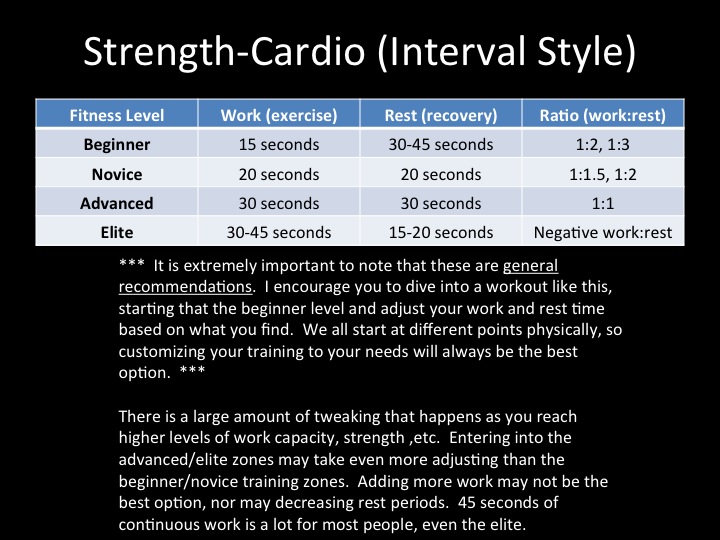
Although the amount of time designated for work and rest during a strength-cardio workout will vary depending on your fitness and skill level, you should be able to find a sweet spot for yourself.

Here is a simple table to reference:

Strength Cardio Interval Training

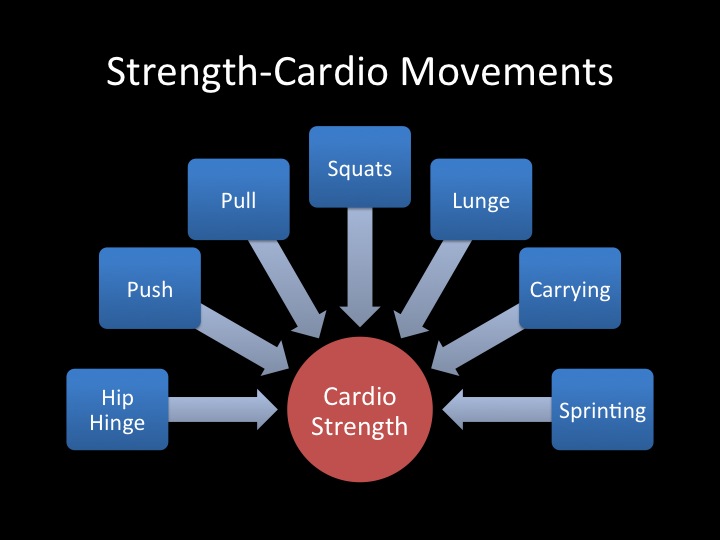
Choose from these simple movements…

Strength Cardio Movements

2)  Train on the weekends.

Nothing ground breaking here, but I just want you to start thinking about where you can fit in a training session.  The weekend usually provides some relief from the time commitments of the workweek, so look toward Saturday and Sunday for squeezing in a couple solid training sessions.  This will work wonders for your attitude as you enter into Monday and Tuesday.  You’ll have the confidence knowing that you put forth a solid physical effort that you can leverage for 24-48 hours.

I train on the weekends all of the time.  During this time, I feel no need to rush through the workout like I do during the week.  The training session becomes enjoyable.  Often times, I will spend a significant amount of time working on my mobility and addressing any muscles that feel overactive with knots.  It’s a time for training aggressively and regenerating my body.

Weekend Training Solutions

3)  Two Sessions Per Day

This might sound crazy, but incorporating two smaller training sessions into your day might provide some relief to your training efforts.  Rather than spend 60-90 minutes exercising once a day, try splitting the day into two smaller training sessions that last anywhere from 15-20 minutes.  The smaller window of time will keep you focused on moving forward throughout the workout and also motivate you to do more in less time.  Stoking your metabolism twice a day will work wonders.

Check out this recent post about that would help you coordinate a couple short training sessions:

—> Time Based Training

Having a career and committing to a life of physical fitness should be able to coexist with each other.  They have to.  Wealth without health is completely pointless, just as health without any wealth is stressful.  Find the balance that fits your situation, integrate the suggestions above and make an effort to not only maintain your body, but improve it.  Succeeding in career and physical performance will elevate your attitude and take your confidence to new heights.


Cheers to earning the $$$ and engineering a high functioning body in the process…

KG

A Time Based Bodyweight Workout for Boosting Fitness and Fat Loss

Quick Tips

Let’s face it, time is a commodity.  It’s our most precious commodity.  The clock will continue to tick no matter what we do.

I used to think that people who claimed that they “have no time to work out” were just dishing out lame excuses.  I might be conditioned though.  I have heard this time and time again from people who ask me for fitness advice.  Once I give them a rough outline of what they need to be doing in the gym or at home workout-wise, they raise their eyebrows and throw out the “I have no time for that” card.

What did you expect?  Hahaha.  It makes me laugh every time.

Enter:  Time based training.  

What follows is a simple time based workout program that is an immediate solution for anyone leery of investing decent time in a workout or for people who are legitimately short on time (because I know that you are out there folks).  

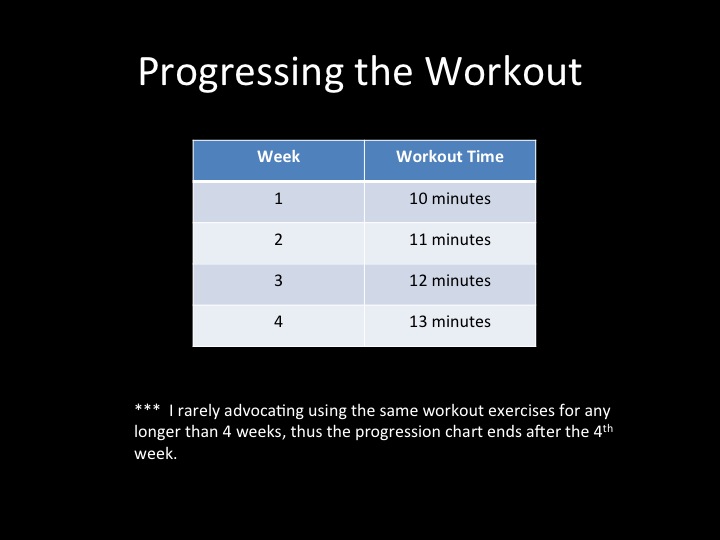
You’ll be able to progress this training plan for about four weeks while avoiding stagnation and adaptation.  The body tends to get really efficient at activities that we repetitively engage in, so don’t be silly and try to ride this program out for a year or something crazy like that.  

Building fitness demands that you constantly keep tweaking the variables.

Here you go… 

ImageImageImageImageImage


Essentially you are increasing the volume of your training sessions by adding one minute per week for four weeks straight.  I like workouts like this for beginners or advanced individuals alike because everyone can move at a pace that is appropriate to them.  Beginners can grab a breather and some water if need be, and advanced trainees can whiz through at break neck pace to get their training effect from the workout.

Best of all?  You can do this type of workout anywhere.  

Worst of all?  No pulling and no hip hinging movements.  Without equipment, it’s really hard to work upper body pulling movements into a workout.  Suspension trainers like the Jungle Gym XT really help this issue.  

Hip hinging is the motion you’d make if you were butt bumping a car door shut.  You’re hinging at your hips.  Without weight, it’s hard to train this movement pattern, which really sucks because hip hinging is one of the most beneficial movement patterns that we humans can train.  

You’ll find that every style of training sacrifices something.  Nothing is perfect.  

The key with short workouts like this is leveraging the training effect of the session.  Short training sessions like this need to be high tempo since you are cramming a lot into short duration. 

If you’re not willing to buckle down on your eating habits, well, prepare to be awfully disappointed by every workout program ever created.  Physical activity is a supplement to eating food worthy of fat loss.  The changes that take place post-workout are just as important if not more important than what takes place during the workout.

Sure, you can reduce body fat and increase performance without any dietary intervention (yes it is possible), but you’ll sell yourself short in the long run.  Sooner or later you’ll reach a plateau.  Eating crap food and training like a crazy person only gives off the perception of health.  Food is the key to the body aesthetic universe and long-term health and wellness. 

Any honest personal trainer or fitness advocate in the world will tell you that nutrition makes up the bulk of the foundation of any athletic or fit-looking body.  We cannot train hard enough or long enough to offset poor eating habits.  Unless you are an Iron Man athlete, in which case you are training for 3-5+ hours per day, almost daily and you have no real world career other than your sport.

Less than 1% of us fit that description, so lets just be big boys and girls and eat nutrient rich foods.  Ok?  Make the food that enters your pie hole primarily veggies and plants mixed with some animal protein and nuts.  Perfect little diet solution that will work wonders.

Plus, it would be so stressful to think about having to workout so ridiculously hard to combat all of the junk food eaten.  

If the food grew from the earth or has a mother, eat it. That’s your checklist to decipher through the food trickery that has saturated our restaurants and supermarkets.  

Rock this workout plan for at least 2 weeks.  Training for any period of time shorter than that isn’t even worth lacing up your shoes for the first training session, and it really shows that you aren’t prioritizing to make some changes.  Stay committed and trust yourself and your program.  

All in good time.


Cheers to leveraging our body’s natural ability to burn fat…


Kyle

Minimalist Fat Loss Training Kicks Ass

Quick Tips

I love working out on the cheap, particularly minimalist fat loss style training that is highly metabolically demanding using short, intense, SAFE workouts.

I can warm up, workout and cool-down in a matter of 30-40 minutes on most days.

Sure, some days are shorter or longer in duration, but in general, it’s about a 30 minute time frame that I need to finish a high quality training session.

Over the years, my views on training have changed quite a bit.  I think it’s been a healthy shift in methods and ideas for me.  There will always be the staple principles of fitness that I may never let go of, but to remain stubborn to the idea of change is career and physical development suicide.  You’ll get what you always got if you do what you always did.  Change can be brutally painful, but sometimes it is necessary.

I’d like to take a few minutes to chat about minimalist fat loss training means to me.

There are two perceptions that people tend to have about working out:

1)  You need a gym membership and expensive equipment (maybe a trainer)

2)  You don’t need any equipment and can get it done at home with no equipment.

Flat out, #1 is false.  I actually despise the gym these days.  Why?  Because I hate waiting for equipment and it hinders my workouts because of it.  I also can’t handle the amount of questions I get when working through a set of Turkish Get Ups.

You can take the most cleverly designed fat loss program on the planet, and if you cannot execute it according to how the author originally designed it, you’ve already effected the results that you’ll receive from any amount of effort that you put in.

Programs are written the way they are for a reason.  If the rest periods say 30 sec between movements, then it needs to be 30 seconds between movements.  What happens when you finish your round of chin-ups, rest for 30 seconds, then you need that ever popular pair of 50lb dumbbells that some guy -who spends more time talking than working out- hogs for 20 minutes while he discusses last Sunday’s NFL results.

If you have ever been in a gym in your life, you have inevitably run into this.  It’s a major headache.

In a nutshell, that was reason enough for me to start training at home (among other things).

AT HOME, I NEVER WAIT FOR EQUIPMENT WHICH HAS ALLOWED ME TO EXECUTE MY WORKOUTS EXACTLY AS THEY ARE DESIGNED.  PRICELESS.

As for #2, I think this is an extreme view-point also.  The minimalist footwear running craze swept the nation a while back, people traded cushioned full support shoes for un-cushioned minimal support footwear, or even barefoot in some instances.  Some people benefited, some found themselves crippled over time from the adjustment.  Attempting to pound the pavement for the same mileage while going cold turkey on footwear caused an extreme overload for the feet.

I share this story because I feel that the minimalist running craze has a relationship to the idea that you need ZERO equipment to burn fat.  While I agree that there are great bodyweight fat loss programs available on the market today, I will also caution you that bodyweight training is JUST A TOOL.  You could train bodyweight style for the rest of your life, but honestly, what fun is that?

On the performance and progression side of things, how much fun could it possibly be to perform 200 push ups and 200 squats and 200 lunges and 200 burpees 4 days a week just to get some kind of training effect?  Good for you for putting up those kinds of numbers, but man o man is that boring!  Lack of variety will hurt your desire to WANT to exercises over time.  No one looks forward to something that is boring.  You’ll start avoiding the daily training session like the plague because you know that it will be boring.

Also, keep in mind that the body adapts quickly and you have got to add load at some point.  Angles and variations are great, but you have got to add load.  If bodyweight training is your end game, your last stop, you may find yourself disappointed in your results sooner than later.

Minimalist fat loss training means maximizing workout/program design with the equipment that you have available to you.  Give me one kettlebell and I can bury myself in a brutal training session.  Give me a suspension trainer or rings, I can do the same with that.  I encourage the purchase of simple equipment.  I highly encourage building a simple gym.  It’s inexpensive and can provide years and years of high quality training in the comfort of your own home.

So, after that long scenario…  Let’s ask a simple question…

What equipment should a newbie to home training have on hand???

1)  Suspension Trainer ($100)

2)  Kettlebell of a challenging weight ($65-$100)

3)  Interval Timer (Free-$20)

I am going to beat this equipment concept into the ground on this blog, so strap in for that.  It will come up time and time again until I feel I no longer have nothing more to say about building a quality home gym.

If you own a treadmill, elliptical or universal home gym, sell that crap on Craigslist and purchase the equipment I listed above, 1 through 3, with money you receive from your sale.  I am serious here.

If you own a gym membership, consider canceling it.  Money, time and travel are great reasons to cancel it.  On the low end, your membership will probably cost you around $300-$400 a year, which will buy you a bunch of home training equipment that will accelerate the fat loss beyond what you ever get out of being a member to a commercial big box gym.

IMG_0562

Suspension trainers are such a dynamic piece of fitness equipment, it is hard not to encourage the purchase of one.  A suspension trainer should be strung up from the ceiling in every single home in America.  Well, at least the homes of those who have aspirations of getting fit. The suspension trainer is a logical step up from simple ground based bodyweight training, with endless variations of movements and the angles of those movements, they really are a revolutionary training device.  It’s amazing the amount of uses you’ll find for a suspension trainer once you have a suspension trainer as a resource.

Image

Kettlebells weight, resistance, external load.  I don’t care what you choose to refer to a kettlebell as.  A kettlebell in the arsenal means the opportunity to build strength and power. Strength and power are the new modern day language for “skinny”.  Strength doesn’t mean bodybuilder-like bulk, it means strength.  Don’t confuse the two.  Kettlebells provide the opportunity for free-flowing 3-dimensional movement.  Functional strength is desirable strength.  Also, who could pass up the opportunity to integrate high-powered moves like kettlebell swings, snatches, presses and the almighty Turkish Get-Up in one’s program.

Assuming you properly educate yourself on how to execute these movements, you’ll feel great and look great.  I love kettlebells not because they are kettlebells and they are a trendy piece of fitness equipment right now, but because of  the number of doors that open once you adopt them into your training regimen.  Very unique piece of fitness equipment.

Gymboss Interval Timer

Interval Timer.  An interval timer should be called an “honest timer”.  Just as people grossly under-estimate the amount and quality of food that they consume daily/weekly, so do they grossly air ball on the amount of time spent resting between exercises.  The first time that you work through an entire training session paying strict attention to your rest periods, you’ll realize that you have been slacking on that front.  The “honest timer” keeps you focused on your training.  There are multiple FREE online interval timers… just type free online interval timer into Google and you’re golden.  If you want a portable timer, I HIGHLY HIGHLY HIGHLY recommend the Gym Boss.  Simplicity and effectiveness of monitoring your work sets and rest periods for what should be a one time fee of $20.

Like I said, I am going to ignite a home training movement.  People are already promoting it and have been for years, but I am going to perfect it.  The benefits outweigh any possible negatives.

Soon, I will be posting a “Day Old Workout” series and I want you all to follow along.  I practice what I preach and I would never ask you to do something that I haven’t already done. Period. End of story.


2013 is the year of connecting with people for me, so let’s do this.


Cheers from “Party Central USA” Eau Claire, WI,


KG

Single Device Workouts for Indirect Core Training

Kettlebell Training

I love training one tool at a time.

The stress that it places on the body to maintain posture during movement is priceless to me.

Sure, you’ll sacrifice the amount of weight that you’re able to use for the movement(s), but you’ll sacrifice something with every training method that you choose.

Single device training could be born out of necessity not having enough equipment or from a simple desire to breathe some fresh air into a stale program.

Staleness sucks.  You’ll stop training when things get stale.  The workout will feel like a chore more than a chance to challenge and better yourself.  Stale is boring.

For me, I started single device training with dumbbells and medicine balls first.  I was traveling and wanted to get a workout but the equipment in the hotel was lacking so I had to improvise to get some kind of respectable training effect.

Working out with one dumbbell at a time is effective in that you can use a weight that is challenging and most people are familiar with using dumbbells as a training tool.

However, since I am deeply in love with kettlebells- their flow and versatility I now prefer KB’s to DB’s (that’s kettlebells to dumbbells by the way).

The flow of a kettlebell is unmatched. I can’t say enough about it.  Especially when you start working in single device training sessions, you’ll find that being able to flow from one exercise to the other seamlessly provides a much more enjoyable experience.

Here is an example of an improvised single device complex that I threw together.


***Remember, a complex involves 4-8 exercises grouped together without rest between movements.  Complexes are metabolically demanding and probably not suited for beginners, although there are progressions that beginners can work through to get to a true no rest complex.  It just takes time, like everything else.

Progression is everything.  Don’t skip the basics.

You’ll notice in the title of this post I wrote “… for Indirect Core Training”.  I mean that.  Anytime you load one side of the body and not the other, you’ll find that the unloaded side’s musculature contract aggressively and goes into overdrive to maintain posture.  If you’re paying attention to your exercise technique during a uni-laterally (fancy term for one/single sided) loaded movement, you’re going to have to work harder to maintain a normal posture against those uneven forces.  Your torso musculature will light up like a Christmas tree, naturally.  No need for direct core work here.

I love it.

Even just pressing a dumbbell or a kettlebell over head one side at a time delivers such a unique training stimulus.  You’ll be sore in places you’re typically never sore, assuming that you are fighting to maintain that perfect posture.  When that happens, just understand that it happened because you loaded your body unevenly.

We tend to train everything with both legs or arms mirroring each other, so breaking out of the norm and going single arm or single leg is a great training tactic for the body.

Cheers from the great city of Eau Claire, WI…

KG

Completely Un-Organized Kettlebell Training for Fat Loss and Athletic-Like Conditioning: Part 2

Quick Tips

Part 1, if you made it through that novel, was me thinking out loud about systems.  Part 2, right here, is what I actually did to spark that post.

Here we go…

Using my trusty jump rope, I started the training session with a 10 minute jump session.  I always start slow with two-foot jumps and work into more progressive drills like running, single foot, etc.  I keep the rope moving continuously, only stopping to change a shitty song, scratch or grab a swig of water.

Last night, this is where the un-organized part comes in.  In the kettlebell training world, there is a world-famous tough guy test called the “SSST”.  The “SSST” stands for “Secret Service Snatch Test”.  Initially, I thought it was another gimmick workout but I later learned that there was actually a story behind it.  Interesting.

So, here is what the SSST entails:

  • Perform as many snatches as possible in 10 minutes using a 24kg (53lb) kettlebell.
  • Record your score while trying to hold your lungs and eyeballs from shooting out.

That’s it.  

My best score with the SSST is 226 repetitions respecting the perimeters of the test bulleted above.   

I haven’t attempted a full SSST for about 2 years, and I would like to think that I could get 250 reps in the 10 minute time frame.  Who knows.  I tend to not have a governor when it comes to pursuing competitive type stuff.  All or nothing.  

The kettlebell snatch is a technical move just like the dumbbell snatch, so there is a method to the madness.  Grip, arc of the bell, hip snap, etc… all make a HUGE difference in your numbers.  The first time I tried the SSST I ripped all of the skin off of both of my palms.  It’s important to note that a “rep” in the SSST is counted only if the elbow is locked out overhead.  

Back to last night…  

Initially, last night was scheduled to be a recovery style training session because of the intensity of the previous day’s workout.  Typically I would just jump rope and bike while keep my heart rate in specific BPM zones, then call it a day.  Nope, I decided to try something different.  I decided that I would mess around with mini-circuits using my kettlebells.

Here is what I did:

5 minutes each of:

1)  Kettlebell snatches (alternating hands every 10 reps)

2)  2-Hand Kettlebell swings (30 reps then rest until ready)

3)  Intense jump rope (not sure of the revolutions per minute)

Done.

For the snatches, I completed 110 repetitions and for the swings I completed 120 repetitions.  My heart rate stayed where I wanted it and I felt great during the session.  The jump rope at the end was a bear.  

All in all, the workout lasted about 30 minutes, which was perfect because that is roughly how long I would have biked for had I gone that route.  

Soreness today was not bad and overall the workout was a success.  

Is it possible to train improvised in every session?  Of course, but I am still not convinced that it is superior to an organized, progressive training system.  Attempting to train too many qualities at once seems to make a person “average” in all of those qualities.  However, for fat loss efforts and general athletic-conditioning, I think training sporadic will work just fine assuming you are using big movements with solid technique and load.  

Again, at this point I would look to stay within a system.

Also, be realistic about the SSST.  If you aren’t qualified to be snatching a kettlebell, don’t attempt the SSST.  Honestly, this is high level stuff.  I don’t mean to make myself or anyone else sound superior in any way, but injury prevention is important to me.  Snatching a 53lb kettlebell for 10 minutes straight is not for the average person.  Don’t be a hero.  If you don’t have the technique or the conditioning, stay away from it.  Building your technique, strength and conditioning and then give it a go when you are capable.  Make sure your hands are prepared, you won’t want to grab your steering wheel for a week if you don’t rough those hands up first.  


Cheers to the improvised workout…


KG

Completely Un-Organized Kettlebell Training For Fat Loss and Athlete-Like Conditioning: Part 1

Quick Tips

I am a huge believer in following a system.  Sticking to the game plan if you will.

There is nothing like a well executed game plan.  If you have ever played sports you know what I am referring to.  If you are fortunate enough to have a career with an employer (or as an entrepreneur) that preaches game plan for success and then the entire company comes together and follows through on executing it, well, it feels damn good.  

Sticking to your systems is the best way to measure your progress.  A system can tell you where you have been and also points you in a focused direction of where you are going.  For a beginner or even a novice aspiring to reach new levels of health and wellness, there is nothing more effective at creating change than executing a system to perfection.  

I love systems.  Did I say that already? 

But let me ask you something that I often think about in my own life…

  • What’s wrong with being sporadic about your exercise selection, sets, reps, interval length, rest periods, etc?
  • Does everything have to follow a set system?
  • Can I still maintain strength and conditioning levels and leanness improvising workouts?

I know those seem like a silly questions, some that most people will never think about, but after you make so many visits to the gym, work through workout after workout following a set progression to an end goal, systems get boring.  

Once I took a step back to get a deeper understanding of how and why we humans move, what our movement options were once we choose to train movement and what seemed to be the most effective at creating total body change… I realized that building high functioning lean bodies can be achieved in a completely un-organized way.  System-less if you will.  Cross-Fit does it in every single workout.  Besides following their two days on, 1 day off (rinse and repeat) training schedule, they seem to be building some pretty resilient humans.  I can’t say that I agree with everything that they are teaching and coaching, but the system-less approach seems to work pretty well for them.

If I can ever focus long and hard enough to put the final touches my books (they are coming I promise), you’ll find that I love simple advice.  Once you become more than a recreational exerciser and decide to invest time in learning about more serious forms of fitness and nutrition, topics can get really complicated, confusing and blurry.  The fitness and health pool is really deep.  There is a lot of conflicting advice, methods and even research.  

But it doesn’t have to be complicated, confusing and blurry.  At least I don’t think it does personally.

I spent years (and still do) reading heavy literature for no other reason than I enjoy reading it. I have a major chip on my shoulder from years and years of personal athletic endeavors that had no real guidance in strength and conditioning.  I didn’t know what a power clean was until Senior year of high school.  That sucks, because I no know what a dramatic difference a simple program can make a young athlete.  It’s incredible.

Sorry, sidetracked for a second there… Where was I?

Oh, I know…  I was just about to finish discussing the title of this post.

I love systems and I love simple training and eating advice.  Give me the meat and potatoes of what I need to know and I can figure the rest out as we move forward.  “Learn by doing” kind of thing.

I have also found that I love the concept of physical preparedness and completely un-organized kettlebell training.  I love heading to the basement, drawing up the workout based on my goals, and getting after it.  Sometimes there is good flow to the training session and sometimes it is full of sticking points, causing a much choppier workout.  Either way, I really never know what I am going to be doing until I get down there.  

However, that being said… I do stick to some key guidelines that help me get away with this un-systematized approach.  Here they are:

1)  Train big movements with challenging resistance

2)  Multi-planar core training

3)  Mobility Mobility Mobility

4)  Conditioning using many different methods

5)  Rest and recover harder than I workout


1)  When I say big movements, I am talking things like squats, kettlebell swings, snatches, presses, pulls, etc.  Stop messing around with tricep extensions and bicep curls, you have to eat your main course before you can have dessert.  

2)  I train my torso region in all directions and planes of movement.  I train my core for force production and force absorption.  I train my core to reinforce stability I can transfer as much force with any energy leaks from my lower extremity to my upper extremity.  

3)  Mobility.  I train mobility so that I can experience life as it should be experienced physically.  Loss of mobility is a prerequisite to pain through faulty movement  Loss of mobility is loss of life to me.  

4)  I condition myself with as many methods as I have resources.  When I was an athlete, I conditioned myself using set methods.  Running early in the off-season, slide boarding and then biking as the season drew closer.  It was scheduled and systematic because that was what my sport (hockey) demanded.  It made sense.  But, now I don’t have a sport.  I simply want to be physically prepared for anything.  It feels damn good to go for a 50 mile bike ride, run a 10k or play hockey 3-4 nights a week without feeling like a slug.  I use many methods to achieve both aerobic and anaerobic-like qualities.  I want to be able to endure long duration activities as much as short burst activities that get my heart rate sky high.

5)  I rest and recover much harder than I train.  Sleep, tissue work, hydration and nutrition are all important to me.  I am what I eat, drink and how I recover from my training sessions.  The green light isn’t always on.  You have to learn how to sit at the red light patiently until it is time to accelerate once again.  Rest, recovery and regeneration.  

Do you see what I am getting at?

I can train myself using a simple set of rules to keep myself lean and athletic, without experiencing the boredom of a system.  Training smart and slightly sporadic will keep me athletic for the rest of my life.  Sure, age will catch up with me as it does everybody at some point, but each training session will be fresh and purposeful.  Movement longevity is something that I am fully invested in, and I encourage you do invest in the same. 

I will say this however, I HIGHLY recommend systems to everyone.  You’ll never get better results as you will when following a system step by step.  My books leverage systems.  Systems get results.  They keep the main thing… the main thing.  Following a system takes discipline, and discipline is something worth developing throughout life.

I treat myself like test rat for variations of time tested methods.  I enjoy seeing if my 5-mile Airdyne ride for time improves or suffers after I train high repetition kettlebell snatches for 3-weeks versus metabolic body-weight circuits.  That kind of comparison scenario is interesting to me, but it isn’t for everyone.

(Any strength coach that reads this is going to grind their teeth)


Cheers to moving more and with purpose,


KG 


Red Table Round Table #1

Quick Tips

Good Saturday morning from the little Red Table in Eau Claire, Wisconsin.

Part of the fun of keeping a blog is being able to write whatever you want, whenever you want to write it.  It’s your own personal space to release thoughts and ideas on this massive beast we call the Internet.  That is a pretty cool thing.

I decided that I really wanted to develop a blog posting series where I could just discuss whatever topics happened to come to mind during that writing session.  

Basically, I am talking about just putting my fingers on the keyboard and having at it.  

Creatively, I think this will help me regurgitate some of the interactions, questions and experiences that I had from the previous week.  

A recap of sorts from the past week.

Here we go…


—> Fat loss isn’t an ongoing process, it ends eventually<—

The concept of losing fat has to end at some point.  You cannot forever be in “fat loss” mode with your training and your eating.  You have got to have some kind of end goal to attain.  Whether you choose a certain body fat % or a performance related goal, it doesn’t much matter to me.  Although I suppose that if you are partaking in a full-fledged fat loss program you should probably be measuring the amount of fat you lose.  Skin calipers are a simple and relatively effective way to do this, otherwise hydro-static weighing or a BodPod will give some fairly accurate numbers also.

I was talking with my girlfriend Amanda about the whole concept of fat loss.  I told her that in my experience, sometimes people end up taking the fat loss concept to the extreme.  They literally attempt to walk around with 0% body fat.  They engage in extreme eating habits (calorie restriction and the like) and sign up for extreme workouts.  It becomes just as addictive as eating sugar or smoking cigarettes.  

At some point, you have to realize that you are going to enter a maintenance phase.  You’ve reached  your goals and you’re content with your body figure and your physical abilities and now you’re in what we call:  Maintenance. 

Fat loss ends at some point and maintenance begins.  You decide when that happens.  

Fat loss is a war and it is a lot more mental than physical in my opinion.  Habits need to be broken and new habits need to be hardwired.  Mentally you’ve got to prepare yourself for fighting off your old self-talk.  You’ve also got to get your head in the right place to endure your training schedule.  Physically, the human body is incredibly resilient.  You can handle a lot more physical stress than you think.  (Just keep it manageable physical stress)


I often go back and forth between favoring two approaches fat loss, and I think both depend on the personality of the person.  

Here they are:

  • Aggressive training and eating for 4-6 weeks, followed by a tapering process.
  • A consistent, not overly aggressive effective training regimen paired with a smooth transition into concepts of clean eating.


The first bullet point is an approach that is my definition of a fat loss war.  It’s pedal to the metal. You go crazy in your training and you stay brutally strict with your diet.  You get results quickly and then you turn back the dial a bit and continue pushing on at an effective yet much more manageable pace with regard to training and nutrition.  

The second bullet point is an approach that is quite popular also.  This is the “lifestyle” approach.  I am sure you’ve heard that a million times… “It’s not a diet… it’s a lifestyle”.  Puke.  

Anyways, this approach is a gradual climb.  There is a lot of acclimation to this approach.  I enjoy this approach to losing fat because fat loss is inevitably going to happen if you are eating clean and training purposefully.  I love the research and the highly technical information that the experts put out, but they complicate topics in an effort to sell products.

Eat clean and drink water, learn how to lift weight using big movements, ramp up your cardiovascular training from aerobic to higher effort intervals, then move into a more cardio-strength style training regimen and you’re going to experience a reduction in overall bodyfat.  

Measure your fat loss progress on the cheap.  Use a snug fitting pair of jeans and a tighter fitting shirt to gauge your progress.  Remember, you’re after fat loss and lean tissue gain… not weight loss. (I lose up to 3-5lbs just from sleeping, it doesn’t tell me anything useful).

 —> Again, I encourage you all to set your sights a goal.  A goal is a target.  Once you have the target, set the timeline.  Once you have the timeline, you can assess what kind of effort is required to achieve that goal in that timeline.  It’s simple.  We over-complicate what should be simple.   


Cheers to keeping it simple…


KG