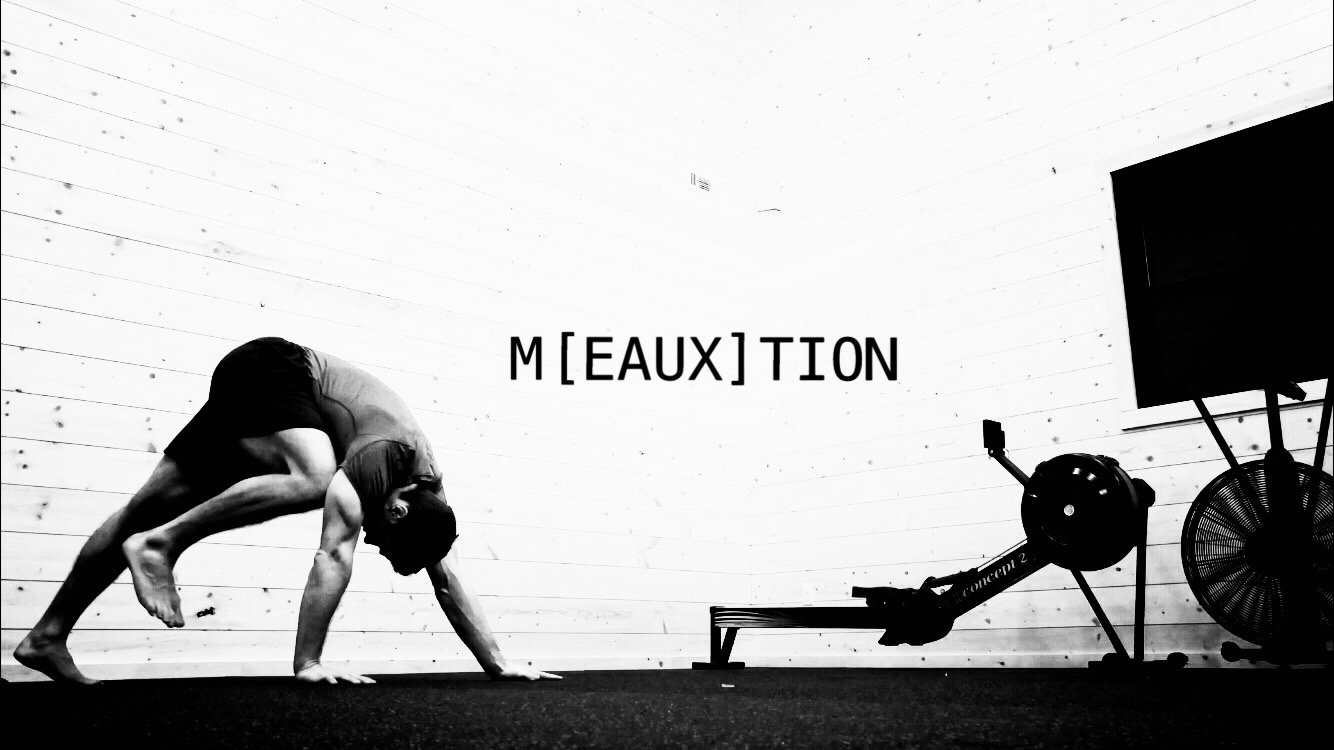
How to Warm Up Before a Home Workout (Video)

Quick Tips

Below is a sample of what a warm up looks like for me prior to a training session.

The only awkward moment comes when I attempt to stay on the rubber matting while performing forward, backward and side to side gorilla hops.  Hey, I’m human, shit happens.  This isn’t Hollywood produced, it’s real world home training.  Film it like it happens, right?

The important thing to remember is that you should always maximize the equipment, time and space that you have available to you.  You can always get way more accomplished with what you have than you originally thought.

I have really come to enjoy integrating animal style movements in the warm up, as it demands rhythm, stability and mobility to accomplish the moves.  Plus it isn’t boring, which is important for keeping your movement endeavors interesting and sustainable.


After you watched some of the video, it’s important to understand a couple of things:

1)  I only foam roll problem areas (trigger points, stiff muscles, overactive muscles)

2)  I only address mobility in areas that I lack it.

3)  The dynamic movement prep is mostly total body.

4)  Jumping rope serves to increase blood flow, core temperature and gets me sweating.

The point is that there is no time wasted and everything has a purpose.  My body is prepped for the transition into the physical demands of the workout.

My workout for this day was highly metabolic, which is how I have been training for quite some time now.  All workouts are designed mindfully and not intended to destroy my body, but rather build and condition it intelligently.  I completed all of the exercises below without rest between movements in a 15 minute timeframe (I was tight on time):

Metabolic Strength Training


I have used workouts like this successfully for over 5 years now.  The loads and exercises are appropriate for my skill and fitness level.  To be completely honest, the less complicated you make a session like this, the more fun you will have.  I rarely stray from the basic movement patterns: push ups, vertical pulling, squats, kb swings, etc.

I am after the training effect, not a circus-like performance.  The risk doesn’t always match the reward with complex movements.  It usually looks great on paper and sucks in practice.

For the time invested, I haven’t found any other style of training that keeps me lean and functional for the time invested.  The trade-off for time reduction is an increase in intensity.  This isn’t for beginner or the weak of heart.  You’ll be tired at the end.

It’s a great blend of work capacity and strength movements that demand full range of motion and attention to technique.  Of course, you can increase the difficulty of a workout like this or make it slightly easier if need be.  Progression is always the answer.


Cheers to making less excuses and  taking more action…


KG


My Hero: Gray Cook + Movement Pattern Stretching/Mobility

How-To, Injury Prevention

Gray Cook is an icon in the movement and physical therapy realm.

Quite honestly, he is one of my heroes and has been since I first pick up his book “Athletic Body in Balance”.

Gray sees things years before they are fully adopted by the mainstream.  His landmark body of work, The Functional Movement Screen is the best assessment system being used in gyms across the world.

Movement pattern training is here to stay, and will be the future of quality movement and performance for years to come.  It really is landmark work.

As I often mention on a couple of my Facebook pages related to personal growth and success, it is so important to submerge yourself into networks of people who make you feel uncomfortable.  This feeling of being uncomfortable often causes an acceleration in positive change in your own life.  It motivates a person to be better at what they do.  I feel this way whenever I read Gray Cook’s work.

I would say that a lot of professionals feel this when they read or watch Gray speak.  He is on another level when it comes to professionalism and pioneering methods for improving or assessing human movement.  He really is world-class.

Let’s get into it…


Mobility in the thoracic spine…

The thoracic spine needs mobility.  It needs mobility in all three planes of movement, and is often one of the main culprits for influencing poor movement.  When the T-Spine’s mobility is limited, other areas of the body begin to pick up the slack and move.  This is rarely a good thing.  Think low back pain here.  The lumbar spine (lower spine) begins to over-compensate due to the lack of mobility in the T-Spine.  Shoulder range of motion goes to hell and then everything snow balls.

Just like smoking increases your risk of lung cancer, inadequate mid-spine mobility increases your risk of injury.  It’s a slow death in a lot of cases.  It may not be a situation where injury happens over night, but rather a cascade of events that lead to the grand explosion.  Your body will inevitably reach it’s breaking point and then…  boom.  Injury.

Everyone could use a little more thoracic mobility it seems.  This is a generalized statement, but we often see more people will thoracic restrictions than we do people with adequate motion at the T-Spine.  Another generalization, but sitting is toxic to spine health, especially core activation and T-Spine mobility.  Keeping a crunched posture all day leaves does little for your movement quality.

Take a proactive approach to regaining some motion.  Your body will thank you for it.


A quick word about joints…

The joint by joint approach is still methodology that I follow.  I think that the thought process of acknowledging that some joints in the body need stability and some need mobility is genius.  Obviously, this is a simplification, but simple is effect.  Simple can get results because we are avoiding the ever common over-complication of things.

In my experience, when things get complicated, little to no action is typically taken.  But when things are clear-cut and made simple, there is little confusion as to what needs to get done to see results.  This is what the joint by joint approach means to me.  Simple and effective.

So, in my continual effort to avoid re-inventing the wheel, I give you an extremely valuable video of Gray Cook teaching and explaining the Brettzel and the Brettzel 2.0.  I always figure that if someone else can say it better than I can, all credit to that person.  Whatever gives my reading audience the greatest return is the route that I will take every single time.

Here are two fantastic movements for not just improving thoracic spine mobility, but movement pattern range of motion.


Watch the video a few times and follow along.  I can assure you that you will get something out of these drills should you be diligent about implementing them.