A Self-Limiting Barrier to Fat Loss and Performance: “If I Had ________ Than I Would Definitely _________ ” Syndrome

Quick Tips

Image

This will probably be the easiest post that I ever compose on this blog.

The idea is clear and I think that most of us can relate to it, at least at some point in our lives.  Heck, maybe we feel this on a daily basis.

It’s a common barrier to fat loss and performance.  

As the title of the blog shows, “If I had ____ I would definitely be _____” is a self-inflicted syndrome.  

Some common examples go like this:

  • If I had more time to workout, I would definitely be in better shape.
  • If I had a membership to that new gym on the other side of town, I would definitely be in better shape.
  • If I had more money to go 100% organic with all of my food, I would definitely be able to see my abs.  
  • If I had more equipment at my house, I could perform all of the best exercises and engage in all of the best workouts that the magazines talk about.
  • If I had more fitness apps on my iPhone, I would be able to make much greater gains in much shorter time.
  • If I had better fitness apparel, I would re-dedicate myself to my movement.
  • If I had those supplements, I would be able to drop the weight and exercise more frequently.

If I had _____ I would definitely_____” Syndrome.

It’s a syndrome brings us to our knees, cripples us, leaves us uncertain about whether our goals are worth all of the effort. 

We convince ourselves into thinking that the grass is greener on the other side, and then when we get to the other side, we realize that the grass is the exact same color.

Use exactly what you have right now, where you are at right now.

If something is worth doing, it’s always worth the effort.

Don’t get caught up in the minutiae of building health, wellness and performance.

Because there is a lot of minutiae.  If you’re a beginner, all you need to know is enough to get started.  If you’ve already started, all you need to know is enough to keep going.  

You’d be surprised at how taking a few minutes to re-examine your training options can open doors to new challenges and a refreshing movement experience.  But you have to be willing to open your eyes to all of the things that you do have going for you (time, equipment, space, a roof, mobility, etc) versus dwelling on all of the things that you don’t have.  

If you’re wondering where you can find new ideas for your training, comb over the archives of this blog.  I have been posting for a little over a year.  There are more than 150 posts to read on Range of Motion.  Bookmark it in your browser or better yet, sign up to get an update whenever I post.  

A lot of the posts on this blog contain workouts and effective exercise variations, some performed by yours truly and others I outsourced because I didn’t have the video or someone else was more effective at demonstrating.  Eat your heart out.  

One big culprit of “If I had _______ I would definitely ________” Syndrome are fitness “secrets”.  There are no secrets, there is only what you know and what you don’t know.  And you don’t know what you don’t know.  Ok?

If you’re really in an exercise slump, redirect yourself back into the movements that you avoid and hate the most.  Chances are quite high that those same movements might be the missing link in your training success.  More often than not, this advice will hold up.  That which you dread just might that which you need.  

Just a few simple thoughts on a Monday.

Go do something great today.  Go ahead, you have time.

Less thinking and more doing, and I will do the same.


Cheers to wiping “If I had ____ I would definitely ______” Syndrome off of your shoes at the front door before entering!


KG

A Glimpse of a Sample Staircase Interval Workout

Quick Tips

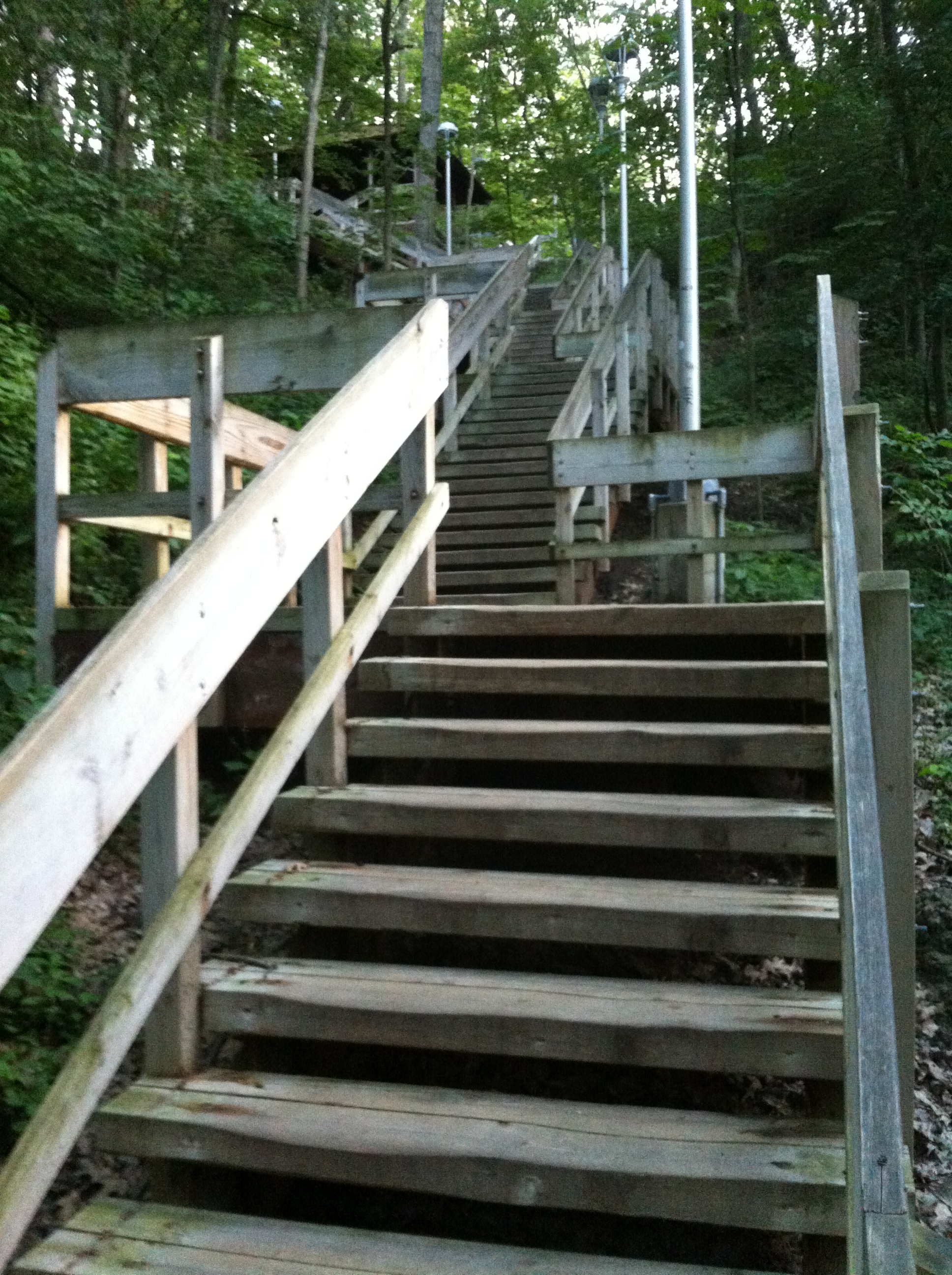
There is really nothing like sprinting up and down a long staircase.

If you’re fortunate enough to have a staircase near you that is of decent length, congrats, you’re in luck.

By decent length, I am referring to a staircase that takes about 30 seconds or longer to run up at a brisk pace.

If you’ve never treated yourself to a staircase training session, you’re going to find that running vertically is nothing like running horizontally.  Every step/stride requires brute force and attention to detail.

Why attention to detail?

Because the split second that you get lazy or lose focus on what you’re doing, you’re going to miss a step and leave shin skin on the staircase.

Staircase running requires hip extension.  You can fake to make it for a little while, but you’ll find that opening up the hips and driving “down and back” with every stride is going to get you to the top faster and with a higher efficiency.  The hips are the powerhouse of the body, so you might as well use them if you have them, right?

Besides, your quads are overworked.  Let’s build a backside.

If you are finding that you cannot comfortable achieve hip extension, I would suggest regressing and addressing these issues quickly…

Here are some videos that might help…

Thanks KStarr.

Now on to the workout…

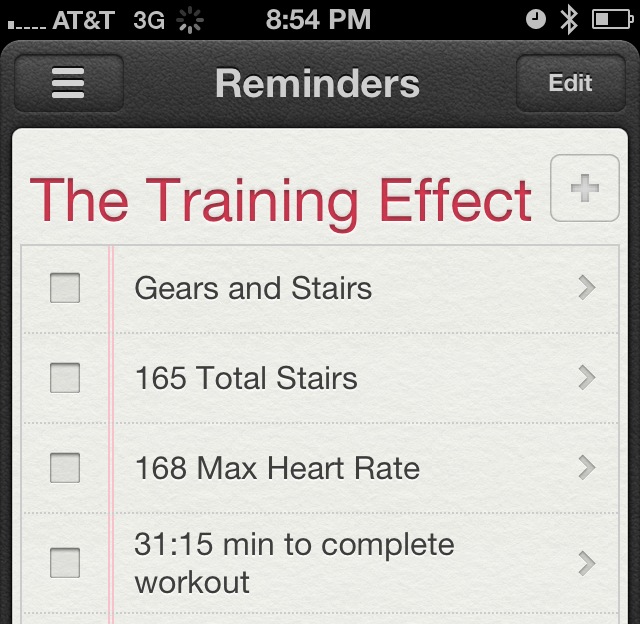
Staircase Interval Training165 glorious stairs

Staircase interval training

Total time from start to finish for this workout.

Staircase Interval Training

This is the break down of the workout.  30 minutes of work was my initial target.  I hit that.

My heart rate peaked at 168bpm, which I thought was surprising.  I thought that it would have been much higher.  I’ve seen it 175bpm while running trails.  Interesting.  I suspect that had the staircase taken me longer to run, I may have seen higher heart rates.

I have to disclose that I probably whipped through 12-13 rounds.  2 of these round were loaded up with kettlebells.  I brought my trusty 24kg LifeLine kettlebells with me for some fun carrying variations.  After looking at the length of the staircase and evaluating what I wanted from the workout, I decided that I would only use one kettlebell for these carrying drill.

I worked overhead, racked position and farmer carries, switching hands using a single arm swing hand transition + KB clean + Press.  I can explain this later, but I prefer using this method for switching hands during single kettlebell workouts.  Always loaded this way.

The general structure of the workout look like this:

  • Running the stairs took around 60 seconds (I think)
  • Rest periods were 1.5x-2x the length that it took to climb the stairs (or recovery to 130bpm)
  • Upper body focus was placed on arm action (elbow drive and hands to face) and keeping posture vertical versus slouching once fatigue set in.
  • Lower body was all about putting force into each stair and extending the hips aggressively, picture your feet as springs… explode!

Men’s Health ran an article almost a year and a half ago that I thought I would share because they included a research study out of the British Journal of Sports Medicine which concluded that stair climbing was pretty bad ass, even at relatively low output (just walking up).

Here is that article

One interesting thing to think about here.  Keep in mind that the speed with which you run the stairs is not the only quality we are aiming to build here.

We are also aiming to reduce the time it takes for you to recover, and repeat that effort.  Faster recovery is a sign of improving conditioning.

If you’re a weekend athlete or a movement enthusiast, increasing your ability to recover quickly from multiple bouts of vigorous activity is beneficial for performance and your body composition.

Runners, I would consider this an amazing supplement to improving your running endeavors.  You’re essentially lifting yourself with every stride while running a staircase, and focusing on explosive hip extension is what most of you could benefit from.  Get the hips involved people.


Cheers to training where other people aren’t…


KG