Metabolic conditioning is often shortened to “metcon.” It is a type of fitness training designed to supercharge your metabolism. This acts as the engine that burns calories in your body.
Think of your metabolism like a car engine. Like how some engines burn fuel more efficiently, metabolic conditioning helps your body become better at using energy. This means you can get stronger, faster, and leaner, all while improving how your heart and lungs work.
Let’s dive into what metabolic conditioning is. We will explore why it’s important. You’ll learn how you can do it and when it’s best to include it in your fitness routine.
What is Metabolic Conditioning?
Metabolic conditioning is a mix of high-intensity exercises. These workouts raise your heart rate using primarily resistance-based moves with little rest between exercises.
Why Do Metabolic Conditioning?
1. Burns more calories. Even after you stop, your body keeps burning calories at a higher rate. This is great for losing weight or staying lean.
2. Improves endurance. Regular metcon training makes your heart and lungs work better together. So, you can do activities like running, swimming, or biking longer without getting as tired.
3. Builds strength and muscle. Lifting weights or doing bodyweight exercises makes you stronger. It also builds muscle. This helps your body burn more calories even when you’re not working out.
4. Time-efficient. This is because they’re so intense. This means you can get a great workout in a shorter amount of time.
How to Do Metabolic Conditioning
Metabolic conditioning workouts usually combine strength training exercises with cardio exercises. For example, a circuit. It includes push-ups, squats, jumping jacks, and mountain climbers. You move from one exercise to the next with little rest. The key is to pick exercises that target different parts of your body. You should do them at a high intensity.
Here are some tips:
Start Slow. If you’re new to metcon, start with simpler exercises and shorter workouts. You can add more challenging exercises and longer circuits as you get stronger.
Keep it varied. Mix up your exercises to stay interested and to work different muscles.
Listen to Your Body. Metcon is intense, so it’s important to rest when necessary and not push yourself too fast.
When to Do Metabolic Conditioning
How often you include metcon workouts in your week depends on your goals and fitness level, but 2-3 times a week is a good starting point for most people. Make sure to have rest days between to let your body recover.
A sample training week could look like this:
Monday: MetCon
Tuesday: Mobility + Zone 2 Cardio
Wednesday: MetCon
Thursday: Rest Day
Friday: MetCon
Saturday: Mobility + Zone 2 Cardio
Sunday: Rest Day
Metabolic conditioning workouts are great for people with busy schedules. They can be performed in 20-30 minutes from start to finish. The higher intensity part of the workout lasts 10-15 minutes.
Final Thoughts
Metabolic conditioning is a powerful way to boost your fitness by improving how your body uses energy. It helps you burn more calories, build muscle, and increase your endurance, all in a time-efficient way.
Adding metcon workouts to your routine can help you achieve many fitness goals. They also keep your workouts fun and hard. Remember to start slow, keep it varied, and listen to your body to get the most out of your metabolic conditioning sessions.
Kettlebell swings are a dynamic exercise that’s been proven to be a powerful tool for weight loss, especially when shedding unwanted fat. Kettlebell swings are a highly effective exercise for fat loss due to their high calorie burn, total body workout, cardiovascular benefits, functional movement, and low-impact nature.
This blog post will examine why kettlebell swings are one of the best exercises for fat loss and explore the science behind their effectiveness.
First, let’s define what kettlebell swings are. I won’t assume everyone reading this has been swinging kettlebells for years. Here’s what swings look like. My YouTube and Instagram have tons of clips of me swinging.
Kettlebell swings are a ballistic exercise that involves swinging a weighted ball-shaped object, known as a kettlebell, between your legs and up to shoulder height. This movement engages your glutes, hamstrings, quads, core, and back muscles.
So why are kettlebell swings the best exercise for fat loss?
High Calorie Burn
Kettlebell swings require significant energy output and have been shown to burn a lot of calories quickly. Studies have shown that kettlebell swings can burn up to 20 calories per minute, making them one of the most effective exercises for fat loss.
Total Body Workout
Kettlebell swings exercise an extraordinary number of muscle groups simultaneously, including the legs, glutes, core, and back. This full-body workout is ideal for increasing strength and conditioning and promoting fat loss.
Improved Cardiovascular Health
Kettlebell swings are a high-intensity exercise that gets your heart rate up quickly. This type of cardiovascular training has been shown in studies to improve heart health, boost metabolism, and increase fat burning.
Functional Movement
Kettlebell swings mimic (and enhance) many daily movements, such as lifting and carrying heavy objects. This functional movement pattern helps improve overall fitness and enhances our ability to perform daily activities efficiently.
Improve Maximal and Explosive Strength
Kettlebell swings are a powerful exercise for building muscle and improving overall fitness. The explosive nature of the movement requires a significant amount of force to be generated by the lower body muscles, making it an effective way to improve strength and power.
The study “Kettlebell swing training improves maximal and explosive strength” was published in the Journal of Strength and Conditioning Research in 2014. The study investigated the effects of kettlebell swing training on maximal and explosive strength in the lower body. The participants were 16 recreationally active men and women randomly assigned to either a kettlebell swing training or a control group.
The kettlebell swing group trained with kettlebell swings twice a week for six weeks, while the control group did not perform any resistance training during the study period. The kettlebell swing training program consisted of three sets of 20 kettlebell swings with moderate weight.
After six weeks of training, the kettlebell swing group showed significant improvements in maximal and explosive strength in the lower body compared to the control group. The researchers concluded that kettlebell swing training effectively improves lower body strength and power output.
Low Impact Exercise
Kettlebell swings are a low-impact exercise, which means they put less stress on your joints and muscles compared to high-impact activities like running. This makes swings an excellent option for individuals looking to lose weight but may have joint or mobility issues.
How Many Kettlebell Swings Should I do?
Most people will see fantastic results (after about 4 weeks) from performing 75-150 repetitions of kettlebell swings in a single workout, 2-3 days per week. The sensible approach for beginners is to start with lower repetitions an
Over time, the swing volume can increase by adding repetitions to each work set, or by adding an additional work set.
3-5 sets of 5-8 throws per side (ideally early in the workout the body is fresh).
32.Chops and Lifts
Chops and Lifts are two simple (not easy) exercises that most people will find they:
a) struggle to execute on either side (even with lightweight).
b) can only successfully do on one side, not the other (even with lightweight)
There are many different positions to perform Chops and Lifts in, but the inline position is one of the most humbling.
Assume a half-kneeling position (one knee down, one knee up).
Place the down knee directly behind the heel of the up leg.So, make a straight line with your up and down legs.
Chopping or Lifting once in this position is dramatically more difficult.
33.Anti-Rotation Press Outs
Training rotation is often forgotten yet a HUGE part of everyday movement.One of the core’s important functions is to brace against forces acting upon it.
Stretching a resistance band under tension, pressing the hands out away from the body, you’re calibrating the core to resist rotational forces.
3-5 sets of 8-12 repetitions.
Hold each rep (elbows extended) for 2-3 seconds. Add time as needed.
34.Single-Arm Push-Ups
Everyone is fanatical about something, and I am fanatical about the value of single-arm push-ups.
To get started here, allow me to say that single-arm push-ups are not a circus exercise only for the flashy calisthenics athlete.They are for EVERYONE.Follow the progressions and you can make great gains with upper body pressing strength, stability, and range of motion.
Single-arm push-ups are a fully scalable movement for a beginner.A beginner can make single arm push ups more approachable by executing from a kneeling position, hands elevated on stairs/bench/plyo box or by wrapping a resistance band around the chest to reduce the loading.
All of these regressions will build strength while moving you closer to a full single arm push up.
I have found single arm push-ups to be one of the best upper body pressing exercises available.
35.Atomic Push-Ups
There is a time and place for isolated core work, and at some point, you realize that all exercises are “core work” on some level.So if you can add a push up to a knee tuck, do it.
The key to the knee tuck in this exercise is lifting the butt/hips to the ceiling, as high as possible, to make room for the knees tucking in toward the elbows.
3-5 sets of 6-15 reps
36.Core Smash
Core smash = intense core flexion contraction.
Lay face-up on the floor.
Place hands on the side of the head (fingertips just behind the ears), slowly bring your knees to meet your elbows, pressing elbow into the knees as hard as you can.
Hold it there, think of something other than the cramp brewing in your mid-section.
The set ends when the elbows lose contact with the knees.
Aim for brief holds at first, extending the duration as you gain strength.
37.Arch Body
The core is not only on the front of the body, easily seen in the mirror.It wraps around your body like a weight belt.Hard to see in the mirror, the glutes and spinal erectors are crucial for human performance, body health, and injury mitigation.
Arch body exercise is the opposite of the Hollow Body exercise.Chest down on the floor, you’re going to create a pronounced U-Shape by lifting the arms/back/hamstrings and heels.
Many will feel weak during the arch body, cramping, etc.It’s ok.Hold as long as you can, rest and repeat.
Hammer the front side, hammer the backside.
38.Hollow Body High Plank or Push Ups
Assume a high plank position (aka the top of a push up), roll your pelvis under, arch your spine and protect your shoulder blades to make as pronounced of a “U-Shape” as possible.
Hold there and embrace the suck, because it’s a highly rewarding position but a sucky position at first.The hollow body position is fundamental for many more difficult gymnastics based movements.
Stability balls are naturally unstable.So, putting the elbows on the stability ball to perform a plank creates a wobbly situation.Now, add a circular motion with the elbows as if you were stirring a giant pot of soup.
Why do this exercise?Because adding more time to a marathon length standard plank is not what most people need.More time doesn’t mean greater gains.At some point, especially with planks, make them harder.
One way to make them harder is to add a dynamic movement to a fundamental stability exercise.
40.Suspension Trainer Pendulums
Slip your feet into the loops of a suspension train or gymnastics rings, turn over and assume a high plank position (top of a push up).The feet are now suspended while the upper body is supporting.
Initiate a side to side motion pendulum motion from the waist on down by activating the hands/arms/torso.Grip the ground hard and swing the legs without breaking at the low back, hips, knees.
This is a very non-traditional exercise that will blow up your mid-section.Expect oblique soreness in the days that follow.
3-5 sets of higher repetitions, maybe 10-20 per side.
41.Core Compression Pulses
Core compression pulses are a beginner level gymnastics exercise, which in itself is humbling to think about.
To do them, sit on the floor, upper body erect and legs straight out in front of you.
Place hands on the outsides of the thighs, pressing into the ground for assistance as you lift each leg entirely off of the ground, pulsing up and down.
Lift the legs as high as possible without rocking, bending the knees or compensating to do so.
Core compression pulses are a high repetition exercise, but beginners don’t be surprised if you’re only able to get 3, 4 or maybe 5 before form breaks or cramping commences.
I like to work these early in the workout, before any other lifting or cardio because they are so demanding and isolating the motion is important.3-5 sets of 4-20+ reps.
42.Loaded Carrying Variations
Loaded carries are incredible for core development and total body tension.
For the functional fanatic in all of us who want every minute of strength work and cardio exercise to translate to real-world scenarios, is there any other mode of exercise more functional than carrying objects of varying weights, texture, shapes and sizes (not to mention carrying in various positions) from Point A to Point B?
Personally, I do not think so.
43.Lizard Crawl + Push or Pull
Perform a lizard crawl while pushing or pulling an object of weight.Simple as that.
I hesitated to include this hybrid exercise but ultimately felt that people who can Lizard Crawl proficiently would enjoy adding a brutal push or pull to the exercise.
A sandbag on carpet or a hard floor surface, a kettlebell, dumbbell or weight plate can all be used as the equipment for the push and pull.
I’ve used all of these tools with success, but I prefer using a sandbag on carpet or hardwood.
44.Spinal Waves
It’s been said, “we are as old as our spines”.
The spine is our life force and if we cannot move it when we need to, it is likely to become a problem down the road.
Exercise tips: Soft pump the wall for 100-200 reps most days of the week.
Sounds like too much?200 reps of spinal wave take less than 5 minutes and your body will thank you for the movement.
45.Standing Spine CAR’s
Lock in the hips, hug yourself and articulate in a circular fashion as if you were trying to dodge pushes from a boxer.Say hello to controlled articulations and their ability to wake up the obliques.Brace and breathe.
46.Hip CAR’s
Assume a quadruped position with hands, knees, and feet in contact with the floor.Raise your leg out to the side of your body as high as possible, pretend like you’re a dog about to pee on a fire hydrant.Be mindful to keep your shin bone parallel with the floor, which means your foot doesn’t move higher or lower than your knee.
[The guys at MyDailyMobility.comteach controlled articulations and a lot of other effective mobility drills in their daily mobility program. Give it a look. Your body will thank you]
Draw a large circle with your knee (articulate) as you slowly move the knee behind the body.This will look like the finishing position of a donkey kick.Lower the knee back underneath the body, but don’t set it down.Reverse the pattern.
Many of the best “core” movements are not isolated movements, and they shouldn’t be because isolating the “core” is not how humans operate.
47. Movement 20XX Kick Throughs
Side Kick Through’s are a basic movement element in Movement 20XX, resembling a break dancing type move.
Movement 20XX is a bodyweight focused, ground-based movement system packed with performance and restorative movement patterns.
Begin in a quadruped position, hands and feet supporting the body (knees hover 1-2 inches off the floor).
Rotate to one side by pivoting on the ball of the foot, opening up your chest to the side you’re turning toward.
Slide the trailing leg through and “kick” it through until fully extended.
While the leg kicks through, pull the opposite arm/hand back as if you were drawing back a bow and arrow.
Fusing body weight locomotion movements with traditional strength and conditioning exercises can create a hybrid workout experience. can breathe new life into a stale training regimen.
When training gets stale, mix it up to breathe new life into your regimen.
Basic linear lifting can get extremely monotonous. Instead of skipping the workout, toss in different exercises to give you new motivation.
What exercises are you avoiding or leaving out of your program? Everyone has some. It is impossible to do it all, all of the time. My YouTube channel has hundreds of exercise demos, only 4-10 exercises can make the cut for a workout on any given day. That leaves hundreds more sitting on the sidelines.
Many people forget about the value of carrying heavy objects. Carry those objects in as many different positions as possible (overhead, at your side, chest height, bear hug, etc). Do it all.
Locomotion drills are also a relatively new platform for building fitness most people haven’t explored. If you haven’t, you must.
This training session includes both.
Today’s workout includes the following exercises:
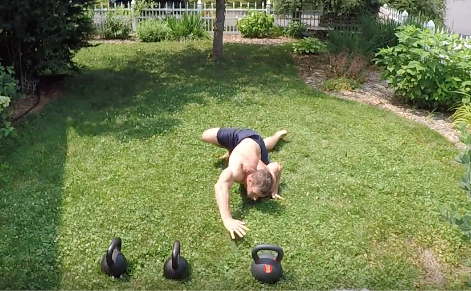
Lizard Crawling (“traveling forms” in Animal Flow)
Suitcase-style Kettlebell Carries
Overhead Kettlebell Carries
Kettlebell Walking Lunges
Reverse Crab Walks (“traveling forms” in Animal Flow)
*** For all of the kettlebell exercises, feel free to use dumbbells instead. Any object with a handle and some challenging weight will do.
What you’ll need:
1 heavy kettlebell
2 kettlebells of matching weight
15 yards of walking space
The Structure of the Workout
Start by lizard crawling 15 yards the location of the kettlebells.
Clean the heavy kettlebell up to chest height and position overhead. Walk down and back with the overhead carry.
Clean the same kettlebell overhead with the opposite arm. Walk down and back with the overhead carry.
Suitcase carry the same heavy kettlebell down and back with both arms.
Pick up the matching kettlebells and lunge walk the same 15-yard distance, down and back.
Reverse crab walk to the initial start position.
Repeat the process, beginning with lizard crawling once again.
Workout Video Demo
Workout Notes
This workout can be executed for rounds or time, whichever you prefer.
If you were going to work this for rounds, I suggest starting with 3-4 rounds and crushing those rounds. The idea is to work hard and work smart. Working smart is awareness of fatigue and body position. When your movement turns sloppy, you’re done.
Of course, more rounds can be added if you can handle it.
If you’re hammering this workout for 8-10 rounds, you need to increase the difficultyof all of the exercises. Lizard crawl for 20-25 yards, increase the weight of all of the kettlebell carries and the walking lunges. More is not always better.
If working for a target amount of time, I suggest capping this at 20 minutes. The video demo above shows roughly 8 minutes worth of execution.
Use the lizard crawl and overhead kettlebell carry as indicators of when you need intra-workout rest periods or when you need to pull the plug on the session altogether. Don’t be afraid to rest. There is zero shame in it. Your body can only fight fatigue for so long before the movements get sloppy. Take the rest, towel off, get back to work.
The overhead carry is an amazing shoulder stability/vertical core exercise, but it is also an exercise that deserves respect. DO NOT FORCE THE OVERHEAD CARRY FATIGUE IS EATING YOU UP AND TECHNIQUE IS DROWNING.
There are few exercises that accomplish more for functional lower body performance than single leg squats, aka “pistol squats’. They’ve been referred to as the “king of lower body strength training”, and I cannot disagree.
Here are some key benefits of pistol squat training:
Improve single leg performance (strength, balance, stability, etc)
Challenge movement complexity beyond regular squats
Training body control and coordination
Low reps, high reward
Mind/body focus
Assessment for movement deficits (strength, balance, flexibility, etc)
Portable strength (you can do them anywhere)
I’ll expand on each of these benefits in a separate article. For now, the takeaway is pistol squats are a potent lower body performance enhancer, connect the mind and body to a greater degree, progress body control and coordination, and you can practice them anywhere.
Symmetry
Building symmetrical strength, balance, and coordination between the right and left sides of the body provides immediate and noticeable benefits to performance in daily life and sport. Bilateral squats are not bad, but they can mask deficits and encourage compensations. Your body is extremely good at finding a way to complete exercises by any means necessary, even if the movement is full of compensations.
For a lot of people, one of the great payoffs in practicing physical fitness is that one moment when you realize a physical task was executed that wasn’t previously possible. Surprisingly yourself physically is rewarding.
“Oh, I can do that now”.
Unknowingly, many daily tasks are performed on one leg. Improving one’s ability to perform on one leg makes doing anything on two legs that much more efficient.
Personally, increasing my focus on improving pistol squat performance has saved my lower-back, and served as a door opener to more advanced movement flows.
More so, single leg training brought to light my own right/left performance deficits. I won’t say I became a better person once I cleaned up my asymmetries, but my performance saw improvement and nagging irritations went away.
If you find yourself unable to mirror a range of motion, or lift a similar amount of weight on one side of the body but not the other, it’s worth investigating why these differences exist.
It could be because of favoritism. Right/left side favoritism is common. I have it, you have it, we all have it. Repetitively completing tasks using the same arm or leg can slowly create imbalances, which may or may not manifest into acute or chronic issues down the road.
Examples: Stepping up or down a ladder with the same leg, using the same arm for heavy lifting or carrying, slinging the work bag over the same shoulder, driving with the same hand on the steering wheel tilted to the same side.
I’m not saying audit your entire life and become a hypochondriac with these things, just be aware favoritism exists.
Though it is important to practice traditional bilateral squats (2-legs), single leg training, even if only using one’s body weight, addresses gaps left unfilled by regular squats.
Balancing on one leg requires hip stabilizers to wake up and participate. This is a positive for those who sit for long periods throughout the day.
Leverage Exercise Progression
For a beginner, a full round of pistol squats may seem unachievable, and only for the “fit”. This is bullshit.
The “fit” didn’t enter this world sporting six-packs while ripping out pistol squats, just as the wealthy (typically) haven’t always been wealthy. The simple truth is your body isn’t acclimated to the mechanics of the pistol squats yet. Leveraging proper exercise progression and dedicated practice, a full pistol squat is a lot closer than you’d think.
If you’re unable to execute a pistol squat, the simple truth is that your body isn’t acclimated to do so. It’s a sign you may be lacking strength, flexibility or coordination, all of which can be improved quickly through proper exercise progression and practice.
You’re a lot closer to doing pistol squats than you think.
With proper progression and some tenacity for achievement, the human body adapts to be strength and new patterns quickly.
The power of progression is why I continue to demonstrate progression roadmaps leading to these “big bang for your buck” exercises.
All 3 of the following exercise progressions can be used regardless if you’ve been squatting with two-legs or using supported single leg squat variations. Though these exercises are a nice stepping stone, they are not necessary if the exercise is regressed back far enough to be manageable.
Use the suspension trainer to guide your body into and out of the squat. Grip the handles with intent and use the arms to lessen the intensity as needed. Slowly ask your legs to do more work as you gain strength.
3-5 sets of 5-8 reps per leg
Variation #2: Pinch Grip Assisted Pistol Squats
This pistol squat progression is demonstrated using a squat rack, but a door frame will work just as well. Grip the rack or doorframe with your fingertips, lower into the squat and back up, assisting as needed. Slowly soften the grip as you become more efficient. Move to a 2 or 3 finger pinch grip to increase the challenge.
3-5 sets of 5-8 reps per leg
Variation #3: Dowel Assisted Pistol Squats
The dowel acts as unstable assistance in this progression. This unstable assistance provides an introduction to a training effect similar to an unassisted pistol squat. Maintaining balance throughout the range of motion will have the hip, knee, and core stabilizers working overtime.
Expect to feel soreness in the days from maintaining balance throughout the work set.
3 sets of 4-6 reps per leg
All three of these exercises should be used as progressions to a fully unsupported single leg pistol squat. Keep in mind that each exercise demonstrates a full range of motion.
Select a progression according to your current fitness level. Aim to graduate to the next most difficult progression as you gain strength and efficiency.
The landmine attachment is a hybrid workout tool and a great addition to any home gym set-up.
Landmine attachments are a part free weight/part fixed range of motion apparatus. One end of the barbell slides inside of the landmine sleeve while the other end is controlled by the user. The sleeved end of the barbell pivots about a range of motion as the user engages in pressing, pulling and grappling with the free end.
Here’s a video…
Similar to barbell training, the exercises can be progressed by adding weight plates or increasing the complexity of the exercise. Training factors like reps, sets, time under tension may also be adjusted to suit the needs of the individual.
The user controls the free end of the barbell, which will travel through an arcing, fixed range of motion. Commonly barbells are 7 feet in length, so the range of motion is wide.
For the beginner, no weight or a very limited amount of weight may be necessary to familiarize oneself with the functionality of the set-up.
The barbell/landmine integration adds another dimension of unique exercises to a person’s exercise selection. Many of these exercises will surface in future articles, though a few will be discussed in this post. which will be discussed briefly with the elements of this workout, but in greater detail in future articles.
Nearly any traditional exercise can be performed using a landmine, the main difference becomes this “fixed range of motion” feature. Having a fixed range of motion transforms many exercises into “angled exercises”, naturally.
Using the landmine in combination short rest and a high amount of work can inject a much-needed freshness to fat loss workouts where creating EPOC (excess post oxygen consumption) is the goal. Maximum metabolic disruption.
Obviously, nutrition is an important piece of any body transformation, but including challenging workouts will increase the speed at which fat is burned and lean muscle is earned.
This simple landmine complex workout is just one in an entire Rolodex of workout options. I plan to share them all, so strap in.
The Workout…
Perform each exercise in descending order for the reps listed…
Split Stance Angled Press x 5 right/left
Reverse Lunge x5 right/left
Bent Over Row x6 right/left
Front Squat x6
Landmine Grappler T
Single Leg Deadlift x6 right/left
This workout might be considered a complex, where all of the work is performed and rest is taken at the end of the last rep of single leg deadlifts.
I recommend working through 3-6 total rounds of this landmine complex.
Rest will vary based on a person’s current conditioning, but 45-90 seconds is generally appropriate for most people.
I’ve had complexes where I rested for 45 seconds in between early rounds (1-3), and longer in between later rounds (4-6) based on my fatigue level. Adjust the rest as needed.
There is no right or wrong amount, the key is to push yourself without sacrificing exercise technique.
[Sidenote: If this type of training interests you, all landmine workout ideas are going to be continually posted on the M[EAUX}TION YouTube page and described in further detail later on the blog.]
Closing it out…
Using the landmine in combination less rest and a higher amount of work can inject a much-needed freshness to fat loss specific training where EPOC (excess post oxygen consumption) is the goal. EPOC, in my world, is simply creating a training effect specific to burning fat loss. It can be achieved through many methods: cardio, resistance training or a combination of both.
Short-term metabolic disruption. Stressing the body to expand performance.
Doing more work in less time is one way to measure and describe work capacity. Work capacity-oriented workouts are a very potent method to assist in reducing body fat.
Obviously, I cannot tell you it is the ONLY WAY (because this is not true), but there is no arguing the “lean out effect” from doing more physical work in less time. The training effect is massive, and the benefits extend beyond the workout.
It’s common for people to lose fat despite any nutritional changes.
Lower-load resistance training coupled with interval-style bursts develops work-capacity beyond what traditional cardio can offer, while maintaining the potency of resistance-training. The keyword in the bolded/underlined sentence is “lower”. Sub-maximal weight is best for metabolic workouts.
For the record, I don’t feel metabolic workouts trump traditional cardio. You’ll see this as the M(EAUX)TION content grows. Both have their place in training as useful tools.
In the future, you’ll see more landmine workouts posted, except integrated with bodyweight exercises and other training tools to increase the flavor and shake things up a bit.
At first I was going to say yes, without a doubt building fitness makes a person harder to kill.
I’m not sure about you, but personally every barbell squat, kettlebell swing, turkish get-up, 500m row and jump rope interval makes me that much harder to put 6 feet deep.
[Improving fitness cannot just be centered around improving exertion. Exertion is just one piece of the puzzle, a fragment of a much larger picture. We must consider the role of achieving better body position or movement pattern quality, tissue health and integrity, recovery and nutrition to be highly influential topics that enhance our ability to perform.]
It’s empowering to know that my stopping power increases with each and every repetition, distance covered and position held.
In fact, I was walking through the grocery store yesterday sizing up other customers wondering who might challenge me to a scrap.
As fate would have it, I navigated my way through the treacherous isles of the store without a single encounter, purchasing my groceries unscathed.
Leaving the store, my thoughts quickly shifted to a classic movie scene from Indiana Jone’s. Many of you will remember this particular clip quite well…
But if you do manage to trick me with ninja smoke and slip in a finishing move, please, do me the service of burying me ass up so you’ll have a place to park your bike.
Harder to kill? Sweet slogan but hardly relevant for most of us. 🙂
Saturday always provides adequate time to explore different combinations of work capacity style circuits.
I like to take the governor off and push myself on Saturday mornings.
This past Saturday didn’t disappoint.
The goal was to accumulate 25-30 minutes of a work:rest style circuit. I didn’t feel like being monotonous with the exercise selection so included 10 different exercises, stringing them together strategically so that I could give an honest effort to each exercise without sacrificing anything (mostly due to fatigue) to the next exercise in the circuit.
It really worked out well and challenged a number of movement patterns.
The equipment that I used: 24kg kettlebells x2, jump rope, Jungle Gym Suspension Trainer
Here is how the workout was structured…
—> 20 seconds of work: 20 seconds of rest of the following:
Kettlebell Figure-8 (advanced and technical, but great drill)
rest
Bodyweight Push Ups
rest
Double 24kg Lunge (alternating sides)
rest
Hand-to-Hand 24kg Swings (alternating every rep)
rest
Burpees (jump and push up)
rest
Jump Rope (combination of two foot bounce and running)
—-> Repeat 4 complete cycles of the above…
The best part about this workout is that you don’t have to worry about keeping track of reps. When I am doing work capacity style training, counting reps can be a major pain. It’s really the last thing I want to be doing while I am huffing and puffing. Instead, the work starts on the buzzer and ends on the buzzer. It’s really convenient.
Know thyself… If you’re a beginner, this workout might not be scaled to suit you. If you’ve been working out for a while, this might work great for you. If you’re a tough guy or gal, bump up the weight for kettlebell exercises, add a weight vest to chin ups and push ups, use a weighted jump rope, etc. I can provide exercise progressions to bury anyone if that is what you are seeking, hopefully that isn’t the case though. Smart training reigns supreme.
You might see a lot of volume in a workout like this, and you’re absolutely right, so nice observation. However, I preach workouts that can be managed. I managed this one nicely. Notice how explosive work is ordered first in the workout. That is on purpose. People tend to get hurt when they attempt to move weight quickly under fatigue and will poor form. I am not foolish enough to place a highly technical lift at a place in the workout when I am most fatigued.
Also notice that all of the exercises are non-competing, and ordered in such a way to respect that. In fact, look at the kettlebell figure-8 + bodyweight push ups + double 24kg lunge… sequence. Very different muscles are being taxed there. Figure-8’s are combination of squats with rotational power where the kettlebell moves from a high front to low back to side and finally diagonally across body to high position (hybrid movement). Push ups are an upper body push dominant exercise, and lunges are mainly a lower body hip dominant exercise. This allows for an increase in heart rate and work, without gassing out the body for the next exercise. You tax one movement pattern, than move on to the next.
Different movement patterns, different muscles, quality technique, short rest, big training effect.
Now I don’t own a calorimeter or a metabolic analyzer, but I would guess that the calorie burn from a workout like this was quite high. Maybe 650-800kcals total, and that doesn’t include the residual calories that are burned post-workout. Shortened rest periods combined with resistance based lifts that leverage a sub-maximal muscle contraction are notorious for creating an after-burn effect, it’s been studied quite extensively in the last few years as the concept of fat loss slowly gains momentum versus weight loss.
Metabolism can stay elevated for several days leveraging workouts like this.
If you leverage some quality eating habits during that period of elevated metabolism, you’ll burn some fat no doubt. Rinse and repeat the process and you’re going to end up burning a bunch of fat.
I should also note that I designed this workout knowing that the coming days were going to be either complete rest (no workouts) or at the very most, a short yoga/static stretch session. It’s important to rest, recover and let your body heal in between workouts. Your body can only handle so much stress before adverse events begin to occur. You really don’t want to play chicken with overtraining or chronic fatigue in general. The point of recovering in between workouts is to give your body the best possible chance to leverage the work done in the previous workout, while allowing enough time to enter the next training session and make gains.
I think that a lot of people could lose greater amounts of body-fat (faster) while boosting performance if they decreased the amount of cumulative stress from workouts. You want your body to recover in full. Always entering a workout in a state of recovery is bad for business. If you haven’t acquired a full taste for physical activity, this is good news for you, as each dedicated workout can be used to accelerate
Instead, choose fewer weekly workouts that create a larger (but quality) training effect. Make them count.
Focus on accelerating other areas of life while you recover in between sessions. Focus on establishing quality eating habits. Re-think your water intake. Read more books on success and self-growth. Calm the mind with yoga, foam rolling and a long static stretch session. Get more sleep.
Learning how to workout is great, and building fitness is empowering. But keep your training efforts sustainable. Win the war, not just the battle.
In life it can be hard to convince yourself to take a delicious bite of humble pie, but sometimes it is absolutely necessary, especially when we begin to dissect our daily workouts.
First off, if you’re finding a way to get to the gym, you’ve put yourself ahead of the curve. They say much of sales is just showing up, and I firmly believe fitness is very similar. Getting to the gym is half of the battle. Once you’re there, small shifts to progress beyond your current training habits will work magic for your body.
For example, if you’ve been killing it on the leg press, pressing a half ton load for endless reps, it’s time to remove yourself from the leg press and enter the world of free weight squatting. You don’t even need weight. You could knock your ego back down to earth by mixing in some pistol squats.
A few sets of pistol squats and you’ll figure out what you’ve been missing. Single leg strength is where it is at.
If you’ve been dominating bicep curls, walk over to the squat rack and load up a set of chin-ups. Lower yourself slow and explode on the way up. Vertical pulling strength is a fantastic benchmark for upper body strength. It’s important to work on handling your own bodyweight (and beyond) during upper body pulling actions.
Too cool for school on the lat pulldown? Mix in some strict pull-ups using the same tempo as the chin ups. Pull ups are the king of upper body exercises. If you find yourself knocking it out of the park with pull ups, I would bet you will find yourself becoming extremely strong.
Still doing cross-words during the treadmill jog? Take the incline up to 6-8%, turn up the speed and run some 15-20sec sprints. Aerobic work is great, but shuffling your conditioning to venture into the higher ranges of heart rate BPM has great carryover to leaning out and resistance to fatigue during sport.
Tired of being unsure about how hard you are working? Buy a heart rate monitor and measure your effort. There are plenty of brands, colors and features to choose from. It’s really a solid investment and I highly encourage that everyone leverage a heart monitor to increase the effectiveness of their training habits.
Improving your workouts is a lot easier than you might think, but it requires turning away from the path of least resistance and toward the path of progression.
Trust me, I know it feels really good to be awesome at certain exercises while simultaneously avoiding the exercises that plague you, but re-adjusting your training plan to include some of the exercises listed above (among others) is a sure-fire way to see quick improvement.
It really doesn’t take much put yourself on the right track for certain progress. But you have to put yourself on the right track. You have to progress. If you don’t progress in some way, you’ll stay the same.
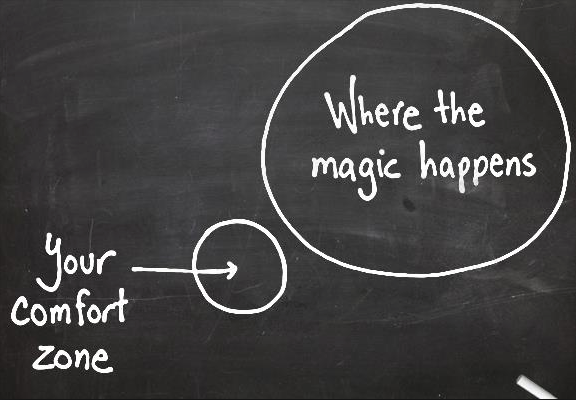
If you desire the next level of results, it will take some effort and an inner strength to consistently (and intelligently) push yourself out of your current comfort zone. If you remember from an old post the picture below is worth a thousand words.
credit: thinkingmomsrevolution
Progress applies to all aspects of life. If you do what you always did, you’ll get what you always had.
Keep progressing and you’ll keep improving. It’s a simple concept, but it isn’t always easy.
Cheers to progressing the workout in small increments!
KG
Progress your nutrition to see results, click the photo to find out how to make it happen.
There is another organization that names all of their workouts, which isn’t a bad thing, I just don’t feel like labeling my workouts with someone else’s name. I could name this one “Brutus” or “Cactus Jack”. Maybe I should name my workouts after WWF wrestlers past and present. That would be cool. Everyone seems to know WWF wrestlers names whether they admit to watching it or not.
I could use a numbering system I suppose, like “Workout #1” or “Level 5”, but maybe I’ll just call it what it is.
I selected the movements listed above because they represent most of the major movement patterns, and also because these exercise could be easily executed with the workout equipment that I had available the other day.
As I mentioned, I typically only incorporate big movement patterns into circuits. To be honest, I don’t like wasting time with exercises that hardly stress the prime movers. Bicep curls and such are desert. If I have time after I have completed what I often refer to as the “main meal”, I will work in the accessory exercises for fun.
I value my time. Time is a commodity in my life (as I am sure that it is in your’s) so I prefer to get in, get out and get back out to experience other aspects of life. Sure, I write about working out, structuring workouts, movement and nutrition a great deal, but that doesn’t mean that I am working out 2 hours a day. Efficiency is the name of the game. How effective can I make my workouts without taking away from other areas of my life that I also value.
Occasionally I will add an exercise or two that is slightly out of the box, but these movements are usually treated as a filler exercise (active rest) between more demanding exercises, or reserved for before or after the main circuit of the workout.
While I will admit that doing this is my personal preference, I would suspect that most of you will find that your own workouts are immediately enhanced by working in the big movements instead of a series of fillers. More muscles engaged equals a greater training effective at the end of the workout session.
If you do more work in a smaller time frame, now you’ve primed your body for fat loss + muscle gain.
This is a great scenario, one that we need to keep advocating instead of “weight loss”. You can lose weight by dehydrating yourself down to a raison in a sauna. That’s weight loss, right?
Swap the fat tissue for muscle tissue.
Chase muscle and while running away from fat.
So what are the big movements? In this case, the big movements that I leveraged for a training effect were:
I’m continually amazed at how effective bodyweight strength movements are, especially when organized into a circuit.
I can get the training effect that I desire while minimizing risk of injury and awful soreness in the days that is so commonly associated with resistance based training. Of course, if you have never performed a push up or a squat, you’re going to be sore in the coming days. That’s something you can expect with a new training stimulus and re-discovered muscle contraction.
Loading up on bodyweight style training sessions. This type of training sessions should be heavily considered by anyone that struggles with achy joints, etc. Bodyweight resistance exercise provides a low load introduction to basic strength drills, easing your body back into the swing of things.
Plus, being able to control your body exhibiting stability, strength and power through a healthy range of motion will do wonders for your performance, whether that performance be for sport or raking the leaves out of your yard.
So what does last weekends workout look like?
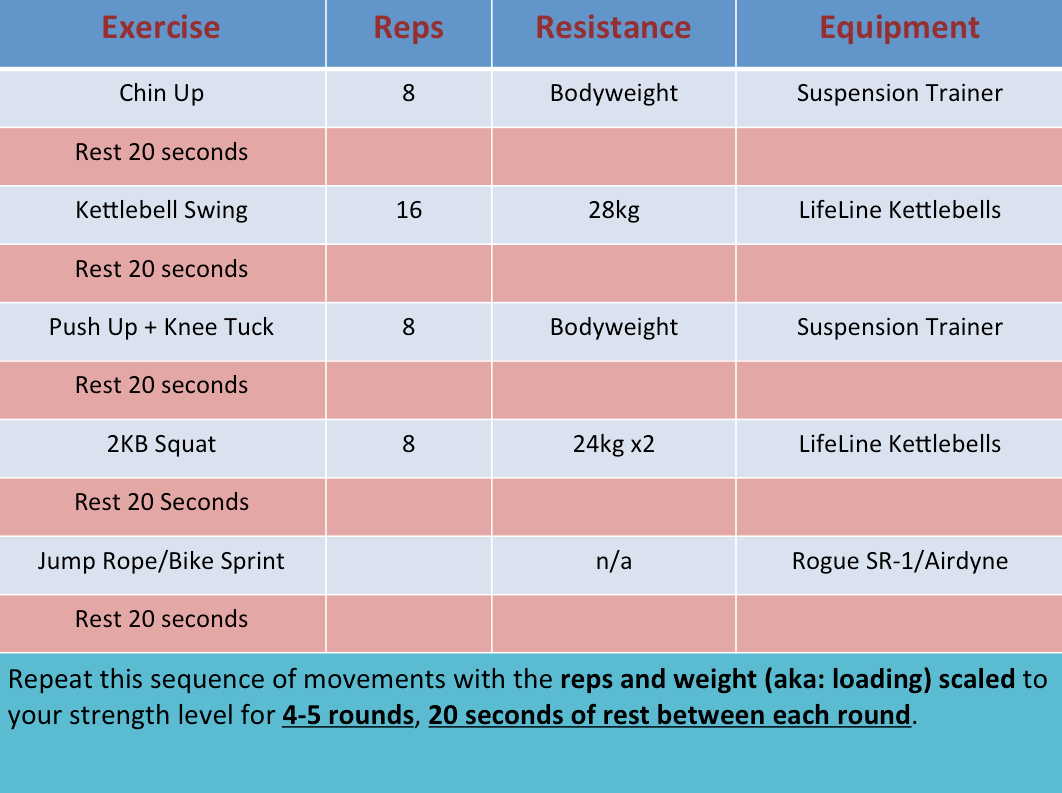
The structure looked something like this:
I loaded up most of the movements and went for 4 rounds, which took slightly over 20 minutes. 20 minutes continues to be the sweet spot for workout duration. Anything more than that and I lose output, anything less and it seems like it wasn’t enough… as if I left some fuel in the tank.
20 minutes also seems to allow for focus on proper exercise technique (and grooving) while the fatigue continues to snowball. Technique is important, don’t forget that.
If you take another look at the exercise selection above, I’d like to share a couple of substitutions that you could make. If you cannot perform a bodyweight chin up, wrap a resistance band around the chin up bar you’re using, and stretch it down around your knee or foot. This will assist you on the way up and ease you down from the top.
You could swap out standing broad jumps or squat jumps for the kettlebell swings, although there really isn’t a movement to mimic a kettlebell swing. If you have dumbbells you could use those in a pinch, but again, there is no tool that functions quite like a kettlebell.
If you don’t have a suspension trainer, just do regular old push ups. If you want a less expensive option that does a decent job of mimicking the push up+knee tuck combination, use furniture sliders or socks on a hard surface. Both work decently. I would go the furniture slide route if I had to choose.
If you don’t have kettlebells, dumbbells or a barbell for squats, you can do bodyweight squats just as well. If bodyweight squats are easy, mix in pistols alternating each leg. If you squats are too easy and pistols are too hard, use squat jumps.
If you don’t have a jump rope or a bike, run in place. High knee with simultaneously arm action. If you’re lucky enough to have a place to run a short distance, figure out how far it takes to run half of a 20 second shuttle run (10 sec out, 10 sec back).
As you can see, there is a progression, regression and alternative to just about every single movement known to man. Once you know what a level up and a level down from an exercise is, you’re in business. Now you can OWN your workouts.
Cheers to Chin Ups, Kettlebell Swings, Squats, Jumping Rope and Push Ups!
KG
PS: Seriously check out the nutritional link that I posted above. If you want to see dramatic change in your body and performance, nutrition is at the bottom rung of the pyramid.





 and measure your effort. There are plenty of brands, colors and features to choose from. It’s really a solid investment and I highly encourage that everyone leverage a heart monitor to increase the effectiveness of their training habits.



 M(eaux)tion Fitness