It’s Just a Kettlebell Swing and Suspension Trainer Workout

Quick Tips

A few months ago, I wrote a post titled:

—>  It’s Just a Kettlebell Swing Workout

Kettlebell Swings

That has been my most popular post on this blog, by far.

I wrote it because I wanted to convey how simple a workout can be, and probably should be for most people.

Totally stripped down.  Nothing but a timer, a towel and water bottle, and a kettlebell of a decent weight.  You could make the argument that a “totally stripped down” workout would only involve bodyweight exercises, but that’s beside the point.

A lot of people avoid physical activity because of two things:

  • Time
  • Preconceived thoughts and anxiety about how the workout will feel.

Simple workouts are time effective and aim to limit anxiety.  You look at the agenda for the workout and say to yourself, “Oh, I just have to focus on kettlebell swings today.  I can do that”.

If you have a kettlebell or have the means to acquire a kettlebell for the future, I will ALWAYS encourage you to make the purchase.  Don’t wait, don’t peruse, don’t over-analyze.

Just buy and be done with it.  You won’t be sorry.

Well, I take that back, you could be sorry… if you buy it and fizzle out and using it.  Then it’s just another heavy object holding a door open.  What a shame that would be.

Anyways, I wanted to build on that post, because I felt that the workouts displayed were rock solid, and applicable to a large population of readers.

They are simple, yet brutally effective.  I would consider them entry-level workouts, however, I have to admit that I continue to use the 15sec work/ 15sec rest (24 rounds) kettlebell swing protocol to this day.

The only difference is that I have climbed the ladder in weight.  When I started with the protocol, I used a 20kg kettlebell from LifeLine Fitness.  I then climbed to the 24kg kettlebell, then to the 28kg kettlebell and now on to the 32kg kettlebell.  All were purchased from LifeLine Fitness also (yes, I promote these guys heavily, they make equipment worth buying).

Don’t be fooled by elaborate training protocols.  Keep it simple and be detailed.

A simple workout/program executed to perfection will trump the world’s most complex/perfectly written program done poorly.

Stay in the “simple” zone, do it right.

That being said, I would like to say that kettlebells and suspension trainers are a match made in heavy.  For roughly $300, you can outfit your home with a Jungle Gym XT and a nice variety of kettlebells ranging in weight.

The combination of a suspension trainer and kettlebells is magic.

Seriously, they are match made in heaven.

Let’s look at workout that I’ve employed over the years…

Kettlebell + Suspension Trainer

A workout like this is complete.

The kettlebell swings alone are enough to initiate a tremendous training stimulus, but when paired with the other movements, the workout is magic.  Push, pull and ballistic movements for the upper and lower body are all represented here.

With high volume workouts, I typically choose simple rep schemes.  It’s annoying trying to remember how many reps to complete in the middle of round, when you’re real focus should be on controlling your breathing and fatigue.  Once you experience this frustration, you’ll wish that you would have picked simple rep schemes.

After completing each round, I would rest anywhere from 45-75 seconds depending on your conditioning level.  Don’t be a hero and rest for 45sec in the first round if you can’t handle it.  This decision may bite you in the ass in the later rounds when your fatigue levels spike.

Fatigue accumulates throughout the workout, just as it does for every workout.  It’s inevitable that it’s coming, but timing it so that you complete quality work while you can is the idea here.

The number of rounds that you complete is depends on your ability to complete quality work (exercise technique, complete reps, etc).  If your form breaks, you make the decision to rest before re-engaging, or you pull the plug on the workout altogether.

Safety first, always.  Form good habits.

Put this workout in your back pocket for now, load it in the chamber when you need a challenging high tempo training session.


Cheers to ST’s, BW’s and KB’s!

KG

(PS:  I turned on “Location Tagging” so that you’ll really believe that I reside in God’s Country… Eau Claire, WI)

My Philosophy: Great Point Alwyn Cosgrove!

Quick Tips

Image

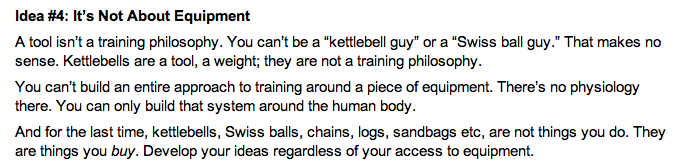
When I initially read  Alwyn Cosgroves post (shown above) I immediately felt that it was too good not to share. 

Once I established my training philosophy, I was set for life.  I was set to teach others and also to execute for my own benefit.  

It doesn’t matter what equipment is around, what I have access to or what I don’t have access to.  

I can accomplish something even though I don’t have everything.  

Sure, my ideas and preferences will evolve, but I think that much of what I believe makes a great program and workout is solidified.  I am not sure (at this point) how it can get much better, without sacrificing certain things that I morally cannot consciously sacrifice.  One of those being safety of myself, or the you guys.  

I write about kettlebells and suspension trainers on this blog A LOT.  

But it’s not for any other reason than I believe whole heartedly that the combination of kettlebells and suspension trainers make for insanely effective workouts, especially since they fit into my training philosophy so well.  

Kettlebells provide loaded (resistance), ground based movements that are primarily (not all) completed in a vertical standing position.  The bold print is a part of my training philosophy.  I could substitute “kettlebells” for a whole host of other fitness equipment, and things would be just fine.  

Movements like kettlebell swings and turkish get ups are world class for building a variety of qualities, at the same time.  

Suspension trainers are an entire gym in a box, weighing in at less than 2lbs tops.  Equipment-free bodyweight training is great, but suspension training makes it better.   Suspension trainers allow for the leverage of a person’s bodyweight against gravity.  My favorite benefit of the suspension trainer is the fact that you can PULL!  Inverted rows (aka: body rows) and chin ups (supinated and neutral grip) are all made possible by two straps with handles.  

Get rid of that shoddy kitchen chair set up that you’ve been using for so long…

But as stated in Alwyns commentary above, kettlebells and suspension trainers are just tools that I use to to implement my philosophy of what makes a great workout, program, etc.  I am not exclusive to any piece of equipment.  That’s not my style.

The fact is that most equipment works wonderfully.  

It’s the user (aka: you) that has the opportunity to make the magic happen.  

I know a lot of people that own a complete set of kettlebells and the best suspension trainer money can buy, but they don’t have a philosophy, or any sort of guidance on how to use it.  In turn, they are stalemate in their efforts, or on to the next fashionably trendy workout tool.

For most people who are beyond their days of athletics, the total body approach to training is probably best.  I know that there are upper body/lower body splits and a thousand other ways to organize your weekly training, but total body is effective in short windows of time.

Time is probably our most precious commodity.  We can never get time back.  Once a minute passes, that minute is gone.  Same with days, weeks, and months.  Time keeps moving forward at the same steady pace regardless if we want it to slow down or stand still.

That being said, leveraging a total body workout, using a smart philosophy to structure the workout is (in my personal opinion) the best approach for accomplishing goals of fat loss, building all around strength and many other athletic qualities using time management.

But, it must also be said that paying attention to your nutrition, specifically what you shove into your mouth and drink, is the most time effective way to stay lean.  

My advice to all of you is this:  Treat tools are tools, not philosophies.

Gravity decides what an object is going to weigh, humans decide how the object will be shaped, how the weight is distributed and to some degree how the tool should be used best.  An example of how a tool should be used best is in fact, the kettlebell.  You can swing a dumbbell, sure.  But your first time swinging a kettlebell will lead you to believe that dumbbell shouldn’t be swung.  

Kettlebells are the standout choice for swings and many other exercises.  

But I can in fact swing a dumbbell.  I can also perform a turkish get up with a dumbbell, or a sandbag, or a filled milk carton, or a loaded backpack, etc.  It might not feel the greatest, but I can do it because it has weight and a handle to grip.

The tool is not the philosophy.  It is an augment to the philosophy.  A supplement to your training philosophy.  

Again, I can perform a squat with any tool, or no tool.  If I don’t have a two, it’s bilateral air squats or for an added loaded and challenge, it’s pistol squats.  

Therefore, pay attention to more important aspects of your workout such as:

–  Consistent progression of loading.

–  Rest

–  Time under tension

–  Range of motion

–  Sets/Reps

–  Heart Rate

–  Movement patterns

–  Exercise progression

–  Your goals, needs, abilities and dysfunction

-etc…

These are things that can you can use to imprint your own philosophy of how an effective training session or long-term program should be designed, regardless of what equipment you have or don’t have.

Very simple thought pattern yet often overlooked.  Thanks Alwyn…


Cheers to philosophies and sticking to them…


Kyle

The Gym is Dead to Me

Quick Tips

It’s not really, and it never will be, but the point here is that the gym reminds me of a jail cell.

When I first started training, it was very traditional.  Barbells, cable machines, stationary bikes and treadmills were the ticket.  It was how people stayed “fit”, strong and athletic.

Again, these tools still work, but the deeper you go into the rabbit hole, the more you question why building high functioning bodies has to be such a cookie cutter process.

Barbells will never go away.  Why?  Because a barbell’s design is perfect for lifting heavy things off of the ground, loading up the squat pattern and building explosive power through exercises like the clean, snatch and push press.  We need tools like barbells.  Barbells are safe.  A quality barbell isn’t going to break mid-rep, and there are a series of checks that a person can run through to make sure that  replicate their technique every single time.

But what I am beginning to question- and the better term might be “explore”- is why movement should be so cookie cutter.

Because that is how I am seeing it these days.  It’s cookie cutter.  We preach posture, we preach exercise technique, we preach moving within manageable ranges of motion.  But how about this… let’s get out of the gym and move.  Forget about all of the in-depth information, get off of the couch and out of the house.  It’s sunny and 80 degrees outside and it’s a prime opportunity to use your god-given right to move yourself around.

If you’re a newer to training , and you cannot handle your bodyweight… the load that you carry around with you 24/7/365… forget about barbells, cable machines and kettlebells.  You have bigger fish to fry than worrying about the next great exercise.

When I left the gym I started to LOVE training again.  When you’re done with organized athletics, working out just for the sake of working out is a sure-fire way to burn out.  Boredom sets in and you start to wonder what all of the effort is for?  A six-pack?  Honestly, who cares.

Six packs are nothing without function.

You can have a rippled six-pack and blow out your back in a heart beat, tear a rotator cuff, etc.

It’s like, “Congratulations, you can see your stomach muscles through your skin, but you can’t run a mile or pull yourself up to a bar or pull yourself out of Quasimodo posture”.

In fact, these days, I think that dedicating your training to achieving a six-pack is comical.

Once you get in this “I’m training for a six-pack” mindset, you’ll go insane trying to get it or attempting to maintain.  It will elude most people not because their workout program sucks, but because their eating habits suck.  You wouldn’t believe how hard that is for people to swallow (no pun intended).  If you want a six-pack and don’t have it despite insane physical efforts, it’s most likely because your eating is not conducive to having a six pack.  Ok?

It would be like if you started a business only with the goal of getting uber-rich and but ignored your customer service.

It’s short-sighted.

Get yourself out of the gym and start moving more.  What do parents tell their kids when they are inside for way too long?… “Go play outside”.  Adults should take their own advice.

Once you’re outside bodyweight training is an amazing method to leverage when you use the correct formula.  Climb some stairs, hills or jog flat ground.  Get your heart rate up and get the blood circulating rapidly.  Mix in some squats.  If you cannot squat, grab onto a pole, hinge your hips down and back, keep your chest tall without folding at the lower back and feel the movement.  Use the pole to help groove that squat pattern, and what it should feel like.  Gradually let go of the pole and continue to “feel” the movement.

Face the wall squats

“Face the Wall” squats are great for learning technique.

If you cannot perform a certain movement- and I use the squat as a common example because it seems to give people the most trouble- you have got to practice it.  Occasionally, you’re going to find that your internal wiring is all mixed up.  In this case, you need to implement corrective exercises, which I why I promote The Functional Movement Screen so much.

Everyone should be able to squat, among other things.  This isn’t a circus move that is exclusive to fitness buffs, this is exclusive to all humans.  If you cannot squat, you need to figure out why and restore your ability to squat.

Screen Shot 2013-08-04 at 1.32.21 PM

Gym memberships.  We seem to think that just because we buy a gym membership we have just bought ourselves a fit body.  But you haven’t.  What you did is you bought yourself a gym membership, a contract that says you can walk into a brick and mortar structure where a bunch of fitness equipment resides, waiting for the next person to pick it up, push it, pull it or run on it.

But most people who purchase memberships never go.  Buying the membership is the easiest part of the process.  Anyone can hand over a credit card, swipe it and feel great about their decision.  Especially credit cards, because when you don’t physically see the money being handed over, the impact of the purchase is dampened.

The real work begins when you make it a priority to go that gym over and over again.  Daily.  Every other day.  Or at least on some kind of consistent schedule.

But most people burn out or never commit from the beginning.  Out of the gates hard and fizzle, or they purchase the membership and never go in the first place.  But they have the membership, so they will go “someday”.  The membership is comforting because they always have it in their back pocket, never to be used… but it’s “there”.

Ido Portal

In the back of my mind, I have long thought movement should be explored.  We should be able to execute movements that require power and strength, yet exhibit a stable full range of motion and gracefulness regardless of the environment or the obstacle.  And let me tell you something flat-out, one brief glimpse at how life happens in real-time when you are actively engaged in movement (outside of the confines of the gym) will reveal that you need to be able to adapt to the unknown.

However, I also believe that exploring movement should be done unloaded.  External loading in really awkward positions can cause injury, and that erases any ground that you’ve made.  Move with your body, and your body only.

Unknown stress, unknown range of motion, etc.

You’ll never be running on a trail and find a barbell neatly loaded with a chalk container sitting next to it.  You’ll find a rock with shitty hand holes for gripping that is weighted heavier on one side than it is on the other, and wet.  Or maybe that rock isn’t on the running trail, but it’s a part of the magnificent landscaping in your yard.  Maybe you’re gripping 40lb bags of mulch carrying for 30 yards up an incline, shoveling gravel or raking a 2 acre yard.

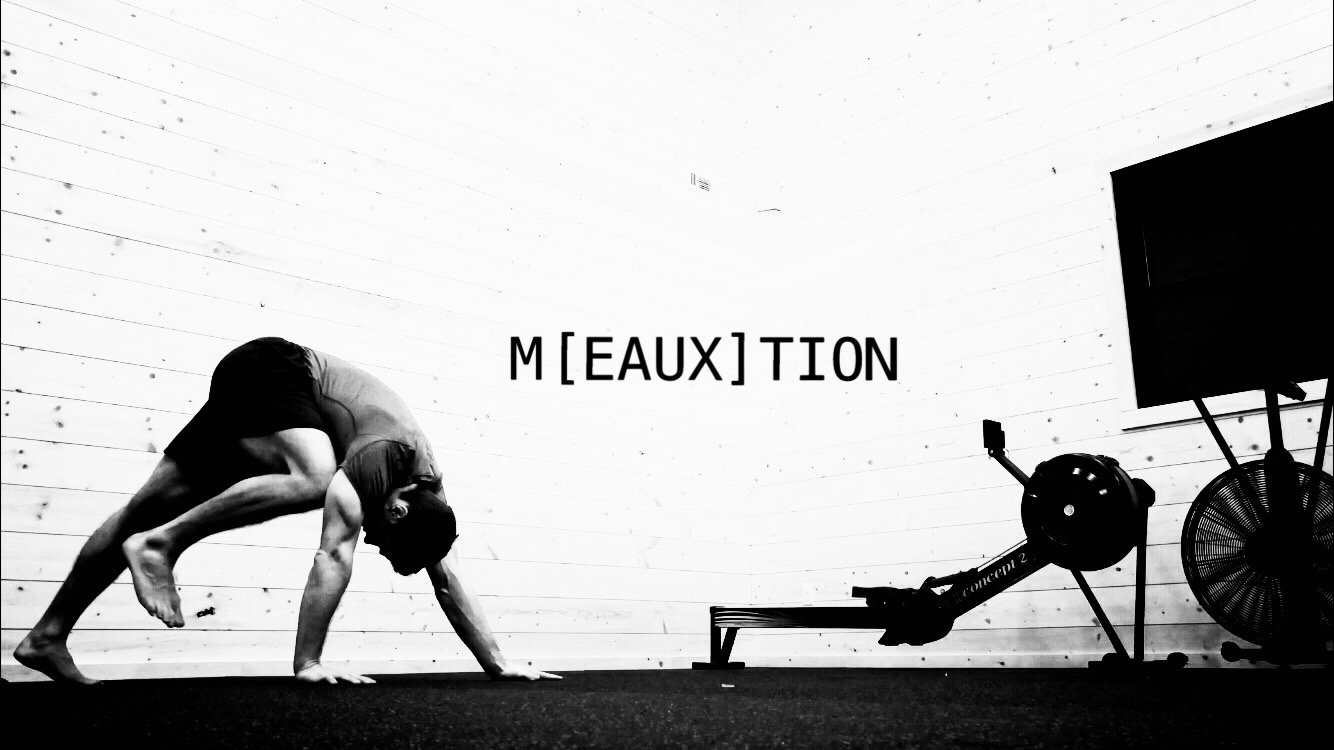
You cannot train for this stuff.  You can prepare, and barbell training and other more traditional forms of gym work can aid in your completing of these tasks, but we have to develop succeed in raw movement.  It’s life.  Movement is part of life.  So I have embarked on my dabbling of increasing my ability to move, mixing in Ido Portal-like methodology (logo seen above, great logo).

I believe that there is something to be learned here.  Getting out of the cookie cutter mindset and into the movement mindset.  Exploring the bear crawl, moving into a lateral lunge flowing into a crab crawl, gorilla hops and then into single leg pistol followed by a pull up to a bar where you pike out and lower yourself with a graceful strength.

Got that?  🙂

I value the building of systematic strength.  I value programs that are geared toward making damn sure that strength progress and conditioning progress can be measured and evaluated.  We call this “periodization”.  We move through 3-4 week phases where focus is placed on building a certain quality, such as strength or hypertrophy.  But all of this work needs to transfer over into the unknown, into life.

Systematic strength building and conditioning will always have a place for every human, and I will never stop promoting that to athletes, Mom’s and Dad’s and the elderly.  We should place some focus on this method of building physical fitness.

But once we leave the gym, we have to realize that movement is more than bending over to pick up a piece of iron, grunting, standing up with it, then dropping it back on the floor.

Blip on the fitness map

Fitness is a blip on the movement map.

Fitness doesn’t mean that you can move.  

In fact, I really don’t know what fitness means?  Who’s considered fit?  The powerlifter who can pick up 1,000lbs in a deadlift?  The marathon runner who can win the Boston marathon?  The UFC fighter?  Usain Bolt?  The kettlebell guru?  The Crossfit Games champ?

I know this might not make sense right now, but fitness does not mean that you can move.

Ah, the gym.  It’s really dead to me at this point.  I value the tools found in the gym, particularly cable machines that can be used for movements that cross the midline, such as chops and lifts, but not the gym itself.  I think there are better places to train.  Places that inject an energy into your sessions.

With the evolution of  training equipment that is capable for training outdoors, I’ve never been more motivated to explore movement in different environments, using different tools and lately with others who value the same approach.  It’s a great bonding experience to train outside with someone else and finish the workout together, just as it is to climb a 14,000 foot mountain, bike 100 miles or complete a marathon.

SUP ATX Stand Up Paddleboard

With the popularity of unique outdoor activities like stand up paddleboards on the rise, I’ve never felt more justified about my decision to leave the gym in my rearview.

Come join me out here.

Cheers to movement and your ability to do it anywhere!

KG

Some of the Greatest Workout Habits of Effective Fat Loss and Athletic Performance

Quick Tips

I transferred this post away from the static page tabs above and into a post.


1)  Resistance/Ground Based/Closed Chain  

  • Train with some kind of load or resistance as much as possible.  Push, pull, pick up, drag, carry, swing, squat, throw, slam… All with resistance and all with your feet on the ground whenever possible.  Lean muscle tissue from resistance training.
  • Women… (sigh)  You are not going to get “bulky” from picking up some weight.  Don’t be afraid of it.  If you knew what it takes to look like a bodybuilder you would laugh.  You’ll never get there.  If you want the “toning” effect… pick up some weight and get after it.  Nothing is sexier than a woman who is confident in the gym.  Ease into it with some effective bodyweight movements and progress from there… you’ll quickly realize what I am talking about.

2)  Aerobic/Anaerobic (Cardiovascular improvement)

  • Aerobic training isn’t the devil… it just isn’t the most effective way to drop fat and look better.  If time is a factor, and it often is, choose other methods.  Stress your cardiovascular system using as many different methods as possible.  Run, bike, paddle, swing kettlebells, use battling ropes, row, etc.  Train yourself to be effective for short distances, up inclined hills and stairs, flat surfaces, etc.  Run for distances that develop endurance-like qualities.  Do it all.  Tweak the variables:  distance, work periods, rest periods, direction, speed, heart rate recovery etc.
  • Grandma was right, “All things in moderation”.  Too much of anything can be bad.  Too little can be bad too.  Find the balance.

3)  Multi-joint (movements not muscles)

  • Unless you are rehabilitating an injury or training for a bodybuilding competition, avoid training your body in isolation.  The body is a single unit made up of many moving parts.  Train your body to push, pull, squat, hip hinge, lunge, carry, sprint, etc… and your body composition will change and performance will improve. Muscles and joints love working together (synergistically) to accomplish physical tasks.

4)  Joint-by-Joint Approach

  • The body is a vertical Jinga tower of joints.  Some joints need stability and some need mobility.  Improve your joint stability where you need it and improve your joint mobility where you need it.  Failure to obey this simple rule puts you at risk for injury and decreased performance.  Generalized approach, but simple and crazy effective.  Freedom to move effortlessly in all 3 planes will keep you functional in the game of life, and most of all, injury free.

5)  Progression

  • In simple terms, every movement/exercise has an easier or more difficult variation.  You just have to know where to start based on your abilities.  Beginners must spend time mastering the basics before they earn the right to step up to a more difficult variations.  Proper progression means leaving your ego at the door.  Do what YOU can do, not what you WANT to do or what you saw someone else do.  This is a hard lesson to learn and implement (even for myself a long time ago), but in the long run, you’ll thank me on this one.  All in good time.

6)  Rest—Recovery—Regeneration

  • Train hard… Recover harder.  If you train hard enough, you can elicit a training effect worthy of fat loss, injury prevention and performance.  If you recover hard enough, you will give yourself the opportunity to continue to train hard week in and week out.  Recovery is also where the magic happens.  Nutrition, sleep, hydration and soft tissue maintenance allows for a life-time of physical success.
  • Foam roll, roll a lacrosse ball on your feet, iron out your muscles with Tiger Tail.  Keep your tissue healthy and circulation flowing.  Stretch and elongate.  Soft tissue restrictions are uncomfortable and breed dysfunctional movement.
  • Think of it this way:  You have a full glass of water prior to a workout (water= energy levels/fatigue, etc).  After completing your workout, you have now poured out have of the glass of water (fatigue, hormones, muscular health, etc).  It is important to put more water back in your glass before the next training session (rest, recovery, regeneration). If you pour all of the water out of your glass before you replenish what you have poured out from your workout, you increase the likelihood of injury, over-training and increased fatigue, sub-optimal hormone balance, decreased performance, etc.  Keep your glass full and your body will be happy.  Keep the balance.

8)  System

  • Just like movements over muscles… choose systems over workouts.  Following a system will always get you further in the long-term than “winging” it.  A system is a road map to body re-design.  It’s a plan.  A system allows a person to experience continued improvement in a scheduled, intelligent, measurable and safe method.  A system is sustainable and built for the long-term.

*  There are a TON of variables to consider when designing a training program.  Getting yourself adjusted to healthy habits takes repetition/practice and body re-design takes time.  Be patient but don’t get complacent.  Attack the hell out of it.  You have to be all in on this.  Focus on doing the simple things really well and be patient as your body begins to experience positive aesthetic change and performance.


Cheers to the full integration of these habits…

KG

Example of 3 Simple Kettlebell Workouts

Quick Tips

Lifeline Kettlebells

Kettlebells are a great tool for the home gym.

If you’re scared of making the monetary investment in a decent pair of kettlebells, don’t sweat it.

Kettlebells will out live you.  Spread $100-$200 over a lifetime and you’re looking at pennies per month to own a nice selection of kettlebells.  Besides, nothing is more refreshing than eliminating that boring commute to and from the stuffy ass gym that you’re training in, where you have to fight for equipment or discuss politics with the guy next to you (who is resting on the equipment that you need to finish your training session).

Ugh, I don’t regret leaving the gym atmosphere, not for one second.

I’ll always pump the tires of companies that I personally support and believe in.  If you’re interested in purchasing some kettlebells, head on over to LifeLine Fitness (a Madison, WI based company) and get yourself some.

Read up on the good starting weights for males and females, but I’ll go ahead and make the suggestion that you purchase the next size bell.  You’ll grow out of your suggested starting weight rather quickly.  Adaptations happen quickly with kettlebells and most people are swinging bells that are far too light to have any significant impact.  Especially swings are designed to load the hips explosively, and the hip musculature are the most powerful in the human body.  Swings require a decent load, so load up people.

I started with a 20kg kettlebell and almost immediately moved to the Russian Special Forces standard weight of 24kg. I hovered there for a while before adding a second 24 kg kettlebell.  Double kettlebell movement opens doors to whole other world of training, one that is perfect for complexes and other work capacity based sessions.

Training sessions that incorporate high amounts of work in a condensed time frame will blow fat off your body quickly.

Here are examples of 3 simple kettlebell workouts that I commonly use in my own personal workout regimen…

1)  Kettlebell Flow

2)  Kettlebell Swings on the Minute (aka:  swing-stop-swing-stop)

Screen Shot 2013-07-25 at 6.47.23 PM

I tend to use a much heavier kettlebell for this workout than I do for workout #3 (listed below).  Grip strength is tested toward the middle/end of the workout, but having two hands on the bell during swings helps to distribute the stress to both hands, versus snatches, where the load of the bell is directed at one hand.

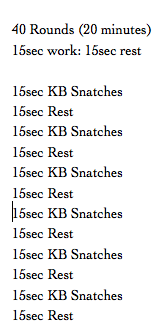
3)  15:15 Kettlebell Snatch Intervals (20 minutes total)

Screen Shot 2013-07-25 at 6.52.18 PM

I use a sub-maximal weight kettlebell for this type of workout.  Speed of movement from top to bottom, without sacrificing technique are my focus.  I could probably go for a 24kg kettlebell for this type of training session, but the 20kg has been my go to.

This is hight repetition snatch work.  Make sure you’re resting between sessions like this.  Overdoing snatches will tear up your hands, mess with your nervous system and potentially cause some overuse response in your shoulder/back musculature.  Just be aware of these things, don’t dwell on them.


Fire up one of these workouts today or tonight.  If you don’t own a kettlebell, go buy one.

You won’t regret it.

Oh one more things… if you want shorter tidbits on movement and health, head over to my Facebook Page and give it a like 🙂


Cheers to the simplicity of effective workouts,

KG

Assess Yourself Often, Decide What’s Next

Quick Tips

Image

Assessment is an essential element of physical improvement.

Ideally, frequent assessments are made not only to your body aesthetics (weight, fat, muscle, etc) but also to your ability to move freely with stability and strength (mobility, stability, strength, etc).

After all, it is completely possible to look great and move like shit.

It’s also possible to move great and look like shit.

*** I should clarify what I mean when I say “look great”… it’s in the eye of the beholder.  Our perception of what a great body looks like is grossly skewed by mainstream models, magazines and media.  Obviously, carrying higher levels of body fat can raise health concerns, but “looking great” doesn’t have to mean visible muscle striations and the almighty six-pack.  If you’re body type allows you to feel confident in your own skin in any situation, good for you, you’re there.***

Besides, most magazine models, movie actors, and testimonials from famous workout programs like P90X and Insanity are manipulated and photo shopped to amplify their physiques.  Did you know that?

Check out this great article recently published in the Huffington Post describing how fake testimonials for workout programs really are…

Having looks without movement or movement without looks both carry their negatives.

The best approach might be to meet in the middle.  It’s more than possible to improve both at the same time without sacrificing one or the other.

If you look great but you cannot move without encountering restriction or pain, life’s activities become a hassle and certain movement patterns might be avoided altogether.  No one enjoys feeling pain, so we tend to avoid moving in ways that cause it.  I’m not referring to that burning sensation felt in your arms and legs when executing push-ups or squats, but rather the debilitating lower back pain experienced while you attempt to pull up a pair a socks.  Or maybe it’s the pinch in your shoulder when you reach overhead for a clean glass in the cupboard.

Looking great isn’t the only qualifying element to health.

The advances in made in assessing (and correcting) movement over the last 10 years or so have been tremendous.  The physical therapy world and fitness world are beginning to bridge gaps to one another, with ancient practices like indian clubs, yoga and martial arts adding value to the mix.

Image

We have a much clearer understanding of joint function, breathing and soft tissue health and how it all ties together to create a highly functioning body.

We understand that six-pack abs, bulging biceps and a set of trapezious muscles big enough to scratch your ear lobes may not mean a damn thing if movement dysfunction is present.

On the other hand, maybe you move really well but you pay little attention to your body composition.  I know a lot of people who are extremely athletic but don’t pay much attention to what they put in their mouths food-wise.  Ironically, poor eating can case inflammation and pain in and around your joints also.  Here are some common foods that are worth re-considering.  Eliminating most of these foods, or at the very least reducing and substituting with more nutrient dense options can work wonders.

In the operating room, it is obvious that a lack of attention to body composition will eventually restrict joint range of motion.  Many of the patients in need total joint replacements are also overweight/obese.  The increase in body fat literally prohibits the patient from achieving a healthy range of motion in the knee joint.  The additional weight combined with the lack of range of motion earns them a trip to the operating room where a surgeon hacks, cuts and pounds his way to an artificial knee.

This is an extreme end of the spectrum, but it’s worth mentioning none the less.

Image

Both scenarios described have solutions.  But it requires that you take a step back and assess what your next move is.  Just like a chess match, there is a next move, unless you’ve waited too long.  Then it’s checkmate.

If you desire the lean body, assess your training habits while simultaneously assessing your eating habits.  I’ve tried to out train my diet before, and it’s a pain in the ass.  Once my eating was in check, my body appearance improved but ironically so did my performance, skin and quality of sleep.

If you want to improve the quality of your movement, learn a few simple assessment tests give you feedback as to what’s going on.  If you cannot squat with arms extended overhead or perform a push up without breaking at the midsection, you’ve got some work to do.  Film yourself while you test out.  You don’t have to show anyone the video, it’s for your reference and education only.  Watch yourself, compare it with other folks, preferably a fitness professional that moves effortlessly and do some research on how to fix your hang ups.

I would start with the Functional Movement Screen, and someone who knows how to conduct such as test.

Consistently assessing yourself gives you important information on you where you are, your progress thus far, and allows you to decide on the next course of action.  It gives you focused direction.  It creates a clear and simple route from point A (where you are now) to point B (where you want to be in the future).

Assess and make the next move.


Cheers to assessing, correcting and building non-photo shopped bodies!

KG

Shakira’s Hips Don’t Lie and Adding Burpees to My Kettlebell Complex Workout Kicked Ass

Quick Tips

Image

Burpees and I have a love/hate relationship, and I’m sure that most of you probably have similar feelings.  

On one hand, full burpees are as close as it gets to being a complete bodyweight exercise.

Burpees are ridiculously effective for elevating heart rate and recruiting a large amount of muscles.  Large muscular recruitment is a beautiful thing.  Burpees require little to no space, zero equipment and you can perform them anywhere.  Indoors or outdoors it does not matter.  Burpee workouts are a perfect alternative to traditional running or biking.

On the other hand- the hand that despises every aspect of the burpee- burpees are the red headed step child of my workouts.  When I see them on the docket for the day, I cringe.  I cringe because they test me every single time.  I cannot think of a single workout where burpees felt easy.  If there was a workout where burpees were enjoyable like a walk on a white sand beach on a hot Summer day, that would be a major red flag that I didn’t design my workout properly, or I was leaving something in the tank (aka:  Half-assing it).  Burpees are the vegetables of the workout world.  They require very little thought and are quite monotonous when performed for high reps.

But, when weighing the likes and dislikes toward burpees, I know full well that slipping burpees into a workout can crank up the overall impact of the workout.  The training effect if you will.  In other words, I’ve never felt worse (physically or mentally) after performing burpees at the end of a circuit or as a workout by themselves.  

Burpees deliver every single time.  

ImageShakira’s hips don’t lie and neither does my heart rate monitor.

So while I started thinking about different sub-maximal activities that I could integrate into my complex workouts- to keep my heart rate elevated in between rounds- burpees were one of the first exercises that came to mind.  It seemed like slipping them in between rounds could deliver what I was looking for.  Preferably, the filler exercise needed to be ground based and something that kept me in a vertical standing position.

So, here is what the workout evolved into:

Image

Again, the goal here was to add another 5 minutes of elevated heart rate and exertion to my training session.  I know from extensive experience that the kettlebell complex displayed in the snapshot typically takes 12-15 minutes to complete in full, so my goal was to extend the workout to 20 minutes or longer.  The addition of the burpees between complex rounds successfully did just that.

Overall, I enjoyed the addition.  I’ve added timed jump rope intervals to my complexes before, and they worked quite well.  But since I can’t seem to find a jump rope that can live longer than 2-3 months before breaking, I was forced to use burpees.  The key to adding filler exercises to tough workouts is to choose exercises that require low technical know-how.  When you’re sucking wind, trying to gather yourself before the next bout of exertion, this is not the time to be messing around with movements that have high technical difficulty.  

In fact I will just come out and say it… it’s stupid.  The risk doesn’t even come close to matching the reward.  Avoid it and you’ll put yourself in a better position to avoid injury while reaping all of the good that can come from a workout like this.

Closing thoughts…

The majority of my workouts are by design.  I rarely walk into a workout without knowing what’s about to happen, which is why I think I have adhered to this physical lifestyle for so long, and why I will remain committed to moving aggressively and intelligently for years to come.  It’s habit now, fully engrained into my life.

Each workout (or entire program) follows a general training template that I’ve got embedded in my mind.  Early in my strength and conditioning education, I consumed book after book and realized that everyone was using the same general approach to designing effective workouts and long-term programs, so I began adapting and experimenting with slight variations to these time tested principles.  

My personal preference is a system wide, total body approach to exercising, so I know that I like to see all of the major movement patterns represented in each training session (ex: squat, pressing, pulling, hip hinge, etc).  Body part splits are not for me.  I get bored.  Working a squat pattern four different ways on the same day is un-interesting to me.  But that doesn’t mean that it isn’t a great option for your fitness endeavors.

I also have a crystal clear distinction between what I classify as a purpose driven workout, and what I classify as a recreational activity.  Playing ice hockey on Wednesday nights is recreational.  Kettlebell complexes are a workout.  My approach doesn’t downplay the positives of recreational activities (because they do matter overall), but I feel that there is a major difference between “the workout” and pick up basketball.  

At the end of the day, movement in any shape or form adds up, and there is no denying this.  Any way that you can engage in it, it’s a bonus.  We can debate the details all day long, but the bottom line is make an effort to sit less and move more.  That’s a recipe worth following.

Here is a great video that diagrams how dramatic even the smallest shift in movement can have on health.  


Cheers to adding burpees to the workout…


KG 

Jumping Rope: The Undeniable Negatives (Part 1)

Quick Tips

Summary:

  • Jumping rope can be hard on the joints if done excessively.  
  • The learning curve can be a turn off.  
  • Don’t let me talk you out of jumping rope.

Jumping rope is a low cost, medium to high-skill activity people have been leveraging to build impressive cardio fitness for a long, long time.  Particularly athletes in the combat sports, boxing and mixed martial arts.

As a cardio enhancer, jumping rope is making a resurgence.

Here I am working the Ali Shuffle, and other patterns of jumping rope.  

Modern day metabolic conditioning is giving the jump rope a reason to play a large part of many high-intensity workouts.  

Screen Shot 2013-06-25 at 6.37.53 AM

When you’re a kid, you jump rope… 

As a kid, I can vividly remember jumping rope in elementary school.  We had a yearly fundraiser called “Jump Rope for Heart”.  All the kids brought their jump ropes down to the gym, they pumped some 90’s dance music, and we jumped for hours.

I was never the best rope skipper in the gym, but I could hold my own by showcasing classy moves like crossovers, single and alternate leg hops, and even surviving in the infamous Double Dutch vortex.

As a kid, you don’t over-analyze the value of jumping rope.  You jump because it’s fun, not because you want to know how to burn more calories or lose weight.  Jumping rope provides an outlet for kids to burn off extra energy while

Jumping rope provides an outlet for kids to burn off extra energy while

But then adulthood stumbles in.  Jumping rope is no longer cool, it’s taboo.  

When you’re a kid, you move for the fun of it, when you’re an adult, any movement beyond what’s necessary becomes a chore.

As we age, many ask less and less from our bodies.

The “fun” part of hopping over the turning jumping rope seems like the furthest thing in adulthood.  

“You want me to what?  Uh, no thanks”.  

Exerting on purpose as an adult becomes a depressive thought.

Screen Shot 2013-06-25 at 7.05.36 AM

But when mainstream media picks up on the trends, it often reignites our interest in old training methods.  
Screen Shot 2013-06-25 at 7.05.46 AM

Naturally, we head to the sporting good store and buy a badass jump rope. 

But before you start jumping, let’s work through a couple of hang-ups I have with jump rope training.  Particularly if you haven’t exercised in a while.  

1)  Repetitive ground impact and overuse injuries.

Screen Shot 2013-06-25 at 7.04.32 AM

Any activity overdone is going to put you at risk for overuse injuries.  

Too much of a good thing is generally a bad thing.  Drink too much water, bad thing.  Eat too much broccoli, bad thing.  Exercise too much, bad thing.

Overuse injuries certainly aren’t a jumping rope problem per say.  Overuse injuries often occur because of excess volume or intensity (or both combined) relative to what the tissue tolerance is capable of managing.  

If you’ve ever run barefoot or with minimalist shoes without some kind of pre-workout up, the extreme soreness you felt in the days after is a perfect example of impact forces overwhelming the tissues without any shock absorption.  

In other words, physical stress beyond what the body is acclimated to can create some painful issues.

As for jumping rope, it’s the ground impact forces doing the damage.  Every single jump places strain on the legs, particularly the calves and ankles.

How much strain?  Roughly 300lbs of impact is directed toward the foot and ankle while jumping rope, as measured by lab tests.

But this isn’t 300lbs just one time… it’s 300lbs multiplied by thousands of jumps per workout. Thi can be a recipe for injury if your body is not acclimated progressively.

If a person is spinning a jump rope at an average of 100-120 revolutions per minute, a 10-minute workout can add up to about 1,000-1,200 jumps.

Jumping rope for 10 minutes is nothing like running for 10 minutes.  These are two completely different stresses.  Time seems to stand still when you jump rope.  10 minutes can feel like 30 minutes.

Many websites recommend “20-minute jump rope workouts for toning”, but I am extremely hesitant to encourage anyone to jump for 20 minutes as a starting point.

Start with 1 minute unbroken, then 2 minutes… 5 minutes… 10 minute, etc.

10 full minutes of jumping rope without stopping for breaks is a commendable feat.  Once you hit 10 minutes, it’s time to go harder or increase the difficulty of the jumps (1-foot, side-to-side, running).

Now, the impact forces of jumping rope are far less than running. 

If you haven’t jumped 1,000+ times in a while, or you’re a de-conditioned individual who hasn’t engaged in moderate to high physical activity in some time, you stand a high likelihood of sidelining yourself after a short duration of jumping rope.  

Jumping rope is a sub-maximal variation of plyometrics (jump training), which can be very high-impact. Plyometric training is best kept to reasonable volumes during a workout.  Most high-level athletes are jumping anywhere from 25-40 foot contacts per workout in the off-season.  

Lesson:  Work into your jump rope training, progressively adding minutes to each session.  If you’re a beginner, consider jumping from less than 5 minutes cumulatively per workout.  You can always build up.  

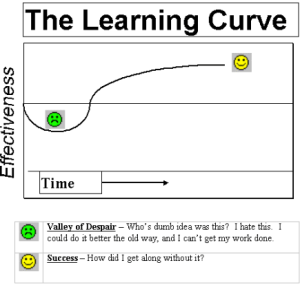
2)  Learning curve versus training stimulus.
Screen Shot 2013-06-25 at 7.03.02 AM

Here’s a realistic scenario…

You go out and buy a jump rope to whip yourself into shape.  You get that baby home, rip it out of the packaging and head to the garage.  After you put on your workout playlist, get ready to turn the rope over like Muhammad Ali.  

Wham!  You catch your feet and stomp the rope on the very first turn.  Hey, no problem, it’s the first time in a long time you tell yourself.  Here we go again…

Wham!  Shins this time.  Wham!  Ceiling got in the way.  Wham!  Back of your head, not enough tension on the twirl.  Wham!  Toes again, but somehow this time the rope tied a knot that you have to unravel.  Damn, a tight knot too.  

Next thing you know, the rope is 10 inches shorter and you’ve wasted 45 minutes jumping 25 times.  Ouch.

Don’t laugh now.  This is a real scenario, I’ve seen it happen to coordinated athletes, so I know it is happening to the average Joe and Jane all over the world.  

The real benefits of jumping rope comes from continuous jumping.  In other words, getting hung up on your toes every fifth turn isn’t going to allow for any real training effect.  You won’t be exerting long enough to accomplish much.  

I applaud your spirit and motivation, but we have to consider one thing…

Jumping rope is a skill.  And like any skill, we all have a unique starting point and learning curves of various lengths to become better at that skill.  Some will acclimate to the rhythm faster than others.  Here’s another important thing to consider:  some of us have a higher resilience for knowing that we suck at activities, yet continue to practice until the day we move passed the “suck” stage.   

If you’re terrible at jumping rope AND you have a tendency to shut down at first encounter of resistance, consider saving jump rope practice for after normal gym work, when you have peace of mind that some quality work was put in.  

But don’t let me turn you off from jumping.  Get after it.  But beware, you may not have the workout of your life on the first go around.  

If your goal is to get into shape ASAP, and for many people it is.  Riding the struggle bus for 15-20 minutes a day just to turn a rope 10 consecutive times without stepping on it won’t sound like fun to most people.

Therefore, it may be worth considering that the jump rope can take a backseat to bread and butter activities like running, cycling, rowing or lifting weights.  Even a potent bodyweight workout should be considered before re-engaging with the rope of death.  Talk about defeating.  

Again, jumping rope is a skill.  Expect it to involve failure, slow progress, and patience.  

If you’re lucky, you’ll hop right into it.  If you’re not, I warned you.  

Lesson:  Treat jumping rope like a skill.  Dedicate a small amount of time before or after your main workout to improving your jump proficiency.  Don’t make the mistake of putting all of your eggs in the jump rope basket, only to find out you can only manage 10 seconds of continuous movement before you smash your toes.

This tip will save you a lot of frustration.

3)  Cardio benefits over-hyped.

Screen Shot 2013-06-25 at 7.01.19 AM

Yes, jumping rope burns calories, but so does doing the laundry or making the bed.

Yes, jumping rope can improve cardiovascular function, but so does push mowing the yard.   help reinforce posture during exertion.  

Yes, jumping rope can be a decent reinforcer of upright posture, but so is waiting in line for public transit.

Compared to running, rowing, cycling, kettlebell swings/snatches, burpees, or smart bodyweight circuits, jumping rope delivers less bang for you cardio conditioning buck.   

Some of this circles back to the learning curve and the barrier it has to a reasonable training effect.  

I’ve seen videos of Ross Enaimat spinning a jump rope so fast I wasn’t even sure it was still in his hands, but not everyone is Ross Enaimat.  

He’s got over a million views on some of his YouTube videos from people eating popcorn watching him sweat, aspiring to have his conditioning without putting any effort in.

Returning to my previous point about training effect, head out to your local hill for some incline sprints or pick up your heaviest kettlebell and swing away.  

You’ll probably find time is better spent elsewhere to get that conditioning stimulus.

Adaptation sadness…

At some point, you’re going to experience diminishing returns on your efforts.  This is called adaptation.  It’s a good thing and a bad thing.  It’s good because you’ve established an efficiency at a certain skill, intensity, and duration.  It’s a bad thing because now, you have to push yourself harder to keep progressing.  

Adaptation is bound to happen with any activity you commit to doing on a regular basis.  It’s only a matter of time.  

When you reach this adaptation point, it is important to remember that jumping rope is no different from any other form of exercise.  You have to re-adjust the variables in order to continue progressing and break out of your adaptation, moving forward to the next level of adaptation.

The problem, once again, circles back to the issue of learning curve.  Once you’re a pro with single hops and the duration of jumping is hovering around 15-20 minutes, personally, I feel it’s time to figure out how to leverage the next progression in order to save your precious time.  Unless you love jumping rope that much.  

So how do we progress?  Well, you could…

  •  Buy a weighted jump rope
  •  Increase the tempo of the jumps (turn the rope faster)
  •  Decrease base of support (single leg hopping)
  •  Mix and match various jumps (front to back, side to side, boxer jump, high knees, etc)
  •  Move on to Double-Unders

Adjusting any one of these variables will progress the training stimulus and keep you away from stagnation.

Wrap Up…

You’ll notice that this post is more of a cautionary tale than anything.  

Personally, I jump rope before almost every single workout.  I love it.  It get’s me in a standing position and it serves as a great warm-up prior the tough part of my training sessions.  

Jumping rope is not a bad activity.  But, it’s important to know how it could be bad, and where the disadvantages are.  Probably the most important part of this article is the warning about overdoing it.  The impact can leave you limping for days afterward.  

Some of you will be able to pick up a jump rope and get after it aggressively from the start.  Others won’t make it 3 consecutive turns without tying a noose around your ankles or blooding up your toes.

Get to know yourself, your current physical conditioning level, and make a decision if jumping rope is right for you.  If it is, schedule some practice time before or after a workout to hone your jumping skills and acclimate your body to the stress.  

This article would be a real let down if I didn’t recommend at least one great resource to related to jump rope training:

If you found this article while searching for alternatives to high-impact activity, I highly recommend you to check out these posts:

Cheers, 

Kyle 
It’s Just a Kettlebell Swing Workout

Quick Tips

Image

The kettlebell is a gym in itself.

I have not found any other tool that produces such dramatic results with body composition.

Sure, nutrition is a MAJOR part of ridding the body of fat and getting lean, but outside of a focused nutritional regimen, kettlebell training and more specifically kettlebell swings are a godsend to those who seek fat loss.

I have seen a lot of talk about the kettlebell swing’s ability to increase conditioning, but the truth is that I am not entirely sold on the idea of using the kettlebell swing for boosting conditioning.  I think that a fit individual who attempts to use kettlebell swings as a conditioning tool is going to quickly find that the volume of swings needed to elicit the kind of training effect needed to take one’s conditioning to the next level far exceeds the risks of overuse and mindless reps.

And quite frankly, extremely high rep sets is going to cause your grip to give out before your hips will.  I guess I would rather use other tools for increasing my conditioning (ex:  Airdyne, hill sprints, sled pushes/pulls, etc)

On the other hand, if you are a person who isn’t in game shape just yet, the training effect of kettlebell swings might be just what you need to mix into your workout regimen.

Either way, kettlebell swings are a great drill when performed with decent form, using a decent weight.  When selecting a weight to use for swings, go heavier rather than lighter.

Your hips are the most powerful region of your body and using a heavier bell will eliminate that chances of cheating the bell up with the arms.  Actually, “lifting” the kettlebell during the finishing movement of the swing is one of the biggest mistakes that I see in people.  The arms should definitely remain “taut”, but there should be no involvement from the shoulders when exploding out of the “hiked” position into the vertical standing position.

I like to picture my arms as two pieces of rope attached to the kettlebell when swinging.  My hand grip is not a death-gripped around the bell, but rather tight enough to keep control of the bell throughout the arcing motion.

The kettlebell, as I mentioned above, provides a fantastic opportunity to engage in a dynamic workout no matter what the occasion.  I personally love to engage in “swing-only” workouts the day after a tough cardio-strength training session.  If my body feels like it can handle the load of the kettlebell, I will go for a nice session of swings only.  Nothing else.  If I feel completely drained from the previous days workout, I will reach for the Schwinn Airdyne (aerobic based session) or simply roll and stretch and skip exertion altogether.
Long-term fitness is maximized when following a plan, but fine tuned and customized when you learn to listen to your body.  If you can train, train.  If you feel like you’re forcing everything that day, take a rest day and focus on hydration, nutrition and rest.  There is no shame in that.  I repeat, learn how to listen to your body and learn how to back off your training when it’s needed.

So, as the title of this post states, here is a simple swing only kettlebell workout that I have used in the past.  I view these as practice.  Swinging is an art, and I am not a master, although I do make a conscious effort to improve the efficiency of my swings, increase weight and continue to make forward progress.

Image

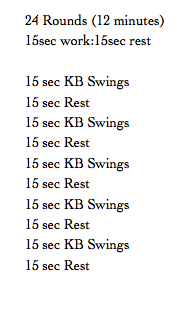
Alternating for 24 rounds (Set #1):

—->  15 seconds of 2-handed swings

—->  15 seconds of rest

Total Time: 12 minutes

Depending on your fitness level, you can stop here, or you can rest for 2 minutes and move into:

Alternating for 24 rounds (Set #2):

—>  15 sec Right Hand 1-Arm Swing

—>  15 sec rest

—>  15 sec Left Hand 1-Arm Swing

—>  15 sec rest

… and so on.

Total Time:  12 minutes

24 rounds seems like a lot, but consider that each work set is 15 seconds long and it is not maximal effort.  Why isn’t it maximal effort?  Because while kettlebell swings are definitely physically demanding, they are not a movement that you can max out on.  The bell swings as it will.  It is very tough to increase the swing count per work set to a point where you are will reach heart rates or perceived exertion that will tap you out.

The glory in kettlebell swings is the muscular engagement combined with the cardiovascular training stimulus.  This combination is pure gold for fat loss.

For a 15 second round, I am typically hitting 8-10 reps of kettlebell swings with a 28kg-32kg kettlebell.  This is my swing count for both two-handed and the single handed swings.  Single hand kettlebell swings call for a lighter weight bell and possibly a slightly slower rep count for the given work period.

*** Set a timer for alerting you when to swing and when to rest.  I suggest a GymBoss Interval Timer, but you can use whatever is easiest.  Ideally use something that doesn’t require you to work through mathematical equations in your head while trying to take in oxygen.  Not fun.

Please take care and attention to your form.  If it breaks down during the workout, put the bell down.  There is no blue ribbon at the end of the workout for struggling through with shitty swing form.  Only bad habits and increased likelihood of injury.  After the first 24 rounds of 2-handed swings, rest (yes, rest), and re-group for the single arm swings.

If you don’t know how to swing a kettlebell, a workout like this is not the place to learn.  If you can swing 2-handed comfortably but have never swung using the single arm version, again, this is not the place to learn.  Practice your technique before you engage in a workout like this.

If you clear the prerequisites listed above for entry to a workout like this, my only comments left are: don’t be afraid of work and opening up those lungs babies.

Set a timer and go for it…

Cheers to swinging fat off your body in record time!

KG

P.S.  As I mentioned above, fueling your body appropriately will enhance your workouts and your results from those workouts.  Precision Nutrition is the best nutritional program in the world right now.

How to Use a Suspension Trainer: The Set Up and Basic Tips

Quick Tips

While combing over the internet, I noticed that there aren’t many updated resources that share how to properly use a suspension trainer.

Since I am a huge fan of suspension training, both for beginners and advanced trainees alike, I thought I would share the need-to-know information on how to successfully use a suspension trainer.

Here we go…


1)  Buy one.

Jungle Gym XT

I know this sounds elementary, but you have got to actually buy a suspension trainer for rest of this post to have any positive effect.  Stop hovering and purchase yourself a nice unit.  I highly suggest buying from a couple of manufacturers… LifeLine Fitness and TRX are the major players.  My suggestions for these units are based on personal experience and also a simple observation of what the best coaches in America are using with their athletes and clients.  I am a LifeLine Jungle Gym fan (pictured above).

You can build your own suspension trainer if you like.  They are really nothing more than tough nylon/kevlar straps with handles and loops.  Not rocket science.  However, if you choose to build your own suspension trainer, I will caution you that your fate rests in the quality of your craftsmanship and material you choose to use.  Build at your own risk.

Below are links to the different brands that I mentioned, along with a link to a


2)  Anchor the suspension trainer.

Suspension trainers are effective because you’re able to leverage your body mass against the directional pull of gravity, which creates the  resistance during exercises, demands stability and mobility, etc.  If your anchor point is sketchy, your suspension training is going to suffer.  Trust me, you don’t want to be in the middle of a set of body rows wondering if the anchor point is going to collapse.  The nice part about suspension trainers is that you can anchor to a closed door, or directly overhead, so you have options.

From personal experience, only anchor the suspension trainer on the door if you have no other options.  Why?  Because anchoring on the door limits your exercise selection, and can make a lot of the exercises, well, awkward.  Anchoring to a door means that the suspension trainer will never cross the mid-point of its range of motion, so exercises will start with arc built into them.  The door prevents any backswing, and any low hanging movements will have arc built into them no matter what.  Due to the arc, exercises like push-up+knee tucks (aka: atomic push-ups) and suspended hamstring curls now become much more difficult.  If you’re a beginner, your technique may suffer because of the increased difficulty of these movements.

Hanging the suspension trainer directly overhead gives you immediate freedom to not only progress all movements, but also regress movements to make exercises more effective.  The overhead position also allows for an infinite number of body positions that will serve to increase or decrease the training stimulus for any given exercise.  Take a simple (yet awesome) movement such as body rows.  For a beginner, I would suggest starting in a lean back position where the heels are firmly planted into the ground surface, while the pulling action is angled to anchor point.  Angling the pull will decrease the resistance of the exercise, increasing the likelihood of successful reps.  For an advanced trainee, I would suggest moving your body directly underneath the anchor point so that the pulling action is completely vertical (up and down).  In this position, the resistance is completely vertical.  The loading is therefore increased the exercise is much more difficult.

***  It is also worth mentioning that increasing horizontal (in relation to the ground) body position (supine or prone) with exercises like push ups and body rows increases the challenge of keeping the body rigid and straight from head to toe.  In other words, there is an increased demand on the torso musculature to maintain this static posture while work is being done elsewhere.

The suspension trainer, based on the body row example, is highly adjustable to fit any strength level.  The stimulus presented to the beginner is just as intense (based on their fitness level) as the stimulus received to the advanced trainee (based on their fitness levels).


3)  Angles

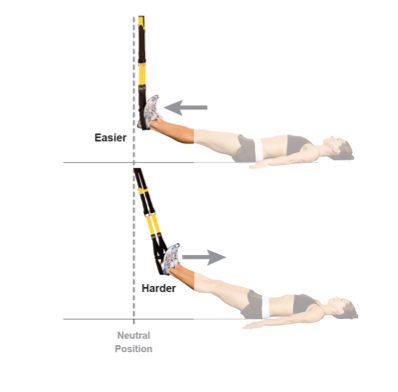
Suspension training is all about body position in relation to the anchor point of the straps.

Suspension Training Angles

Figuring out the angles to increase or decrease the difficulty of movement is part of the beauty of suspension training.  Using the body row example, the more your move your feet underneath the anchor point, the harder the exercise becomes.  Push-up + knee tucks become more difficult based on your starting position.  When your feet start directly underneath the anchor point, the effort to complete the knee tuck decrease.  If you walk your hands out and start with feet ahead of the anchor point, the knee tuck becomes increasingly resisted based on the natural arc of motion.  Move your feet behind the anchor point, and arc becomes an assistance aid for the knee tuck.

Screen Shot 2013-04-19 at 9.53.25 AM

The feedback from the suspension trainer is immediate.  If you know your target reps for a given exercise, it becomes trial-and-error to locate the proper body position that allows for completing those reps without sacrificing technique and challenging your body through the entire range of motion.


4)  Integrated movement.

One beef that I have heard from others regarding the use of suspension trainers, is the lack of real world carry over.  The argument is that a suspension trainer workout regimen lacks a loaded vertical posture (thinking standing) during most exercises.  This is true.  However, we often forget that not every exercise needs to look like something that we are doing in real life.

mowing the lawn

Example:  I often reach for and return water glasses to the highest cabinet of my kitchen, but do I need to lift dumbbells on my tippy toes to train for that?  No.  I push a lawnmower around my yard in the Summer.  Do I need to push a heavy sled to train for that?  No.  This is a personal beef that I have with people who attempt to make exercise look like real world activities.

The suspension trainer is a tool, and as a tool you need to understand that it is not going to be the be all end all of fitness.

Using a suspension trainer will accelerate and enhance your ability to successfully perform other physical tasks in life, no doubt about that.

The suspension trainer provides a low-cost, high reward training stimulus to its users that incorporates movements that are safe and effective.  The workouts are meant to enhance the physical function of our bodies, and as a byproduct you’ll improve your body composition.  Building strength, stability and mobility with a multi-dimensional approach will yield high carry over into daily life.

Besides, if you enjoy suspension training and you’re making progress, why worry about anything else?  The grass is not always greener on the other side, keep it simple and stick to your recipe.  Trust your training.


5)  Buy a book or reference a website for exercises/workouts.

There are thousands of free resources on the internet that share knowledge about suspension training.  I am an exercise technique junkie, so I am going to recommend that you keep checking my YouTube page of updated videos of suspension training exercises, but the choice is yours.

As I always do on this blog, I will remind you to keep your efforts on the suspension trainer simple.  Avoid going fancy with your movement.  Lock in technique for basic movements and then progress (using common sense) from there.  To this day, I still use the simplest of movements which include (but are not limited to):

  • Push ups
  • Body Rows
  • Planks (and variations)
  • Shoulder activation exercises
  • Chin Ups
  • Knee tucks
  • Explosive jump variations
  • Squat variations
  • etc.

If you are finding that you have progressed beyond the basics, add a weight vest and work through the same exercise variations once again.  It’s that simple.  Keep progressing in an intelligent manner.

It’s just a matter of challenging yourself each time you use your suspension trainer.


Cheers to suspending yourself!

KG