
Redemption: The Matthew McConaughey Ninja Bodyweight Workout

Quick Tips

Ninja Workout

I have to start by offering an apology for misleading many of you on my previous article about Matthew McConaughey’s training philosophy.

All I did in that post was mention that “he sweats”, which I suppose made complete sense to me as the main point of the article, but left many of you readers wanting to know some specifics.  After reading it, I feel that the message was received, but it was lacking in “how-to” knowledge.  That is my error.  I hope to redeem myself by sharing a decent little bodyweight workout with you today.

In honor of Spring of course.

Hopefully I can redeem myself here.  I’m nervous.

Wisconsin Mecca

The Mecca of the Midwest

As the weather warms up here in “God’s Country”, Eau Claire, WI, the doors begin to open to all sorts of opportunity for engaging in physical activity outside.

Training outside is the greatest.  It’s freeing.  The air is fresh (depending on where you live), the sun is beaming, and quite honestly, when you train outside the workout seems less monotonous than training indoors.  Training inside year round can make you feel like a rat in a laboratory.

[Segue…]

Alright, let’s talk about Matthew McConaughey’s workout, because that is why we are gathered here today.

Screen Shot 2013-04-05 at 6.54.52 AM

Super awkward that I had to post this pic, but needed the visual.

Let’s face it, guy has the kind of body aesthetics that women drool over and men want, yet his theory on physical activity and what it takes to maintain his physique is so incredibly simple.  I love that.  Why complicate matters?

Performance-wise, I’m not entirely sure how strong the guy is, if he has aches and pains or any sort of endurance.  But aesthetically he is doing alright.

Just sweat everyday… doing something.

I received a lot of interest in the previous article, so I should probably man up and post a workout of his… ahemmmm… or at least a workout that I believe he may enjoy participating in.

Well, ok… maybe it’s just a workout that I designed with the thought that if he and I were hanging out, he would enjoy working through it with me.  Based on some of his older interviews in Men’s Health, he tends to avoid the gym whenever possible in favor of training outside in a more natural environment.

Workout structure

Equipment:  None (although a heart rate monitor is highly encouraged)

Time commitment:  30 minutes-ish

Difficulty:  3/5

Screen Shot 2013-04-02 at 7.01.47 AM

*** Warm up***

Start with a 5 minute run at 70-75% of your HRM (heart rate max)

  • Run #1)  2 minutes at 80-85% of your HRM (heart rate max)

—>  Recover to 130 bpm

a)  20 Push Ups (no rest leading into the run)

  • Run #2)  2 minutes at 80-85% of your HRM (heart rate max)

—>  Recover to 130 bpm

b)  20 Reverse Lunges (no rest leading into the run)

  • Run#3)  2 minutes at 80-85% of your HRM (heart rate max)

Recover to 130 bpm

c)  20 Bodyweight Squats (no rest leading into the run)

  • Run#4)  2 minutes at 80-85% of your HRM (heart rate max)

–> Recover to 130 bpm

d)  20 Burpees (no rest leading into the run)

Finish with a 5 minute run at 70-75% of your HRM (heart rate max)


Fitness thoughts

Buy a heart rate monitor.

If you are going to take your cardio training seriously, you need to be monitoring your work bouts and your recovery time with a heart rate monitor.  Buy the cheapest version Polar sells if you are concerned with cost.  It will work just fine and help guide your training.  The heart rate monitor will give you insight into your progress.

On the 2 minute run, which is the “work” portion of the session, you’ll notice that I suggest running at a pace that is 80-85% of your heart rate max.  The easiest way to figure out your heart rate max is to get on a treadmill, crank it up to a ridiculously high speed and incline, and sprint until your vision becomes blurry.  The test ends when the treadmill spits you off.

JUST KIDDING!

Seriously, don’t do that.  However, there are some equations that you can use.  Most heart rate related formulas have some flaws in them.  They are just formulas, estimations, so this makes sense.  The Karvonen formula is “the best of the worst” when it comes to finding max heart rate.  No matter which formula you choose, remember that your heart rate “training zones” are going to be ESTIMATED.  I’d rather you use these formulas than the really old school method of finding heart rate, which is nothing more than 220-(Your Age).  220-your age is quick, but there is a lot of room for error.

Recover to 130 bpm after each run prior to working through each bodyweight exercise.  Recovering to 130bpm will keep your training efforts aerobically challenging and also provide an beats per minute (BPM) mark to green light the next work bout.  Recovering based on time is ok in a pinch, but recovering based on when you heart is ready to go again is preferred.  Your body will let you know when it’s time to go back to work.

The bodyweight strength movements that follow the rest periods are integrated to break up the monotony of running and provide a low load resistance based training stimulus.  Don’t expect to build great amounts of strength from just 20 reps of any of those movements.  If fact, let me re-phrase that last sentence… You will not build strength from those exercises.  Not at that rep count, with bodyweight load, etc.  Unless you are relatively reconditioned (which isn’t a bad thing) or new to purposeful exercise.  You may experience some strength gains, but I would rather see you work through a dedicated strength program at that point.

Scale the workout.  Run for less time if you need to.  Decrease the reps on the bodyweight moves if you need to.

Or, if you are battle hardened, increase the running time, add a few more rounds of bodyweight moves, etc.

Take your training outside and get some fresh air.  It will change the training experience.


Cheers to breaking up the monotony of running!


KG

Inspiring the Unknown

Quick Tips


Old video, timeless lesson.

The greatest reward of conquering something epic in life often goes unknown to the person that accomplished it.

Huh?

Let me explain this a for quick second.  Hold on tight it might get a little messy (you’ve been warned).

Crushing a task that seems so challenging, so lofty that you’re not even sure how you are going to achieve it (even though you know you’re going to scratch and claw to get there) provides a valuable lesson in character building.

However, attaining goals also inspires onlookers (known or unknown) to initiate an all out attack their goals, dreams, aspirations.

Seeing is believing, and when we see our peers accomplish something epic, it provides just enough of a motivational nudge for us to follow suit.

I call it inspiring the unknown, and it happens every single day.

Screen Shot 2013-04-08 at 6.28.43 AM

Paying it forward.  Nearly 2 years ago, while waiting in line at a coffee shop in Minnesota, I watched my best friend buy a lady’s coffee who was waiting in line behind us.  When she asked why he would be so generous, he proudly announced, “It’s my pleasure, I am paying it forward and maybe you can do the same”.  As he said this, 5-6 other people who were also waiting in line overheard his remarks.  The lady was floored by his random act of kindness.  I was floored at the impact of the event.  I think about it often.

Imagine that.  A single gesture can spread to 6-7 onlookers who then go on to tell all of their friends and family of what they had seen, which then spreads like wildfire to their social networks and beyond.  Inspiration.

These days, I am more impressed by the average person’s journey to greatness than another superstar athlete or hotel mogul.  

(Please know that no one is “average” and that we are all unique.  We become average in our day-to-day actions/behavior).

Average people inspiring other average people to demand more of themselves.

We can all relate to the average person.  The ripple effect of an average person pursuing greatness is amazingly simple.  We see a person achieve their goals, then we want to achieve our goals.  It becomes fuel.  We witness their own personal victory, than we desire that same success.

That’s cool.

That’s a fantastic reason to set targets in life and work relentlessly place the arrow dead center in the bullseye.

Screen Shot 2013-04-06 at 11.06.26 AM

You’re killing two birds with one stone.

Bird #1)  You’re proving to yourself that you’re capable of achieving more than you once thought possible.

Bird #2)  You’re (without awareness) inspiring others to stop testing the temperature of pool and finally jump in.

Screen Shot 2013-04-05 at 11.08.26 AM

It’s scary when standing at the bottom of the mountain, gazing up at the rocky terrain that you’ll have to traverse in order to get to the peak.  Dead scary.  It can be crippling actually, to the point that you never take action.  We all approach these obstacles with a different mindset.  Some people see them as speed bumps and some people see them as 20 foot walls.

But having the conviction to traverse that rocky terrain is what inspires other people to do the same.

If you have a pulse, you’ve undoubtedly run into that 20 foot wall and thought, “shit”.  It’s easy to throw in the towel when that happens.  In fact, it’s a hell of a lot easier folding your cards at the first sign of adversity than it is to grind it out until the bitter end.

A hell of a lot easier.  But that doesn’t build character and that doesn’t inspire others.  That creates feelings of regret.

Screen Shot 2013-04-08 at 6.28.51 AM

As it relates to physical activity, I have thought about quitting more times than I’d like to admit during a workout/run/bike.  More than I can remember. In fact, every single time I squat I feel like racking the bar 3 reps short of my scheduled reps for the day.  It would be so easy.  No one would notice, right?

Or how about eating habits?  I would love to eat pizza everyday and wash it down with a couple of craft beers.  Or eat raw cookie dough for breakfast every single morning.  That would be great.  But I cannot do that.  It’s not conducive to achieving my goals nor is it the example/standard that I have chosen to set on this blog.  I’d be letting you down and letting myself down.

In my athlete days, we would condition ourselves to the point of exhaustion early in the season to prepare for the physical demands of the season.  There were many occasions, with my lungs in my throat, I considered dogging these conditioning practices just enough just to get by.  My teammates wouldn’t notice, right?  I could finish in the middle of the pack, not first but definitely not last.  I didn’t have the heart to do it.  Because if I chose that path, then the next guy would do it, then the guy after that would do it, and on and on.

If I dogged it, who does that serve well?  Who draws inspiration to push on from someone else’s average effort?

keep calm and workout

It took me a really long time to realize that most shitty hands that we are dealt in life rarely involve events that we can’t handle.

We are equipped with the tools and capacity to endure mental and physical stress.

But occasionally, our internal wiring gets mixed up and our systems begin to malfunction.  Our attitudes become vulnerable and we feel ourselves start to stumble toward what we want.  Then crawl.  Things get difficult.  That 10 foot wall turns into a 15 foot wall, then a 20 foot wall.  The negative self-talk appears.

When this happens, remember all of the people who need the motivation of your success to start making moves to achieving their own.

Someone is watching you, wondering if you’ll have the courage to keep pushing forward.

And when you do, that someone who has been lurking, waiting for inspiration, is going to spread their wings and take flight for no other reason than they saw you do it.

That’s one kind of trendy domino effect that this world needs.

Just like my good friend that chose to pay it forward.

Conquering and inspiring.  Two great words to add to your life resume.


Cheers to inspiring average people to accomplish amazing things!


KG

Crushing Your Workout’s Comfort Zone

Quick Tips

Image

Aaaaahhh comfort.  What a great word.  It brings such a heart warmed feeling just thinking about it.  We all love comfort.  The comfort of home, the comfort of socializing with long time friends and family, the comfort of driving the same route to work everyday and the comfort of knowing that everything is going to be alright.

Image

… and here come the black clouds… 😦

Let’s do a u-turn and get real for a few minutes…

… because this post is about identifying and breaking comfort to strive for more.

Comfort is the enemy of building fitness:  getting stronger, running farther/faster, stretching longer, assessing smarter, conditioning harder or choosing to eat wiser.

When you get comfortable in your pursuit body transformation or performance enhancement, you are essentially saying that your work is done.  You slip, lose control, let important things fall to the wayside.

But your work is never done because you are always are work in progress, always.  You have to be, otherwise you have submitted.

I read a Facebook post by Scott Sonnon where he describes himself as being “always a white belt mind”.  If you aren’t familiar with Scott’s background, he is a world champion martial artist turned strength and conditioning innovator.  I don’t agree with everything that he teaches, but he does push the boundaries of what we consider to be “functional” in the training world.  He’s got a bunch of other accolades and awards under his belt (no pun intended) that you can Google if you’re interested further.  He’s extremely bright guy and I enjoy reading this work.

It’s been said that exercising and eating properly is a “lifestyle choice”, and well, as shitty as it is for me to admit this, it really is.  I really don’t like dropping that line because everywhere you walk some donkey is preaching that same old song and dance.

Image

Got lost there for a second… sorry… back to comfort…

Getting comfortable leads to all kinds of silly workout habits that can become hard to break:

  • Lifting the same dumbbells over and over.
  • Never switching your training variables… same reps, sets, etc.
  • Skipping reps and sets, or even entire workouts.
  • Resting for the same amount of time after each effort.
  • Running the same mph, for the same amount of time, for the same distance.
  • Biking for the same amount of time, at the same RPM, for the same distance.
  • Refusing to evolve and try new movements or methods.
  • *** Refusing to change or FEAR of change.

***  This is a big one.  There are a lot of people out there who are scared of the unknown.  They fear the thought of working to improve themselves.  They fear the anticipation of how difficult it will be to lift more weight, condition harder or uncover weak points in their movement.  We end up tricking ourselves into thinking that we are “doing the best that we can”, but there is always another level that we can get to.  Check out this post regarding success, it has a lot of carryover into breaking through the comfort zone in your workouts.

—>  My own story

I’ll step up here… I was scared to put myself out to the world, start a building an audience (again) and take my writing seriously.  I cared too much about what people thought, or how my message would be received, so I threw away nearly 100 pages of written material.  Now I realize that I am on the right track, my writing does serve a purpose and all of this “practice” will force me to break through my own comfort zone.  I learn something new every single day and I love it.

Fear is paralyzing… and it is also just a feeling.  I repeat, fear is just a feeling.

So the next time you step foot in the gym, bring that new strength program with you and give it a shot.  What is the worst that could happen?  You get tired and realize that you’re a little weaker, unstable, immobile than you thought you were?  Who cares.  People care a lot less than you would think.  Go for it.

Most of the bulleted points above are representative of a person who has already committed to fitness at one point in their life and are now stuck in the rut.  They get stuck in a rut and it gets tough to wake up and dig out.  Waking up only happens when you become aware that your current workout habits are no longer serving you well.  You’ve got to realize that your body is really good at adapting to the stresses that are constantly placed on it.  Especially if those stresses never change.

Screen Shot 2013-03-29 at 7.09.46 AM

Experts of developing bad habits.

We become experts are what we repeatedly do, which in some cases is a good thing (good habits), but in a lot of cases, we have become experts of carrying through with poor habits.  Less than optimal habits. (I’ll be the first to stand up here too).  Breaking habits is a billion dollar industry.  Look at guys like Tony Robbins.  He’s built his entire career around teaching people how to break bad habits and develop habits that are more conducive to achieving success.

Change it, don’t be afraid to change it.

But not all of you have begun your pursuit of fitness yet.  Some of you don’t know where to start.  You’re searching for that beginning point to build from. For you folks, you can learn from the mistakes of the folks who are currently stuck in their comfort zone.  Avoid it.  Learn how to progress your exercises, add reps, sets, weight and difficulty of movement.  Train on one leg, two legs, sprint up hills, jump over hurdles, pull your body up to a bar, push your body away from the floor, hold a core demanding static position for time, take joints through a full range of motion even when they feel “locked” up, smash your tissue with a foam roller and then take a lacrosse ball to your feet for a few minutes

Keep progressing, keep pushing forward.

You get the point.

Image

In my own training, I have plateaued.  It is time to move on.  I would’t say that I was in a “comfort zone”, but I definitely reached a point of no return where going longer and harder was foolish… I need to increase the poundage.  Making myself increasingly tired by adding volume during my sessions isn’t accomplishing anything, other than making me… more tired.  Those double 24kg Lifeline Kettlebells have officially become too light.  It sucks to say it, because we had a great run, but it is time to move on to bigger and better kettlebells/barbells/etc.  My conditioning has never been better (except in my hockey playing days) but my backside is weak as hell (article about that coming soon) and my upper body pulling strength is lacking.  It is time to upgrade the gym and increase the demands of my training.  I made it last a while, and it was a great experiment.

Getting comfortable in anything in life can have disastrous outcomes.  Whether it’s career, working at building relationships or making your time worthwhile in the gym, if it is worth pursuing, it is worth pursuing aggressively.


—>  The irony of “having no time” and the comfort zone…

If you’re a person that’s pressed for time and you’re caught in the black hole of a workout comfort zone, you’re committing the ultimate sin.  Do you see the irony in not having any time to workout and then when you do finally workout it is same generic routine that you always use?  No wonder people are depressed and confused from their progress in the gym.

You’re going through the motions… stop now.


—>  Here are 5 quick tips to crushing comfort zone syndrome:

1)  Increase the load of your lifts, now.  (add roughly 2.5-5lbs to each lift every couple of workouts)

2)  If engaging in aerobic:  decrease the time to cover the same distance (move your ass!), increase incline or resistance, monitor your heart rate (effort) or ditch aerobic training altogether and throw down with some interval training sessions.

3)  Trade machines for free weights.  (Machines are for rehab patients and the elderly)

4)  Find someone that trains harder than you do.  (You become who you hang around)

5)  Set a goal with a date and read that goal 2-3 times a day.

If you felt like I was calling you out at any point, you’re guilty.  I feel the same way when I read articles about taking actions to the next level, especially the link I shared early in the article related to success.  There is always room for improvement, room to grow, another gear…


Cheers to crushing comfort in your workouts!


KG

A Quick Cardio-Strength Workout: Suspension Training + Bodyweight Training

Quick Tips

Screen Shot 2013-03-28 at 9.36.02 AM

Time is a limiting factor when it comes to staying active.  Whether the lack of time is a perceived or it is legitimate, it is still a limiting factor.

Proving that a short and intense training session is highly effective for creating forward motion is important.

That’s why I will continue to throw together small installments of workouts like the one below, because you need to know that you’ve got solutions.

Not every workout has to be a 2 hour affair.

Once you see results from these short burst training sessions, you’ll begin to see opportunity in every small window of free time to sneak in a quick workout.

Let’s get into it.

Here is a simple workout that integrates the suspension trainer with more traditional bodyweight movements.  It’s deceptively taxing.

Enjoy…

Equipment:  Suspension trainer, bodyweight, timer

Space:  8x8ft

Time: 15-20 minutes

Impact:  Low-Moderate

Complete at least 3 rounds (up to 5 round) of the following reps/exercises with no rest between exercises:

  • 20 Push-Ups
  • 20R/L Rear Foot Elevated Single Leg Split Squats (Suspension Trainer)
  • 20 Inverted Rows (Suspension Trainer)
  • 10 Ab Wheel Rollouts
  • 20R/L Mountain Climbers or 20 Burpees

Rest:  1-2 minutes before starting the next round.

Repeat for 3-5 total rounds

Here is an unedited/summarized video clip of the workout….

A couple of things:

  1. Scale the workout.  If you are new to training, perform 10 reps of each instead of the recommended 20 reps.  Switch single leg squats for traditional bodyweight squats.  Perform as many regular push-ups as possible, when you get tired, move to knee push-ups. If you’re advanced, aim for 5 rounds.  If you’re still not impressed with the difficulty, add a weight vest.  I can keep going all day with progressions to help increase the difficulty of a workout like this, if you have questions, just ask me!
  2. Buy a suspension trainer.  Some of you won’t see the value in this, but trust me, there is value in this.  It opens up a whole other world of working out that you didn’t know existed.  It makes a lot of exercises far more natural and enjoyable.  I prefer the Lifeline Jungle Gym XT because of price and quality.
  3. 10 reps for ab wheel roll outs.  Please take notice of the decreased reps for this movement.  I have completed this workout using 20 reps before, and quite honestly, it just took too long.  All of the other movements are up tempo and then boom… slow on the roll outs.  Plus, form breaks down quickly with high rep anti-extension core work.
  4. Go for it.  Assuming you’re using your head (aka: common sense) and you’ve been cleared by a physician to participate in physical activity, just go for it.  Warm up, and get to it.  The more you think about it, the greater the likelihood that you’ll talk yourself out of it.  Less reading, prepping and planning.  Sometimes you’ve got to take the road map and get behind the wheel.  I already gave you the road map, now get driving.


—>  Some thoughts…

I love training sessions like this, they are quick and to the point.

If you travel, training like this is cash money.

We address the entire body in a short time frame, using mostly unloaded movements that are resistance based.

One important thing to remember:  Don’t under-estimate the effectiveness of bodyweight training, yet don’t expect too much from bodyweight training.  Keep everything in perspective.

Just do the workout and see how your body reacts to it.  Your body will tell you what needs to be tweaked the next time around.


Cheers to finding a way to get it done!

KG

Is Aerobic Training Bad? (a completely non-evidenced based discussion)

Quick Tips

Screen Shot 2013-03-23 at 1.30.41 PM

Aerobic Training!

Aerobic training was a hot topic a few months ago, and it will continue to be talked about topic for years to come.

First it’s bad, then its’s good, then it’s bad, then it’s good.  Back and forth, back and forth.

There is a thought process among many fitness professionals- mainly strength coaches and personal trainers- that striving to improve aerobic conditioning is a bad thing.  Actually, some magazines and websites have almost labeled it as sinful.

—>  The Most Useless Exercise Ever for Fat Loss

Activities like biking and running are the probably the most popular methods used to improve aerobic fitness, with running taking the cake for popularity it would seem.

I’ll just come out and say it:  Aerobic training is not bad.

It isn’t!  It’s just not the optimal choice for certain goals.

In my humble opinion, fat loss is one of those goals, along with sports performance.

There are other methods, depending on your goals, that would be a much better fit for moving your closer to those goals, especially if you are in the market for dropping useless tissue like fat and uncovering your abdominals.  If you’re aiming at fat loss, there are better methods to choose from than just steady state cardio.

A simple (but smart) strength training routine will crush aerobic training if you’re shooting for body transformation.

You may have seen this side by side comparison between these two athletes.  One athlete races in an aerobic dominated sport and the other races in a sprint (anaerobic) dominated sport:

sprinter versus a marathon body

Some time ago, aerobic training was labeled as a junk method of conditioning for athletes who play fast-twitch sports.  The premise was that if you train slow, you’ll be slow.  There is some truth to this I must admit.  For athletes that need to be fast, aerobic training should make up far less of the off-season training pie than other more effective training methods like strength and power training, sprinting, anaerobic conditioning.

—>  Admirable goals, wrong vehicle 

Again, the problem is that most people say that they want to lose weight (or fat) and put on some lean muscle, then all they do is participate in aerobic activities in an effort to burn calories.  Over time, they see the weight scale move, but quickly become confused because they still don’t like what they see in the mirror.  Frequently aerobic training will cause an “atrophied” look over time.  If all you did was train aerobically, you’d get skinny, decrease muscle mass and lose strength.  I’ve seen it happen time and time again.

Confused by the image in the mirror, these people then panic and jack up the duration and frequency of their aerobic training, pushing harder and harder in hopes of seeing positive changes in the mirror.  It still doesn’t happen.  Weight is dropping, but they look like they haven’t eaten in days.

When all they see is weight loss and muscle atrophy, they become discouraged and render exercise ineffective.

It’s not aerobic exercise’s problem that you didn’t achieve your goals, it’s your problem.   You chose the wrong vehicle to get you to your destination.  So choose another vehicle.  It’s not the end of the world, but you’ve got to adjust your training habits to get your body back where you want it.  Just don’t point the finger at aerobic training.  The bodily changes that occur from high frequency, long duration steady state exercises are quite predictable.

Here is a great article from Jason Ferrugia about why he avoids aerobic training:  10 Reasons Why I Don’t Do Aerobics

—>  Aerobic training has a place in my workout regimen, absolutely…

Personally, I engage in an aerobic training session- usually riding the Schwinn Airdyne or jumping rope- about 1-2 days per week.  It fluctuates depending on my workout schedule, but aerobic training is still very much a part of my training routine.  I throw on my heart rate monitor to keep my efforts measured- not too high and not too low on the bpm- and I get to work.  The aerobic effort will last anywhere from 30-45min depending on how I feel.  The goal is to flush my body from the previous days of hard training, increase blood circulation and just sweat.

In all honesty, sometimes I train long and slow just to sweat.

Schwinn Airdyne

Awkward lady not included.

I never try to set records, although I have ridden the Airdyne frequently enough to know how far I should be riding (mileage-wise) for a give time period.  If I am training aerobically, I am ALWAYS wearing a heart monitor, keeping my BPM (beats per minute) within my aerobic range.

This is what my typical training week looks like right now:

Aerobic, Anaerobic, Strength Training

This chart changes depending on what my goals are…

Remember, I can change these efforts based on physical needs for races/events/hockey season, the time of year (Summer, Winter, etc) or if I am simply interested in pursuing a different body appearance.  I am my own guinea pig.  Self-experimentation with physical effort has always been an interest of mine.

One of the biggest concerns I have with aerobic training is overuse.  Especially folks who run or bike for hours and hours every week.  The risk for overuse injuries skyrockets for those people who long duration exercisers.  These injuries can develop for a number of reasons, including:  impact of activity (running is high impact), muscular imbalances, poor fitting footwear (causing compensations), poor cycling mechanics (poor set up, posture), pre-existing imbalances that begin to surface as chronic pain, etc.

There’s an old saying:  You can’t run to get fit, you have to get fit to run.

Consider what that means for your situation.  Is your body fit enough to begin training for long durations?  Are your joints primed to withstand the ground impact forces from activities like running?

It’s well known that running is great for increasing bone density, yet conversely running with poor form (aka: slapping the pavement) is nothing more than repeated high impact stress.

Check out this snippet from a comparative running study:

Screen Shot 2013-03-26 at 8.47.52 AM

“During each foot strike the body is exposed to repeated impact forces of estimated to be two to three times the body weight of a runner”.

Again, I am not singling out running or saying that it’s a sin, I just want you to consider your training vehicle.  It might be something that you need to consider seriously, especially those of you who are battling aches and pains like shin splints, hip strains and or knee pain.

Aerobic Training Sucks!

Before you bash aerobic training, consider what results you want from your training efforts.  At the very least, aerobic training initiates rapid circulation in the body, which is a benefit that you cannot put a price on.  Rapid circulation helps promote proper internal functioning of your body.  It’s a really great thing to get the blood pumping as much as possible.

Screen Shot 2013-03-26 at 8.52.41 AM

Rapid circulation is a crucial reason to exercise in the first place.

Is this a bird’s eye view of aerobic training?  Yes, but you have to keep an open mind.  Training should be customized to you and you only.

While a lot of people do have the same training goals, you should take the time to investigate if your workout methods are in fact the right fit for your goals.

If they aren’t, switch them.  Easy as that.

Don’t over-complicate something that should be kept simple.

Cheers to accepting the red headed step child of fitness… aerobic training!

KG

*** Coming up next:  Creating stakes to create incentives for getting into shape…

Workout Injuries: Get Hurt and You’ll Learn Quickly

Quick Tips

In the mid-90’s there was a band called Marcy’s Playground.  Marcy’s Playground had a hit song called “Sex and Candy”, which turned out to be their only hit song (name me another one if you disagree).  Marcy’s Playground is what most people would refer to as a One Hit Wonder.  There’s nothing wrong with being a One Hit Wonder, but I bet if you were to ask the band how they feel about being a One Hit Wonder, they would probably tell you that they had wished their career have lasted a little bit longer than it did.

Screen Shot 2013-03-25 at 8.24.26 AM

It would be a great gig spinning One Hit Wonders all day long.

Marcy’s Playground, and other One Hit Wonder music groups, remind me of the first time that you experience a traumatic injury in the gym as a result of working out.  Your relationship with physical exertion should be a lifelong experience, not a one year experience.  We often forget that there building a body (that looks, feels and functions properly) is a process.  There is no instant gratification in training, although the “hardcore” training seen would have you think otherwise.

It doesn’t have to be an immediate injury (acute pain), like dropping a dumbbell on your foot from waist height, but more of a nagging lower back pain that’s built up over time (chronic pain).

Acute pain = sudden injury like a broken bone (maybe from bombing that dumbbell on your foot)

Chronic pain = persisting pain such as low back pain or

Here is a nice definition of both types of pain from a world-renowned hospital.

I picture acute pain as the classic weight drop on the foot, or the overhead snatch that goes terribly wrong, nearly ripping your arms from their sockets.

Not funny, but a reality in a lot of gyms.

Acute pain hurts right away and you know exactly where it came from.  There is no guessing as to what caused the pain.  This is my own definition.  I speak from experience.  It’s the kind of pain that you kick yourself for causing in the first place.

I commonly think of chronic pain as a type of gym injury that is the result of months or years of build up.  Maybe poor technique, lack of rest or something else contributes to the pain.  Squatting didn’t hurt your back initially, but suddenly you’ve developed low back pain.  Maybe you woke up one day and you felt a shooting pain while you bent down to tie your shoes.  You didn’t have that pain the day before, but you sure as hell have it now.

You’ll never appreciate how stupid a workout injury really is you experience it first hand.  Again, I speak from experience.  When I was in college, the hockey team was handed a poorly designed training program that required us to bench press about 3x the amount that we pulled (causing muscle imbalances), along with boatloads of sit-ups, bicycles, hanging leg raises, machine work, etc.  I followed the program down to the last rep, and by the end of the Summer, I could hardly bend over to put my socks on.  My lower back was shot.

Sure, I got strong in the lifts, but I also wrecked my back and spent at least a month sidelined.

It sucked and it cost my parents money to fix it.  Lucky for me, my parents supported me financially, but you?  Chances are quite high that your injury treatments are coming right out of your paycheck.  Ever consider that?

That’s why I preach about the importance of safety.  I want you to push it to your limits, but I also want you to clearly define what your limits are.  If you step over those boundaries, an injury might be lurking nearby.

The first time that you hear your back pop while attempting a “hardcore” workout, or you tweak your knee on the 200th jump of your “Craziest Most Insane Warrior Workout”, you’ll immediate appreciate the message that I was trying to project to you.

I am all about getting people up off their butts and moving, but not at the expense of blowing out joints and causing pain.

Screen Shot 2013-03-25 at 8.55.04 AM

Workout injuries remind me of when a parent recommends you to avoid hanging with the troublemakers in high school .  At the time, you can’t figure out why your parents could  just label and mis-understand your “friends”- you’re just trying to be cool-  but the second you’re found to be guilty by association when alcohol or cigarettes start appearing and you’re under-age, you immediately understand the message they were trying to teach you.  It’s a hard lesson to learn, but a lesson that is learned never the less.

Screen Shot 2013-03-25 at 8.45.44 AM

If you’re a retired athlete and now a professional in something other than sports (career, Mother, Father, etc), I highly recommend that you avoid killing yourself in the gym for no good reason.  It’s not worth it, especially considering that some of the injuries in the gym are completely preventable and can have lasting affects.  Yes, some injuries will be severe enough to cause permanent damage to your body.

Do you really want that?

I’m not here to scare you, I am here to get you to think.  Maybe re-think is the right choice of words.  If you find yourself awkwardly hoisting a fully loaded barbell overhead as your knees shake, back begins to cave and your lungs feel like their about to pop out… it might be time to take a step back and try and justify that experience.

Often, you’ll find that going “extreme” isn’t all it’s cracked up to be and certainly not necessary to sculpt a body that looks as good as it feels.

You should not have to donate your body  in order to consider a workout to be effective.  It’s not necessary.  It’s a big misconception in the training world right now.  The funny thing is that often times, your body will give you various clues when something’s not right, even before you experience the hurt.

*** On the flip side, you can get hurt doing anything physical in life.  Tripping down the stairs, stepping on a tack or burning your hand on a hot pan will all cause pain.  Please do you best to leave those comments in your back pocket, because that isn’t the point of this article.

Train hard, train smart.  Don’t be Marcy’s Playground, be U2.


Cheers to avoid unnecessary injuries!

KG
—> Coming up:  My Glutes are Weak!!!

How Many Box Jumps in a Workout?

exercise

Screen Shot 2013-03-23 at 7.02.06 PM

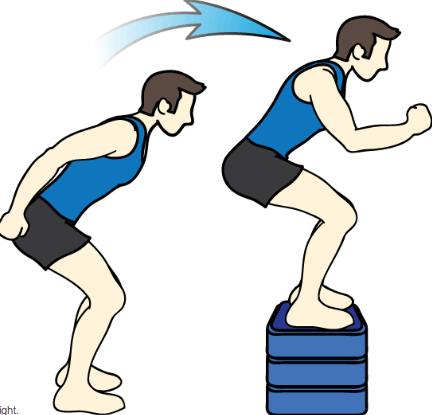
The Box Jump

Box jumps are a lower body (primarily) exercise used to build explosiveness, landing mechanics and force absorption.  Box jumps are a valuable addition to any workout regimen, but they must be progressed according to fitness level, goals and experience.

In short, the average number of box jumps per workout should be 20-40 repetitions.

A person can do more or less, as this is by no means the law of the land.  

This is my opinion deeply rooted in personal experience with athletes, my own training and my observation of modern evolution of box jumps.  

The Details…

  • Primary Muscles: Glutes, Quadriceps, Hamstrings, Calves
  • Secondary Muscles: Hip Flexors
  • Body Area: Legs
  • Modality Types: Body Weight
  • Equipment: Plyometric Boxes

Training intent:  Reinforce jumping and landing mechanics OR leverage as exercise to increase work-capacity in a different movement pattern.

I personally do not use (or recommend) box jumps as primary method (or as a part of) of enchancing cardio or as a vehicle to lose fat.  There are more effective, not to mention safer alternatives available.

Box jumps (like any exercise) have advantages and disadvantages, risks and rewards.  

The risks…

There’s risk in stepping out the front door every morning, I get it.  But let’s take an honest look at things that can happen during box jumps…

The biggest risks are slippage, landing incorrectly or missing the box completely.  All carry have a unique consequence, or potential of injury.  Nobody works out with suffering injury as the goal, but shit happens.  It does.

Murphy’s Law:  Anything that can go wrong, will go wrong.

Every repetition of box jumps has a risk of acute injury or if overdone, chronic pain.  

Speaking from experience, not every box jump is textbook perfect.  As stated before, shit happens.  Whether it’s leaving shin skin on the box, mis-judging foot placement and stumbling or hitting the deck after landing on an unstable box, something is likely to happen at some point.   

Acute pain would be… leaving shin skin on the box, mis-judging foot placement and stumbling or hitting the deck after landing on an unstable box, something is likely to happen at some point.   

Chronic pain is most commonly anterior knee pain, or irritation in the front of the knee.  High rep box jumps are incredibly predictable for causing anterior knee pain.  Sometimes it’s the landing force contributing to this pain, but I’d say most frequently it’s caused by not stepping down from the top of the box but the impact from jumping down and poor absorption.  

The impact force exceeds the tissues capacity to handle the force, pain appears.  

This likeliness increases exponentially as physical fatigue accumulates.  I’ll argue this point with anyone, anytime.  If you’re jumping onto a box with heart rate at 80-90% max,  short on breath, in an altered state… the risk of a failed box jump attempts increases.

Especially factoring in that box jumps are landing onto a surface, a target.  Each attempt must successfully clear the height of the box along with the horizontal distance, finishing with foot placement reasonable enough to stabilize the landing mechanics.  

Doesn’t always happen and it gets progressively more sloppy with fatigue.  The attention to detail drops.  Reps and time (finishing the workout) become the most objectives, not technique and safety.  

Again, when tired, distances and heights can look different, body positions are perceived differently and in general, poor decisions are common (versus being fresh).  

Perception of body position in a fatigued state is an interesting topic.  The gist is, are you in the position that your mind’s eye thinks your in?  

Often times, you’re not.  Your brain thinks you are, but you’re not.  

Scare tactics, right? So, the moral of the story is to boost awareness that there are risks in jumping onto a box. the risks we’re talking about pertain to perception of the purpose of box jumps. My belief is box jumps are a tool for developing explosiveness and landing mechanics in a low-volume (less reps) controlled environment.

The reward…

Finally, the good stuff.  

Box jumps are great training method for building lower body explosiveness.  

Improving, or at least maintaining the ability to produce muscular power is vital to  sport performance, but probably more important to the aging general population.  

As we age, our ability to produce power declines.  Sad, but true.  In fact, one study found power to decline nearly twice as fast as muscle strength…

Screen Shot 2017-06-09 at 6.42.58 AM

Therefore, the velocity component of box jumps crucial for everyone.  Another study drew several other conclusions about power training… 

Screen Shot 2017-06-09 at 7.12.28 AM

As a part of a training regimen, improve power generation has great transfer into strength training, overall athleticism and movement capacity.

Box jumps are a plyometric (aka: “jump training”) involving rapid stretching and contracting of muscles.  The goal is to produce a large amount of power in the shortest amount of time possible.  

Based on this description, it’s reasonable to position box jumps early in a workout, when the body is fresh and able to exert at the highest level.  

Jumping when fresh, ensures we can maximize effect of each box jump, the simultaneous extension of the ankles, knees and hips (triple extension).  It also gives us the best chances to practice landing mechanics and force absorption.  

Aim to land on the box in the same position you took off from.  A box height that is too low won’t challenge the velocity of the jump, but a box that is too high will alter the landing position.  Landing hunched over with the knees in the armpits is not a desireable position.  

It’s one thing to test out the maximum box jump height where you’re attempting to get onto the box by any means necessary, and another to repetitively practice deep squat landing positions.  It’s difficult to make an athletic move when the knees are buried in the armpits.  

Landing in a position that gives the advantage to the next move (whatever that move might be) is desirable.  

Of course, life is not perfect, so it’s not far fetched occasionally familiarize the body with unideal landing positions, to better accomodate the unknown.  

Simple cues for box jumps:

  • Counter-swing the arms/hands behind the body as the hips/knee flex the body lowers.
  • Drive the arms/hands aggressively upward as the hips/knees recoil and begin to extend.
  • Actively force FULL extension of the hips, knees and ankles during take off, EXPLODE.
  • Land soft and quiet with feet flat on the box in a similar position as the lowest point of the take-off.  

That’s it.  Not rocket science, just gentle reminders of exercise technique.  

https://www.youtube.com/watch?v=KX-8e06pGuI&list=PL5A09BB0D766BE510


The premise of this article is to get people thinking on a deeper level about why we do what we do inside of a workout.  There should be purpose and intent behind everything. If you cannot justify or it’s causing harm to one’s body, it might be time for an audit of training methods.  

All of my opinions are subject to change.  However, what I will say is my opinion on the purpose of box jumps is one that hasn’t seen a shift.  I do still believe in the value of training a body to first understand and recognize the technique of jumping and landing.  

Once a person can demonstrate physical compreshensive of a basic box jump, sure, progress out as needed.  But not before.  


Screen Shot 2013-03-23 at 7.17.19 PM


https://www.youtube.com/watch?v=3586susSSfY


Cheers to box jumps, not too much, not tool little, just the right amount.  

KG

SaveSaveSaveSave

How to Warm Up Before a Home Workout (Video)

Quick Tips

Below is a sample of what a warm up looks like for me prior to a training session.

The only awkward moment comes when I attempt to stay on the rubber matting while performing forward, backward and side to side gorilla hops.  Hey, I’m human, shit happens.  This isn’t Hollywood produced, it’s real world home training.  Film it like it happens, right?

The important thing to remember is that you should always maximize the equipment, time and space that you have available to you.  You can always get way more accomplished with what you have than you originally thought.

I have really come to enjoy integrating animal style movements in the warm up, as it demands rhythm, stability and mobility to accomplish the moves.  Plus it isn’t boring, which is important for keeping your movement endeavors interesting and sustainable.


After you watched some of the video, it’s important to understand a couple of things:

1)  I only foam roll problem areas (trigger points, stiff muscles, overactive muscles)

2)  I only address mobility in areas that I lack it.

3)  The dynamic movement prep is mostly total body.

4)  Jumping rope serves to increase blood flow, core temperature and gets me sweating.

The point is that there is no time wasted and everything has a purpose.  My body is prepped for the transition into the physical demands of the workout.

My workout for this day was highly metabolic, which is how I have been training for quite some time now.  All workouts are designed mindfully and not intended to destroy my body, but rather build and condition it intelligently.  I completed all of the exercises below without rest between movements in a 15 minute timeframe (I was tight on time):

Metabolic Strength Training


I have used workouts like this successfully for over 5 years now.  The loads and exercises are appropriate for my skill and fitness level.  To be completely honest, the less complicated you make a session like this, the more fun you will have.  I rarely stray from the basic movement patterns: push ups, vertical pulling, squats, kb swings, etc.

I am after the training effect, not a circus-like performance.  The risk doesn’t always match the reward with complex movements.  It usually looks great on paper and sucks in practice.

For the time invested, I haven’t found any other style of training that keeps me lean and functional for the time invested.  The trade-off for time reduction is an increase in intensity.  This isn’t for beginner or the weak of heart.  You’ll be tired at the end.

It’s a great blend of work capacity and strength movements that demand full range of motion and attention to technique.  Of course, you can increase the difficulty of a workout like this or make it slightly easier if need be.  Progression is always the answer.


Cheers to making less excuses and  taking more action…


KG


3 Time Efficient Methods To Squeezing in a Workout While Building a Career

Quick Tips

One thing that I have learned about writing and consulting on topics related to fitness is this:  Not everyone thinks about training, eating and health as much as I do.

Not everyone cares about how great a kettlebell swing is, how bear crawling can restore function or jumping rope is 10x better for conditioning than a recumbent bike.

I think sometimes as professionals we forget that we care about fitness far more than any other people on the planet.  Hell, we made a career out of it.

One issue with training that comes up time and time again is time, or lack their off.

As I mentioned in a recent post, I completely understand the time issue.  I currently have a full-time career, write, train and am currently building an internet based fitness company/culture to help transition out of my existing career.  Time is short, just as it is for so many other career professionals.  I am in your shoes, which is why I feel so at home writing on this blog.  You and I are in the same boat.

We’ve got to find solutions to working out when time is really tight.

Here are a few ideas that can put you back on track for working out around a career…

1)  Strength-Cardio Circuits

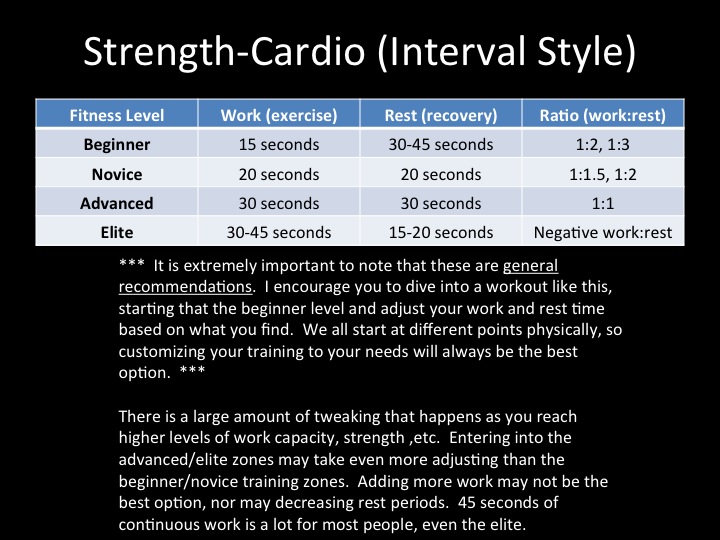
Interval training using strength based movements are amazing for building adequate levels of strength and power while stripping fat.  These workouts leverage our body’s natural ability to continue to burn fat for hours after the training session has ended.  Strength cardio circuits, sometimes referred to as metabolic training, involve short burst efforts and minimal rest periods between movements.  You’ll want the training session to be a total body experience, alternating exercises between upper body and lower body to increase performance by avoiding fatigue. By alternating movements, you’ll be able to hit more muscles in less time without sacrificing exercise technique.

Although the amount of time designated for work and rest during a strength-cardio workout will vary depending on your fitness and skill level, you should be able to find a sweet spot for yourself.

Here is a simple table to reference:

Strength Cardio Interval Training

Choose from these simple movements…

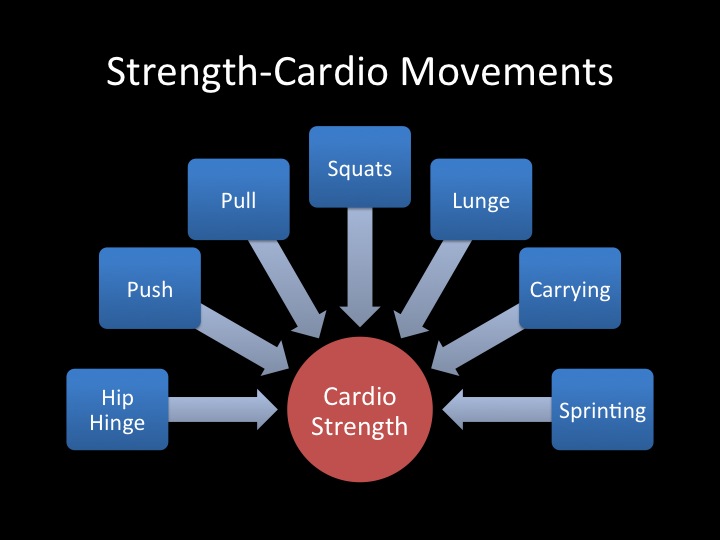
Strength Cardio Movements

2)  Train on the weekends.

Nothing ground breaking here, but I just want you to start thinking about where you can fit in a training session.  The weekend usually provides some relief from the time commitments of the workweek, so look toward Saturday and Sunday for squeezing in a couple solid training sessions.  This will work wonders for your attitude as you enter into Monday and Tuesday.  You’ll have the confidence knowing that you put forth a solid physical effort that you can leverage for 24-48 hours.

I train on the weekends all of the time.  During this time, I feel no need to rush through the workout like I do during the week.  The training session becomes enjoyable.  Often times, I will spend a significant amount of time working on my mobility and addressing any muscles that feel overactive with knots.  It’s a time for training aggressively and regenerating my body.

Weekend Training Solutions

3)  Two Sessions Per Day

This might sound crazy, but incorporating two smaller training sessions into your day might provide some relief to your training efforts.  Rather than spend 60-90 minutes exercising once a day, try splitting the day into two smaller training sessions that last anywhere from 15-20 minutes.  The smaller window of time will keep you focused on moving forward throughout the workout and also motivate you to do more in less time.  Stoking your metabolism twice a day will work wonders.

Check out this recent post about that would help you coordinate a couple short training sessions:

—> Time Based Training

Having a career and committing to a life of physical fitness should be able to coexist with each other.  They have to.  Wealth without health is completely pointless, just as health without any wealth is stressful.  Find the balance that fits your situation, integrate the suggestions above and make an effort to not only maintain your body, but improve it.  Succeeding in career and physical performance will elevate your attitude and take your confidence to new heights.


Cheers to earning the $$$ and engineering a high functioning body in the process…

KG

A Time Based Bodyweight Workout for Boosting Fitness and Fat Loss

Quick Tips

Let’s face it, time is a commodity.  It’s our most precious commodity.  The clock will continue to tick no matter what we do.

I used to think that people who claimed that they “have no time to work out” were just dishing out lame excuses.  I might be conditioned though.  I have heard this time and time again from people who ask me for fitness advice.  Once I give them a rough outline of what they need to be doing in the gym or at home workout-wise, they raise their eyebrows and throw out the “I have no time for that” card.

What did you expect?  Hahaha.  It makes me laugh every time.

Enter:  Time based training.  

What follows is a simple time based workout program that is an immediate solution for anyone leery of investing decent time in a workout or for people who are legitimately short on time (because I know that you are out there folks).  

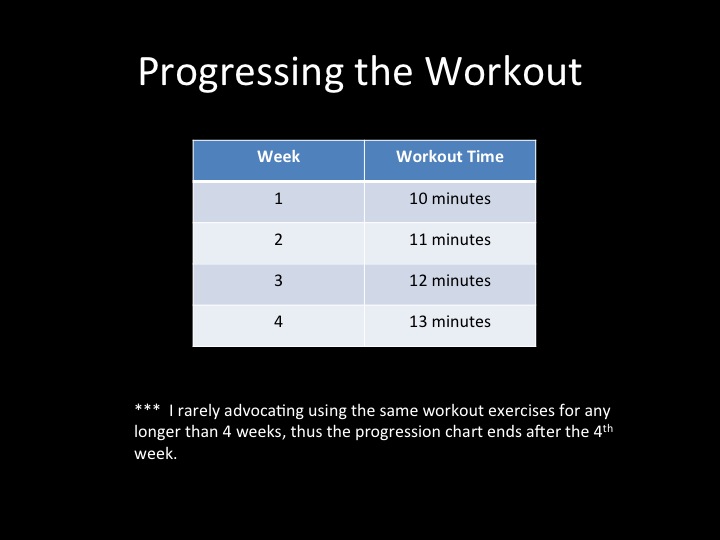
You’ll be able to progress this training plan for about four weeks while avoiding stagnation and adaptation.  The body tends to get really efficient at activities that we repetitively engage in, so don’t be silly and try to ride this program out for a year or something crazy like that.  

Building fitness demands that you constantly keep tweaking the variables.

Here you go… 

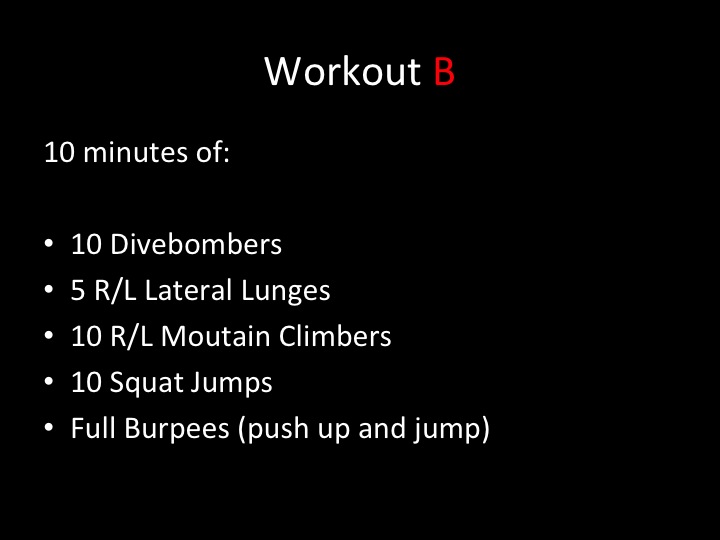
ImageImageImageImageImage


Essentially you are increasing the volume of your training sessions by adding one minute per week for four weeks straight.  I like workouts like this for beginners or advanced individuals alike because everyone can move at a pace that is appropriate to them.  Beginners can grab a breather and some water if need be, and advanced trainees can whiz through at break neck pace to get their training effect from the workout.

Best of all?  You can do this type of workout anywhere.  

Worst of all?  No pulling and no hip hinging movements.  Without equipment, it’s really hard to work upper body pulling movements into a workout.  Suspension trainers like the Jungle Gym XT really help this issue.  

Hip hinging is the motion you’d make if you were butt bumping a car door shut.  You’re hinging at your hips.  Without weight, it’s hard to train this movement pattern, which really sucks because hip hinging is one of the most beneficial movement patterns that we humans can train.  

You’ll find that every style of training sacrifices something.  Nothing is perfect.  

The key with short workouts like this is leveraging the training effect of the session.  Short training sessions like this need to be high tempo since you are cramming a lot into short duration. 

If you’re not willing to buckle down on your eating habits, well, prepare to be awfully disappointed by every workout program ever created.  Physical activity is a supplement to eating food worthy of fat loss.  The changes that take place post-workout are just as important if not more important than what takes place during the workout.

Sure, you can reduce body fat and increase performance without any dietary intervention (yes it is possible), but you’ll sell yourself short in the long run.  Sooner or later you’ll reach a plateau.  Eating crap food and training like a crazy person only gives off the perception of health.  Food is the key to the body aesthetic universe and long-term health and wellness. 

Any honest personal trainer or fitness advocate in the world will tell you that nutrition makes up the bulk of the foundation of any athletic or fit-looking body.  We cannot train hard enough or long enough to offset poor eating habits.  Unless you are an Iron Man athlete, in which case you are training for 3-5+ hours per day, almost daily and you have no real world career other than your sport.

Less than 1% of us fit that description, so lets just be big boys and girls and eat nutrient rich foods.  Ok?  Make the food that enters your pie hole primarily veggies and plants mixed with some animal protein and nuts.  Perfect little diet solution that will work wonders.

Plus, it would be so stressful to think about having to workout so ridiculously hard to combat all of the junk food eaten.  

If the food grew from the earth or has a mother, eat it. That’s your checklist to decipher through the food trickery that has saturated our restaurants and supermarkets.  

Rock this workout plan for at least 2 weeks.  Training for any period of time shorter than that isn’t even worth lacing up your shoes for the first training session, and it really shows that you aren’t prioritizing to make some changes.  Stay committed and trust yourself and your program.  

All in good time.


Cheers to leveraging our body’s natural ability to burn fat…


Kyle