Metabolic Conditioning: The Bear Barbell Complex Workout

20 minute Workouts, Quick Tips

“The Bear” Barbell Complex is as close to flowing barbell training with a barbell that you’ll ever get, or at least I have ever gotten.

I’ll assume that “The Bear” is referred to as “The Bear” because of how difficult the workout is.

This complex workout leverages barbells.  Barbells are mostly thought to develop pure strength and power.

The barbell was manufactured to work well for moving heavy weight.  Moving heavy weight creates the ideal training stimulus for building strength.  If a person moves the barbell fast enough across a set distance (Point A to Point B), the barbell becomes a tool that enhances an individuals power.  Think cleans, snatches, jerks, etc.

  • Slower moving + heavy weight = Strength Development
  • Fast moving + medium/heavy weight = Force Production = Power Development

Although barbell training might not be an appetizing fitness solution for a lot of people, taking some time to learn and practice the basics of barbell training can pay a person back ten-fold over time.

My guess is a lot of people avoid barbell training because of the intimidation and unfamiliarity factor, or for some, the uncomfortable sensation of iron grinding against the skin.  Barbell work will develop tough hands over time.

The callouses I cannot help you with… but if you want to know more about barbell training, buy Starting Strength by Mark Rippletoe.  Read a few pages, practice, read a few more pages and practice some more.  There is a wealth of knowledge in Starting Strength that can help you establish the emotional confidence and the technique to play around with the barbell a bit more.

It’s important not to be afraid or intimidated by the barbell.  When people think of barbell training they usually picture a 300lb tank-of-a-man squatting 500lbs, yelling like a maniac during every rep while his friends stand around yelling like maniacs during every rep.

You’re partially right if this is your initial mental picture.  But barbells, and how we use them to develop physical qualities has evolved a lot over the years.

Like any other fitness tool, barbells can be leveraged for other purposes also.

In particular, I enjoy using the barbell during work capacity directed training sessions (aka: metabolic conditioning) or at the end of a workout for a short burst finisher.  Think high reps with lower loads, or a highly concentrated amount of work done in a short time frame, or unique mixture of both.

When I re-stumbled onto the The Bear Barbell Complex a few weeks ago, I reintroduced myself to a style of barbell training that I used to use quite a bit, especially when available workout time was limited.

“What is The Bear Complex?, you ask.

Come a bit closer and let’s take a look…

Barrier to Entry

Tools: Barbell and plates (bumper or standard metal work fine), clock timer such as the GymBoss.
Skill:  Working knowledge of the barbell based exercises listed below.

The Exercises

#1: Power Clean

#2: Front Squat

#3:  Push Press

#4: Back Squat

#5:  Behind-the-neck Push Press

Workout Structure

–  Each movement is performed for 1 repetition before immediately moving into the next exercise.

–  1 Cycle =  1 repetition from #1-#5 in alternating/descending order.  After exercise #5’s rep, return back to exercise #1.

–  1 Round = 7 Cycles

–  Perform 5 Rounds

–  Rest 90 seconds after finishing each round.

–  Barbell weight is dependent on:

  • Weakest lift (the weakest lift determines the appropriate load, which should be sub-maximal)
  • Exercise technique and know-how.
  • Reaction to fatigue (which correlates closely with the deterioration of exercise technique)
  • Advanced Women – 95lbs
  • Advanced Men – 135lbs

The Extended Break-Down…

There are 35 reps of every movement being performed throughout all 5 rounds.  Just 35 reps.  If you consider the volume of a more traditional work-rest training session, where a squat is performed for 8 reps x 3-4sets, the volume is not much higher.

The weight used is also much lighter than a more traditional work-rest set and should be determined by your weakest lift in the complex.  For a lot of people that is going to be the push press, possibly the power clean (grip). I’m asking you to perform 5 reps for each round.  The barbell load should be a sub-maximal, which means that you should be able to push press that barbell for 8-10 reps comfortably.

My suggestions on weight for men and women are not the law.  Adjust the weight to what is appropriate for your current fitness level and know-how.

Every exercise is performed for a single rep before moving into the next exercise.  From rep to rep, you’re alternating between different movement pattern throughout each cycle.  It’s important to understand this aspect of The Bear Complex, because it’s one of it’s features that makes it so physically taxing.

Elevation Change

The barbell begins on the floor and travels to chest height after the clean and during the front squat.  After the front squat the barbell moves overhead after the push press.  The barbell then transitions from the front of the body to the back of the body on the descent down from the push press.

At this point, the barbell rests on the shoulders while you perform a back squat.  At the top of the back squat, the barbell is forcefully pressed overhead once more, and caught back into the front rack position at chest height.  The barbell is guided back to waist height and eventually back down to the floor to prepare for the next cycle, starting with a power clean.

The training stimulus elicited by moving the barbell up and down, front to back, movement to movement creates a large metabolic training effect.

Performing single rep of a movement pattern, followed by single rep of a completely different movement pattern, while bundling a bunch of different movement patterns together in a row (creating a “cycle”) is extremely fatiguing.  It’s provides a unique training stimulus for the body to cope with and also laser-like focus for the mind to keep up with since every rep involves a different movement pattern.

‘Single-rep-alternating-movement-pattern-workouts’ have proven to be an effective variation of traditional complex training, where exercises are performed for multiple repetitions before moving on to the next movement pattern.

If you’re accustomed to sectioning off your complexes, doing 6 reps of one exercise here and 6 reps of another there before moving on, alternating movement patterns with every rep will be a shock to your system.

It’s reiterating once again that alternating the movement pattern on every rep requires great skill.  The barbell is constantly changes levels, stopping and starting in different positions.  The transitions can be brutal.  There’s a high level of focus needed here.

The Fatigue is Coming…

During The Bear Complex, the first few reps/cycles usually don’t feel too rough, but the wave of fatigue that bites you in the ass somewhere around cycle 5, 6 or 7 can be overwhelming.  Possibly so much so that executing all 7 cycles for any 1 round is just plain unreasonable if you’re new it.  Don’t be afraid to remove your hands from the barbell to take a break and to gather yourself.

Loaded conditioning is a fantastic method to burn fat and develop high level work capacity which has great transfer into sport and becoming more resilient toward real life labor, but fatigue can break down your exercise technique.  Don’t be a hero here, be smart.  If 5 rounds is too much, do 4 rounds.  Be reasonable.

Movement technique first and foremost, forever and always.

Pay Attention to your grip integrity

Alternating movement patterns and transitioning the bar to different resting positions can fry your grip.  Consider that the bar is moving from the floor, to chest to over head, to shoulders, back to overhead and finally back down to the floor position.  That’s a lot of bar movement.  Don’t be afraid to walk away from the barbell if your grip starts to slip.  A quality grip is needed for the cleans.  Attempting to pull a barbell with a poor grip can be dangerous, and the fatigue that’s been created with slow your reaction/recovery time.  Again, rest for a few seconds, gather yourself, then complete the work with a solid grip.

If you’re a tenacious sweater like I am, also be aware of any sweat rolling down your forearm and into the hand/barbell interface.  Don’t push through this situation either.  Dry all surfaces with a towel and continue on.  Maybe consider using a no mess chalk solution such as HumanX Chalk Balls to help maintain grip.  Chalking your hands has come a long way.
.

This workout is advanced 

Complex training in general is an advanced form of training.

Any exercise scheduled in a complex must be an exercise that you have a familiarity with BEFORE you enter the workout.  You must have experience and proficiency in executing each of the included exercises on an individual level before you attempt a workout like The Bear Complex.  If you don’t know how to perform any one of the exercises, The Bear Complex is not the place to learn.

Explore…

If you’re looking to add in some variety to your training, give The Bear Complex a legitimate shot.  Be honest with your rest periods, your exercise technique and the structure of the reps, cycles, rounds.  Also be honest with weight that you choose to use.  There’s no shame in lessening the load if you need to.

Cheers to The Bear…

Kyle

(Video Coming Soon)

Chin Up + Kettlebell Swing + Squat + Jump Rope + Push Up… Workout

Quick Tips

I’ve never felt inclined to name any of my workouts.  Thus, I give you the:

Chin Up + Kettlebell Swing + 2KB Squat + Jump Rope + Push Up…

… workout.

There is another organization that names all of their workouts, which isn’t a bad thing,  I just don’t feel like labeling my workouts with someone else’s name.  I could name this one “Brutus” or “Cactus Jack”.  Maybe I should name my workouts after WWF wrestlers past and present.  That would be cool.  Everyone seems to know WWF wrestlers names whether they admit to watching it or not.

I could use a numbering system I suppose, like “Workout #1” or “Level 5”, but maybe I’ll just call it what it is.

I selected the movements listed above because they represent most of the major movement patterns, and also because these exercise could be easily executed with the workout equipment that I had available the other day.

What did I have available?

As I mentioned, I typically only incorporate big movement patterns into circuits.  To be honest, I don’t like wasting time with exercises that hardly stress the prime movers.  Bicep curls and such are desert.  If I have time after I have completed what I often refer to as the “main meal”, I will work in the accessory exercises for fun.


I value my time.  Time is a commodity in my life (as I am sure that it is in your’s) so I prefer to get in, get out and get back out to experience other aspects of life.  Sure, I write about working out, structuring workouts, movement and nutrition a great deal, but that doesn’t mean that I am working out 2 hours a day.  Efficiency is the name of the game.  How effective can I make my workouts without taking away from other areas of my life that I also value.

Occasionally I will add an exercise or two that is slightly out of the box, but these movements are usually treated as a filler exercise (active rest) between more demanding exercises, or reserved for before or after the main circuit of the workout.

While I will admit that doing this is my personal preference, I would suspect that most of you will find that your own workouts are immediately enhanced by working in the big movements instead of a series of fillers.  More muscles engaged equals a greater training effective at the end of the workout session.

If you do more work in a smaller time frame, now you’ve primed your body for fat loss + muscle gain.

This is a great scenario, one that we need to keep advocating instead of “weight loss”.  You can lose weight by dehydrating yourself down to a raison in a sauna.  That’s weight loss, right?

Swap the fat tissue for muscle tissue.

Chase muscle and while running away from fat.

So what are the big movements?  In this case, the big movements that I leveraged for a training effect were:

I’m continually amazed at how effective bodyweight strength movements are, especially when organized into a circuit.

I can get the training effect that I desire while minimizing risk of injury and awful soreness in the days that is so commonly associated with resistance based training.   Of course, if you have never performed a push up or a squat, you’re going to be sore in the coming days.  That’s something you can expect with a new training stimulus and re-discovered muscle contraction.

Loading up on bodyweight style training sessions.  This type of training sessions should be heavily considered by anyone that struggles with achy joints, etc.  Bodyweight resistance exercise provides a low load introduction to basic strength drills, easing your body back into the swing of things.

Plus, being able to control your body exhibiting stability, strength and power through a healthy range of motion will do wonders for your performance, whether that performance be for sport or raking the leaves out of your yard.

So what does last weekends workout look like?

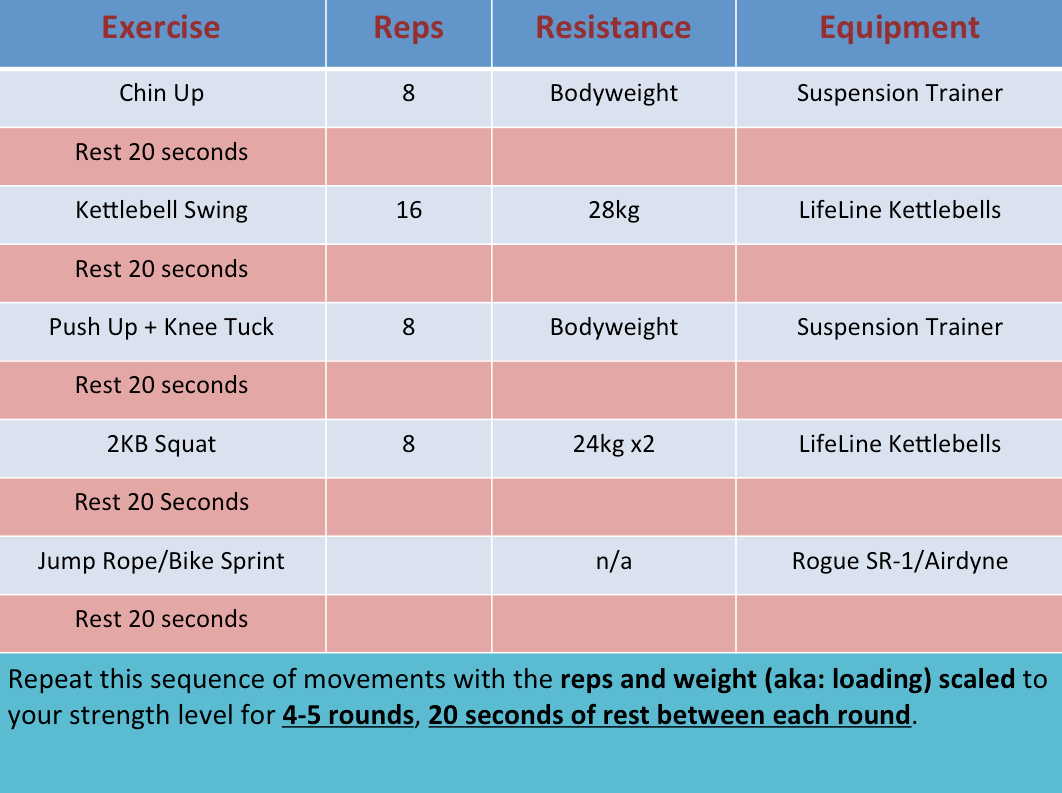
The structure looked something like this:

Metabolic Resistance Training Circuit

I loaded up most of the movements and went for 4 rounds, which took slightly over 20 minutes.  20 minutes continues to be the sweet spot for workout duration.  Anything more than that and I lose output, anything less and it seems like it wasn’t enough… as if I left some fuel in the tank.

20 minutes also seems to allow for focus on proper exercise technique (and grooving) while the fatigue continues to snowball.  Technique is important, don’t forget that.

If you take another look at the exercise selection above, I’d like to share a couple of substitutions that you could make.  If you cannot perform a bodyweight chin up, wrap a resistance band around the chin up bar you’re using, and stretch it down around your knee or foot.  This will assist you on the way up and ease you down from the top.

You could swap out standing broad jumps or squat jumps for the kettlebell swings, although there really isn’t a movement to mimic a kettlebell swing.  If you have dumbbells you could use those in a pinch, but again, there is no tool that functions quite like a kettlebell.

If you don’t have a suspension trainer, just do regular old push ups.  If you want a less expensive option that does a decent job of mimicking the push up+knee tuck combination, use furniture sliders or socks on a hard surface.  Both work decently.  I would go the furniture slide route if I had to choose.

If you don’t have kettlebells, dumbbells or a barbell for squats, you can do bodyweight squats just as well.  If bodyweight squats are easy, mix in pistols alternating each leg.  If you squats are too easy and pistols are too hard, use squat jumps.

If you don’t have a jump rope or a bike, run in place.  High knee with simultaneously arm action.  If you’re lucky enough to have a place to run a short distance, figure out how far it takes to run half of a 20 second shuttle run (10 sec out, 10 sec back).

As you can see, there is a progression, regression and alternative to just about every single movement known to man.  Once you know what a level up and a level down from an exercise is, you’re in business. Now you can OWN your workouts.

Replenish and refuel your body with some rock solid recovery nutrition, and you’ve just done your body good.


Cheers to Chin Ups, Kettlebell Swings, Squats, Jumping Rope and Push Ups!

KG

PS:  Seriously check out the nutritional link that I posted above.  If you want to see dramatic change in your body and performance, nutrition is at the bottom rung of the pyramid.  

High Repetition Kettlebell Swings

Kettlebell Training

The kettlebell swing is a amazing exercise that can build power, strength, improve conditioning and accelerate fat loss.  

Swings are packed with benefits.  

Kettlebell swings have been a staple exercise in my workouts for the past 13+ years.  

I started by swinging a 24kg kettlebell, and have since moving on to 28kg, 32kg and 44kg swings of varying intensities and volume.  

Within 4 weeks, I noticed the impact kettlebell swings had on my physique.  

And I wasn’t using fancy workouts, just a simple 15 seconds on/ 15 seconds off for 24 rounds.  That’s a 12 minute workout, with 6 of those minutes being dedicated to swings.   

Long story short, adding swings to my workout regimine helped to burn fat off of my body while building functional power, improving my posture and delivering a potent form of conditioning. 

Swinging kettlebells has also improved my running.

Kettlebell swings are a total body exercise.

In the beginning, I rarely swung my 28kg bell beyond the 15-20 reps in a work set.  

Overall, my workouts 

Then I started reading testimonials where people described how high rep kettlebell swing workouts (several days per week) was torching fat off their bodies. 

Who doesn’t want to burn a little more fat off their body?  I sure did, and still do, let’s get lean people. 

Of couse, nutrition is a crucial part of fat loss, so factor that in. 

Over the years, I’ve gone pretty far down the rabbit hole with swings.  High rep swing workouts might eclipse 300-400 reps in a session, using heavier kettlebells.  

Note:  Tread lightly using high rep swings too frequently.  Give your body chance to recover and avoid injury.  

—> Here is a short list of my observations and findings while using high rep kettlebell swing workouts <—

1)  High rep kettlebell swings builds grip endurance.  

2)  Might be a good idea to perform self administered soft tissue work on the forearms using a lacrosse ball or a percusion massager like the TheraGun. 

3)  I got lean pretty quick, which is predictable because kettlebell swings work a large number of muscles and burn a significant number of calories in these high rep workouts.  

4)  Take adequate rest between sessions.  Give your low back, glutes and hamstrings a chance to recover from the increase volume.  Foam roll, percussion massage, accupressure mat, active mobility training and long walks are a good idea.  

5)  2-3 high rep swing workouts per week is enough to create noticeable changes in body composition and conditioning.  

6)  Postural changes were interesting.  Standing position seemed like my hips were further forward and my shoulders pulled back.  

7)  15-20 minutes is more than enough time to accumulate a shit ton of swings.   

8)  Don’t be afraid to move up in weight and attack heavier kettlebells.  

I’d consider a high rep swing workout to be 100+ reps or more.  

Taking that number and scaling it for a beginner,  40-50 swings might be high rep for your experience level. 

If you’re advanced, 200+ swings might be your target for that day.  

It depends on your conditioning level and familiarity with the kettlebell swing.

Here’s a good kettlebell swing workout:

Baseline Kettlebell Swing Workout

Workoust like this are deceptively challenging.  

In the early round the rest periods feel long, but in the later rounds the rest periods don’t feel long enough.   

Fatigue is a hell of a drug.  

Using this workout, you’ll accumulate 100 swings in 10 minutes.  

That’s plenty to create a training effect.   

Choosing kettlebell weight.  20-24kg for men and a 16kg/20kg for women.

This is not the law however.  If you need to go lighter, do it.  Need to go heavier?  Do it.  Feel it out and make that decision as needed.  

This workout uses a fixed work:rest structure.  Wear a heart rate monitor if you have one.  A heart rate monitor can provide valuable information on work and rest periods, along with pinpointing how hard you’re actually working according to heart beats per minute.  

Using a heart rate monitor, I’ll perform the swings, finsih, then watch my heart rate monitor until the BPM decresases to 130bpm before starting the next round.  This method will make rest periods short in the beginning and tends to increase the length of rest later in the workout as fatigue accumulates and your body needs more time to calm down.  

Here are a few other workouts I’ve played around with. 

Other tips for high rep swing workouts

Don’t make the mistake of swinging too light of a kettlebell.  

The hips are powerful , size up the kettlebell and challenge yourself.  

If you have several different weights, you can start the workout with the heavier kettlebell and transition to the lighter bell as needed.  

It’s all based on feel.  

If you’re swinging super high rep marathon sessions with too light of a kettlebell, there’s diminishing returns.  

Instead of swinging 500 reps and feeling fresh at the end of the workout, lower the reps while increasing the weight.  

The increase in load will challenge your body plenty, and over time, the volume will increase.  

Repeat this process and you’ll be swinging the 40kg BEAST in not time.  I bet your body will reflect this progress.  

Just remember, the rules of progressive loading apply to kettlebell swings also.  

Again, this is a basic progression with loading, similar to what you’d use with traditional resistance training.

Heavier kettlebells will require greater effort to move the kettlebell through the arc of motion.    

Kettlebells are amazing for building power, improving posture and fat loss.  

Swings, while not the best for building lean muscle, are known to and can build muscle.  

Don’t count kettlebell swings out for building SOME muscle.  Just know there are better exercises.  

Deadlifts, squats, vertical pulling, rows, horizontal pressing and overhead pressing are best for building muscle because muscles will spend more time under tension through the full range of motion.  

Kettlebell swing are great for fat loss, if…   

… you’re in a caloric deficit.    

It doesn’t matter if you’re getting into a  caloric deficit via the swing workouts, or you’re a badass and entering workouts already in a caloric deficit.

You cannot out-swing a calorie surplus and expect to lose fat.  The math will work against you every time and you’ll go insane.  

People fight the calorie deficit thing all the time, like there’s some other secret sauce that can only be found by spending $97 on a fitness guru’s fat loss product.  

The caloric deficit is NOT EVERYTHING when it comes to fat loss, but it does play a HUGE role in burning fat.  

Huge.  

Sleep, hydration, protein intake, eating whole foods over processed foods (as much as possible) will deliver “best” results.

If you found this article wondering if high rep kettlebell swings are a good idea… 

… yes, they are.  

Just make sure you approach these workouts with some common sense, making sure you’re familiar with the swing itself and not overdoing the volume out of the gates. 

Increase the reps gradually, find the sweet spot with the weight, attack the workout. 

Integrating several high volume swing workouts per work alongside decent nutrition will deliver awesome athletic and aesthetic results.  

Cheers to high rep kettlebell swings!

KG

Kettlebell Training Research Studies

Quick Tips

Kettlebells are probably one of the most effective workout tools on the planet.  

They are also one of the most under-researched on the planet.  

So, this post was sparked by my own interest.  

Kettlebells have proven time and time again to blow fat off of people’s bodies, most notably without losing much muscle in the process since all of the movements are loaded, both strength and ballistic exercises.

This makes kettlebell great for ditching fat without sacrificing any valuable lean muscle tissue.

And that my friends, is a win-win situation. 

So what studies exist?  

Let’s take a look at a few:

1)  Kettlebell Swings, Snatch and Bottoms Up Carry Impact on Back and Hip Muscle Activation

Excerpt:  “Some unique loading patterns discovered during the kettlebell swing included the posterior shear of the L4 vertebra on L5, which is opposite in polarity to a traditional lift. Thus, quantitative analysis provides an insight into why many individuals credit kettlebell swings with restoring and enhancing back health and function, although a few find that they irritate tissues.”

This is mostly good.  Stuart McGill is a world leader in spine research as it relates to exercise.  His work is cited and quoted in a lot of publications.  Kettlebell training, like any style of training, can be detrimental to your body if you choose to ignore technique.  Skip the learning the basics and you make yourself susceptible to injury.

Chalk one up for kettlebell swings, snatches and bottoms up holds.

Here is a video clip of the bottoms up kettlebell hold:

Your mid-section will light up like the Fourth of July while stabilizing the kettlebell in this inverted fashion.  Very challenging move.  Stay tight, tall and braced.

Protecting the spine while training is of utmost importance, and the most important role of the abdominal musculature.  Despite what mainstream projects the abs to be important for.  Protect your spine people.  

2)  Oxygen Cost of Kettlebells

This little study looked at the oxygen cost of kettlebells, more specifically the two-handed kettlebell swing.  

The metabolic challenge delivered during a kettlebell workout is large.  Part of the maximizing this challenge is selecting the proper weight bell.  It should be heavy, but not so heavy that you cannot finish the workout.  Swinging light bells encourages poor technique and decreases the impact of the overall workout.  

I’ve talked about leveraging kettlebell swings on this blog over and over again.  I cannot say enough about a properly performed swing, and what it can do for you body, performance and posture.  Preserving muscle while eliminating fat is such a desirable route when you’re seeking body transformations.  

Simple workouts can achieve big results.  Here is a recent post where I diagram some classic kettlebell workouts.  

3)  Kettlebell Swing Training Improve Maximal and Explosive Strength

Strongfirst Kettlebell Swing

The kettlebell swing is an explosive deadlift.  The extension of the hips out of the hinge is aggressive as you drive the hips forward, standing yourself up vertically.  

This hip snap is the same hip snap that athletes use for putting large amounts of force into the ground as they accelerate across the field, court or ice.  

This hip snap is not just for athletes, its beneficial for the working male or female, Mom and Dad and even physically able elderly populations.  The hips are designed to be the power source of the human body.  We spend most of our time on our feet, so having powerful hips is a great thing.  

Will you be able to dunk a basketball?  I can’t promise you that, but it will get you closer to the rim according to this study.  

Will you boost your strength and explosive strength when you call upon it?  This little study thinks so.  

*** Again, choose to swing heavy kettlebells over light kettlebells to reap the full benefits, but not so heavy that you cannot fully extend the hips or move the bell quickly.  


Cheers to the kettlebell and the emerging research behind its use…


KG

Be A Perfectly Golden Marshmallow: Toying w/ BJ Gaddour’s Fat Loss Workout

Quick Tips

Screen Shot 2013-07-18 at 8.56.17 AM

BJ Gaddour

BJ Gaddour is the new Craig Ballantyne.

Craig Ballantyne created Turbulence Training back when it was personal trainers were not publishing material on the internet the way that they are now.  Now everyone has a product.

Hey, if you can write and you have the drive to stay motivated after working 9-10 hour days, why the hell not?  Everyone is selling something, product or self.  Doesn’t matter, it’s how we succeed.

BJ Gaddour currently works with Men’s Health as a consultant.  Essentially that means that he made enough noise doing his own thing that Men’s Health contracted him to write workouts, articles and programs for them.

BJ’s claim to fame is fat loss and boot camp style workouts.

A while back he posted a free PDF titled “The Seven Deadly Workout Sins”.

Pretty solid little article.

In it, he describes a general outline on how to design effective fat loss workouts.

When I read the article, it was a wake up call that I should have WAY more confidence in my writing and methods.  It was nearly identical to my training philosophy at the present time.  It was a great moment for me to realize that what I am cooking up here in Eau Claire (the mecca of the Midwest) is well seasoned (nice play on words) and spot on for what’s current in the training world.

Total body workouts, timed efforts and rest, 3-4 days a week.  No cardio.  Cardio is obtained as byproduct from the unique blend of incomplete rest periods and resistance based exercises.  

Again, this is a STYLE of training.  It’s not the law, but this kind of training gets results quickly.  If you buttoned up your eating habits, you would shed unwanted layers in very little time.

I enjoy giving other trainer’s workouts a run through, as it can get a little monotonous writing your own programs all of the time.  Sometimes, it’s nice to have someone else do the designing for you.  I just follow along for once.

BJ’s workout looked something like this:

Image

I talk about movement patterns on this blog all of the time, and a closer look at BJ’s template shows that he thinks along similar lines.  Hip hinging, squat, pressing, pulling, total body movements are all represented in this workout.  It’s a recipe that has endless variations and keeps your workouts interesting and effective.  The systemic effect of a workout like this is fantastic.

Most people will probably find that they are unable to keep moving all of the way through some of the 30 second work bouts with certain exercises.  Chin-ups continuous for 30 seconds doesn’t sound that hard, but talk to me about that in round 3 of the workout when your eyeballs are teetering on your orbitals.  It’s a different ballgame at that point of the workout.  You’re in the eye of the storm in round 3.

What I like about this workout is that is manageable.  The movements can be scaled up or down depending on a person’s training level and age.  Manageable fatigue is the key to successful fat loss workouts.  If you cannot control and OWN every movement in every rep, every round, every workout, you’re putting yourself at risk.  Posture collapses in a matter of a rep.  I’ve seen it in both my own training and others.  That’s all it takes to slip a disc, tear a rotator cuff or and break bones.  It’s a long, painful and expensive ride to the emergency room.

Injury during training is a tragedy.

Overall, this is a great workout.  The rest periods can be frustrating if you have to adjust your equipment in between exercises.  I was using my suspension trainer for a variation of this workout.  I found that adjusting the straps was a nightmare.  15 seconds is not a lot of time to gather yourself and set up for the next movement, especially when your hands are shaking like crazy.  The nervous system is on full alert.

The 60 second rest periods at the end of each round is also well thought out.  One minute gives adequate time to gather yourself, get a drink and towel off before entering into the next round of work.  In the later round, one minute feels like a blink of the eyes.

Successful work capacity based fat loss workouts seem to have peaking point with regard to exertion, whether in the middle of the circuit itself or as gradual accumulating fatigue that reaches a high point at the end of a workout.  The goal is to manage your output, giving an effort that challenges your body steadily in the early and later rounds.  Early burnout makes for sloppy exercise technique in later rounds and a serious lack of enjoyment.  The workout should be challenging but fun and engaging.  Purposeful.

Lately, I’ve been drawing similarities between the perfect “golden marshmallow” and a fat loss driven workout:

The golden marshmallow

When you cook a marshmallow for a s’more, some people enjoy perfectly cooked golden marshmallows and some people like the torched black marshmallows.  Cooking a perfectly golden marshmallow is a campfire art.  If the marshmallow gets too close to the fire it will burn.  If you don’t get it close enough it’s just a warm white marshmallow.

Peaking after the final rep of a workout (while still being able to own your movement) is an art.  We are all at different fitness levels so this is largely a judgment call by YOU, the trainee.  You need to make the decision on when to pull the plug on a set, a workout, or when it’s necessary to add more.

This is what a smart personal trainer can monitor for a client, and why good personal trainer add value to person’s fitness endeavors.  Personal trainers can take a client close to that edge, that fine line, without pushing them over.  The entire workout remains in control, yet impactful in its training effect.

The goal of a great workout is to be a perfectly golden marshmallow at the end.

BJ’s workout accomplishes this.


Cheers to golden marshmallows and better workouts!

KG

Basic Movements Can Be Leveraged to Produce a Massive Training Effect

Quick Tips

Sometimes the best choice of exercise is the basic one.

Basic movements that are executed with proper resistance and shortened rest periods can produce a massive training effect that can re-shape a person’s body.

Most of my training sessions are as uncomplicated I can possibly make them.

I have talked about perfecting the kettlebell complex for fat loss in the past, but the “complex” is nothing more than a series of simple exercises crammed together without rest.

The reward is an extremely large metabolic training effect.

You cannot deny that complexes will strip fat and build a resistance to fatigue.  If you do have an argument that simple movements don’t produce effective results, I’ll have you know that my performance outside of the gym with activities like trail running, cycling, obstacle course races and hockey has not slipped a bit since I began my self-experimentation with kettlebell complexes.

And I have been working the complex for about a year now.

Moving on…

One of my favorite training methods are tri-sets using basic exercises and incomplete rest periods.  

A tri-set means that you’ll group three different exercises together, moving from one to the next until you complete the number of sets of each exercise for that day.

It would look something like this:

A1)  Dumbbell Bench Press 3×8

A2)  Deadlift 3×8

A3)  Anti-Extension Roll Outs 3×10

All of the movements within this cluster are basic exercises.  It’s the resistance used and the shortened rest periods that is going to produce such a large training effect.

As you can see, once you finish a set of bench press (A1), you rest for a set amount of time, usually somewhere between 30-60 seconds (depending on your fitness level) before moving on to the deadlift (A2).

When I use a workout that is structured like this, I always incorporate at least two different tri-sets.  I prefer my training efforts to be total body versus a split type approach.

The second would look something similar to the following…

B1)  Chin Up 3×8

B2)  Front Squat 3×8

B3)  Anti-Rotation Press 3×8

Organizing a workout with tri-sets using basic movements is a fantastic method for getting in and out of the gym.  The rest periods will keep the workout moving along.  No time will be wasted.

Also, because of the shorter rest periods, your fatigue level won’t overpower your ability to give effort.  By the time you hit the 3rd round of the tri-set, you’ll experience manageable fatigue.

Managing fatigue during a workout is important.  If you drain yourself too early in the session, you won’t have anything left to give later in the workout, leaving a lot of benefit from exercises scheduled in the second tri-set on the table.

This style of training is really popular with athletes.  Strength coaches use tri-sets to make sure that a program is time efficient and balanced for the athlete’s body and development.  You’ll notice that most athletes tend to be quite lean (notice I said most, not all).  Transitioning your training to reflect that of an athlete’s can do wonders for fat loss, strength and power increases and overall performance.

The movements, as you can see from my example tri-sets above, work best if they are non-competing movements.  This means that you’ll be exhausting different muscles for the exercises grouped within a tri-set.  A perfect example of this is pairing a squat (lower body pushing) with a chin up (upper body pulling)

This is an important feature of this particular workout structure.

Tri-sets also represent a total body training session.  I would recommend using a workout like this 3-4 times a week max.  You’ve got to give your body a chance to recover and regenerate in between training days.

The decrease in training frequency during the week is great for a person that is pressed for time, whether with family or career.

Lastly, notice that all of the movements listed a basic exercises.  There is no real reason to complicate your training with complex exercises in my opinion.  Adding complexity to a training session can actually take away from effort aspect and add an element of risk that just isn’t necessary.  The reward is rarely worth the risk.

Pick movements that take very little set up and thought during the set.  Place your focus on exercise technique, breathing and moving more weight than the workout before rather than squatting on a physio-ball while attempting to juggle three tennis balls.

The video makes my point…

Cheers to basic movements organized to produce large training effects…

KG

The 5 minute Kettlebell Swing + Burpee Challenge

Quick Tips

I love metabolic challenges, especially ones that incorporate kettlebells and burpees.

If you didn’t get a chance to check out the burpee challenge from a few days ago, I suggest that you do.  It’s a tough workout that will definitely get your heart rate up.

—>  Metabolic Challenges/Finishers Over Boring Cardio

I favor metabolic challenge workouts, sometimes referred to as “finishers”, because they test your mind and body in a controlled setting.  The movements and reps/sets (aka: volume) should always be structured to YOUR own physical abilities, not someone else’s.  Nothing during a metabolic workout should be forced.

It is crucial that a high tempo work capacity style training session have progressions and regressions.  One size does not fit all.  The workout should be scaled to fit each of us on an individual level.  This will decrease the likelihood of injury while promoting physical transformation and improvements in performance.

Once you have proven that you can move efficiently without pain and have acquired adequate strength, stability and mobility to execute basic exercise like squats, push-ups, chin-ups, lunges and planks, it may be time to consider mixing in some metabolic work.

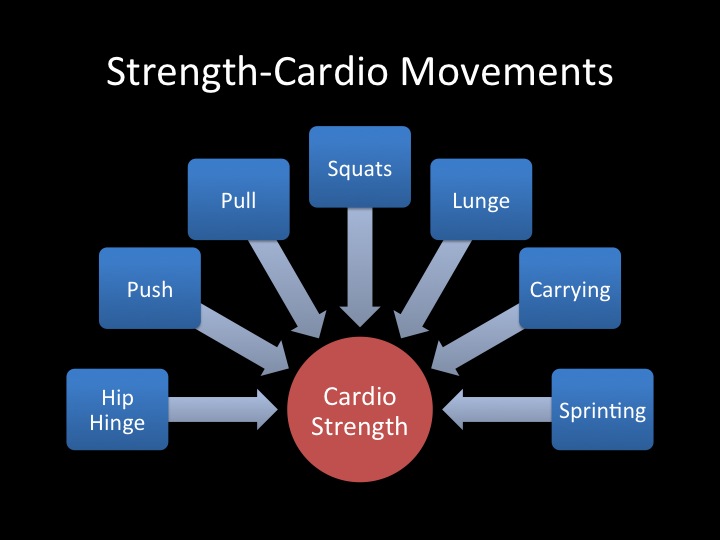
Remember this picture from a recent post?…

Strength Cardio Movements

I use “cardio-strength” and “metabolic” interchangeably…

At the very least, you can mix in some short burst finishers toward the end of your strength training session.  Adding finishers to the end of a workout will shift the way that you think about conditioning.  I know that it did for me.  It was a game changer.

There is nothing wrong with traditional activities like bike and hill sprinting, but to be honest, I find it painfully boring.  I know for a fact that I do not sit alone with these feelings.  Boring cardiovascular training can actually do more harm than good.  If you dread boring cardio to the point that you choose not to workout at all, that’s bad.  It shouldn’t have to be this way.

Boring Cardio Hamster Wheel

Do you ever feel like this while working out?

You don’t have to be a fanatic about your training habits, but long-term adherence to a life full of movement requires that at the very least you find some amount of enjoyment from your workouts.

The main point is that you have great alternatives to the long, slow, boring treadmill trot.  Finishers will keep your training fresh and challenging.  The return on investing in finishers is large.

I will always encourage beginners, novice and even advanced trainees to continue to make conscious efforts to improve strength and power.  This will never change.  So much good comes from building basic strength.

In a normal training session, after working through a complete warm up, strength and power work should be next on the day’s agenda.  Most workouts will require anywhere from 15-20 minutes to work through 2-3 tri-sets of strength/power enhancing movements.

—>  Kettlebells and burpees collide

Lifeline Kettlebells

Lifeline Kettlebells…

I am a huge kettlebell fan.

Kettlebells changed my perception of working out.  Kettlebells brought  the importance of strong, stable, free-flowing movement back into the fitness equation.  You have to be 3-dimensionally strong to lift, swing and carry a kettlebell.  My gym sessions transformed from a of time devoted to the typical big lifts- squats, pressing and pulling- to ground based movement sessions that built strength and stability using in greater ranges of motion.

I now have a level of stability, mobility, and functional strength that I didn’t know was possible for me to have.  Kettlebells aren’t a miracle, but the shift that they caused in my views on what an effective workout could be certainly make them one of the most influential pieces of training equipment I have ever used.

Kettlebell training is represents true movement.

The Turkish Get Up

Segue…

Next, the reason that we’re gathered here in the first place.

—>  The kettlebell swing + burpee metabolic challenge

I cannot remember where I first saw a version of this challenge posted, so please forgive me.

Credit belongs to someone out there, so take it if you’re deserving of it.

I’ve adapted it to fit my needs over the years, as I do with most everything related to training.


Tools needed:  To complete this challenge, you’ll need a kettlebell that you can swing for about 15-18 reps continuously for multiple sets.  I use a 24kg or a 28kg kettlebell for a finisher like the one described below.  Have some kind of timing device on hand.  I always go with my trusty GymBoss.

You’ll also need an open space of about 8ft x 8ft.  This should work just fine.  You can get by with less- and I have- but the more the merrier.  The ceiling of the space you are training in should be high enough to avoid hitting the top of your head when jumping.  If you’ve got clearance, you’re in business.

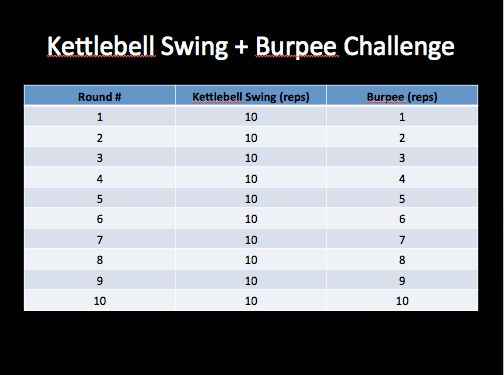
Here is how the challenge is formatted…

kettlebell + burpee workout

Make sense?

Take note of how each round accumulates burpee reps while the kettlebell swings remain the same.  It’s a very simple format to remember.  Two exercise finishers work great because they take very little thought.

The weight of kettlebell used will vary from person to person, but in general I would go with the following:

Females:  12-16kg

Males:  24-28kg

Of course there are going to be those of you who can use heavier kettlebells than what I suggested, but these are common weights for each gender.

The ultimate goal is to finish in 5 minutes.

I won’t p that I “think” a beginner, novice or advanced trainee should be able to finish a challenge like this in.  That’s not the point.  The goal is to finish in 5 minutes, end of story.  Anything longer than that indicates that you have a goal to work toward.  Sound good?

Stop Sign Warning

—->  Mandatory warnings to this workout

If you have never swung a kettlebell before or you aren’t proficient in swinging kettlebells for higher volumes or while under fatigue, this is not the time to test yourself.  Work up then work in.

Lastly, technique breakdown automatically initiates rest until technique can be maintained.  Fatigue kills exercise technique.  Leave your ego at the door when you train, it will save your body from injury.

Work smart and hard, not smart and reckless.

Give it a shot, have some fun and post how you finish up…

Cheers to the conditioning without boredom!

KG

Crawling to Improve Core Stability and Performance

Quick Tips

Animal movement is getting a lot of attention from forward thinking fitness professionals these days.

I predict that Men’s Health will jump on this bandwagon soon enough.  You’ll probably see a headline that screams:

“Burn Fat and Build An Athletic Body Like True Animal!”

Men’s Health has mastered the art of the headline and how to attract to attention.  That’s cool.  I am slightly jealous, but then again, I would rather have the freedom to write with my own authentic voice and tone, not what they think people want to read.  That would get old real quick.  You lose your identity as a person, what makes you uniquely you, when you start working for the man.

My blog articles wouldn’t be authentic if I didn’t get a bit lost here and there, so let’s get back to the business of discussing animal-like exercises, and where they might fit in a workout program.

—>Bear crawling is an awesome therapeutic movement…

First, let me say that I understand movement, however, I am not an “animal movement”, I simply see it as a methodology that can provide some great benefit while keeping your training session fresh.

Crawling for a better body…

I have used crawling off and on for quite some time now, both in my own training and in the training of my general and athlete clients.

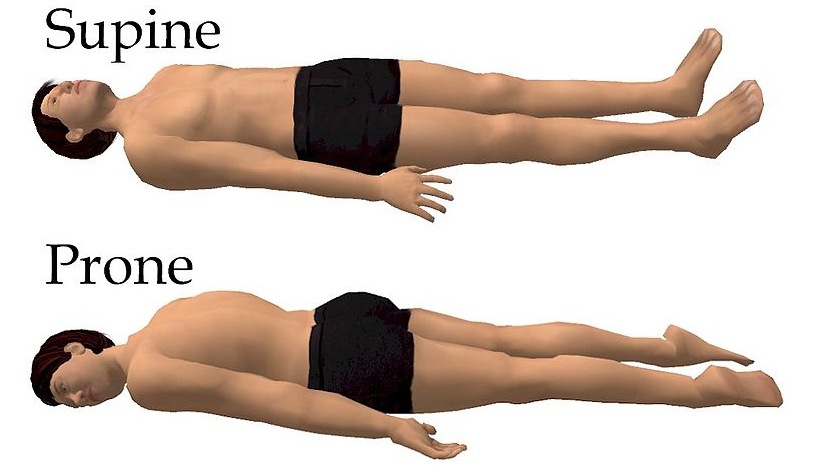
Actually, I have used the supine and prone versions of crawling for about 7 years.  Here is what I mean when I use the anatomical terms supine and prone:

supine and prone

Crawling was valuable part of our warm up when I worked with my younger athletes.  I have to admit however that I really only used crawling movements with the younger population, mostly between the ages 9-12 yrs.  Reflecting back, I wish I would have programmed more crawling with my elite athletes and corporate personal training clients.

Babies crab and bear crawl all of the time.  It is essential for their movement and development into the early walking stages of life… Check out these videos for proof….

The Crab Crawl and Variations

The crab crawl is the supine version of crawling.  The front of the body faces the ceiling and back faces the floor.

Here is a simple variation of a supine crab crawl called the Table Top Pull Through.  You’ll understand why it’s named this way once you click on the video.  Great warm up movement…

With the younger athletes, I mostly used the crab crawl (supine).  I saw (and still do see) tremendous value in the upper body and lower body connection that a supine (crab crawl) provides.  When working with younger athletes, it’s important to keep the balance of entertaining them (keeping them engaged in what you’re coaching) and teaching them how to use their bodies.  It’s quite an interesting process working with younger kids, I deeply respect any coach or trainer that is successful at it.

Here is what a full crab crawl looks like:

I would ask my athletes and clients to crawl forward like you see in the video above until I verbally cued “hips up!”, at which time they would stop, raise their hips and form that human table top that you viewed in the first video.  The backside muscles of the body light up during this static hold, as does the torso.  While the backside activates you’re simultaneously lengthening the anterior (front side) aspect of the shoulders/pecs.

This is such a fantastic movement for people who sit all day long.  It really helps to unwind some of the structural changes that as a result of sitting for extended periods of time.  Unwinding and reversing these changes is really important to avoid unnecessary injury and malfunction.

It was great, but most of all, it was fun for the kids and adults alike.  It’s one of those movements that doesn’t feel like a “workout”, yet has tremendous bang for your buck.

Shortly after incorporating the crab crawl, I started playing around with the bear crawl.  This is essentially the flipped over version of the crab crawl, with the participants face and belly facing the floor.

You’ll notice  that it is quite easy to “butcher” crawling movements and cheat.  However, if you take your time, align your body and move as if you were trying to stay as soft and quiet as possible, there is an incredible amount of motor control, timing and recruitment that takes place to make it all happen.

Sidenote:  I have found the “soft and quiet” idea to be quite effective for working to perfect movements related to crawling and Turkish Get Ups.  Staying soft and quiet asks the person to stabilize and activate muscular in a timely manner in order to be graceful.  In a fitness world that seems to drool over “harder, faster, aggressive, yeah!!!!”… moving with grace is a nice breath of fresh air.  Think yoga-like grace.

Now, the bear crawl, just like any other movement, can be performed at different speeds.  My recommendation is to prove that you can perform the slow motion bear crawl before you start racing around with horrible technique.  I’ve seen some videos of bear crawl racing on YouTube.

Not where you should be starting…

If you can’t go slow with expert like technique, why should you go fast?

It’s almost hard to say “technique” when talking about bear crawls, because I don’t know if anyone has actually established what ideal technique should look like.  It’s open for interpretation and varies depending on who you are talking to.

Keeping the mid-section still and some sort of rhythm is key however. Picture a glass of water balancing on your back as you crawl, avoid spilling any of the water during the movement.

—> Keep the bear crawls training effect in perspective…

1)  The bear crawl is a demanding exercise that has progressions, just like any other exercise.  If you can’t hold a satisfactory plank or properly activate your abdominal musculature, bear crawling might be a little further down on the needs list for you.  You may have to fix some other things first, than work into the full bear crawl.

2)  Start slow and perfect the movement. Move with control over speed.  It’s not a race.

3)  Don’t expect anything extreme to come from the bear crawl.  You’re not going to develop a six pack (abs are made in the kitchen), burn crazy fat, or become super human by incorporating the bear crawl into your workouts.  It’s a tool, treat it as a small but important piece of the whole picture.

4)  Integrate the bear crawl into your warm-up.  It’s a fantastic upper/lower body activating exercise that will prepare your joints for the demands of the workout.

I have to admit, I am fascinated with animal movements and how they can and should fit into a training program.  It’s an old idea that is creeping back into workout programming for forward thinking coaches.  I value animal movements, but I wouldn’t be the first to base an entire program off of them.  As I mentioned earlier, they are tools and puzzle pieces that help create a complete program.

Definitely worth messing around with in your own training however.  I can say that for sure.

—>  People will think you are a weird for sure…

You’ll get some weird looks if you’re doing bear crawls in a public place or at your local gym, but remember, who cares?  People don’t think much about anything, so just do it.  You’ll have a blast and create some positive training effects from it.  If you’re at the gym and people roll their eyes, let them.  You’re ahead of the game by incorporating crawling movements into your training regimen. Keep yourself away from stale training programs.

Cheers to humans crawling around like bears and crabs…

KG