
”Fitness” is a dirty word.
Yet, is there any other way to describe elevating one’s movement capacities?
When think of ”fitness”, a few different thoughts enter my mind:
1) Fixed range machine training
2) Puke inducing metabolic training
3)
It’s complicated.
Spend any amount of time researching “fitness”, “movement” or “exercise” on the internet and you’ll quickly realize how many different disciplines, philosophies and opinions there are.
It’s overwhelming for a lot of people and almost as confusing as nutrition.
What makes me different?
I have allegiance to any one way of achieving “fitness”.
Everything works, some of it is extreme, some of it is lacking and most of it
Despite the hardcore sales pitch and marketing efforts of various fitness entities, none a truly perfect.
Perfect doesn’t exist. I realize this as I get older.
My “best fitness practice” is very similar to the infamous Bruce Lee approach…
… extract apply what’s useful and discard the rest.
Techniques discarded is not forever measure of the value of that technique.
Let’s use me as an example.
At this exact moment in time, using my goals, available time and current fitness level as a guide, I cannot adopt every little golden nugget of movement training.
You just can’t.
Powerlifters will never outrun dedicated marathon runners, and marathon runners will never out-lift powerlifters.
But what you can do, is decide what’s important and create a hierarchy of training habits.
For me, I have decided that maintaining general fitness serves me best.
I’m strong, but not the strongest.
I’m well-conditioned, but not going to win the Boston Marathon.
My joints are pain-free, but I cannot make crazy shapes like some people.
I’m a pure generalist with fitness. I’m pretty damn good at a lot of gym-related and non-gym activities, without feeling pigeon-holed to any one technique, method or approach.
leaves me the opportunity to specialize whenever I want
The value of this approach is having perspective about many different forms of movement training.
It’s left me with an appreciation of ALL OF THEM.
I’ve also developed clarity over how limiting the business of fitness is. People
Social media (and the internet in general) is saturated with minutiae and hair-splitting arguments over “best programs” and techniques.
The banter is nauseating and creates massive confusion (and sometimes action paralysis) for people simply looking to get started and make significant changes.
Taking a step back, it seems like a lot of the arguments are born out of jealousy, refusal to
Unfortunately, YOU, the person seeking fitness advice and betterment, are left wondering what the hell you should be doing with your time in the gym.
It’s sad.
Every exercise, workout and movement system has some inherent value.
Here are some quick tips beginners, intermediate and experienced trainees…
Just start moving. Do something. Anything.
I’ve got to tread lightly by saying “do anything” because I don’t want you to engage in an activity that can cause harm.
However, the message should be clear… TAKE ACTION AND DO SOMETHING.
Ditch all the overthinking and paralysis by analysis before getting started.
Some people wait years to begin exercising because they are “doing their homework”, “conducting research”, “collecting information” and “developing a base knowledge”.
🛑 Stop. Get in the game. Become a participant. Learn by doing. Experiment (within reason).
Action takers rule the fitness arena, no matter the discipline or preferred method.
At some point, you have to JUST START.
Then the question moves to, “Start what?”
Move, stretch, lift, mobilize those joints, walk, crawl, climb, balance, elevate the heart rate, etc.
Less thinking, more doing.
Once you start the habit, give no slack in discipline, hold the line and stick to daily movement rituals.
After you start, invest in “Atomic Habits” from James Clear and read it cover to cover.
You can make subtle tweaks and adjustments to the newfound fitness habit over time, but all in good time.
Learn and practice the basics.
What are the basics of fitness?
- Joint mobility training
- Bodyweight (natural) Movement
- Resistance Training
- Cardio
- Non-exercise activities (walking, recreation, etc)
Most people would be best served focusing the majority of workout time on the above bullet.
Keep in mind, I haven’t included other key elements of health like nutrition/hydration, sleep, mitigating stress, etc.
Mobility training should be a part of every fitness regimen because mobility is a universally necessary for safe and effective movement.
Mobility = useable range of motion.
Make an effort to establish the mobility pre-requisites for the activities you choose to participate in.
Why?
Mitigate the likelihood of injury. Increase performance. Move without pain or restriction.
People suffer tweaks, strains and trauma from exercise.
While it may be unfeasible and unrealistic to fully eliminate the risk of injury during exercise, steps can be taken to give the body it’s best opportunity to avoid unnecessary set backs.
“Injury is the result of applying stress to a structure that is beyond that structure’s tolerance.
Stress, can be defined as a pressure or tension exerted on a material object.
Pressure is force applid, multiplied by the area of application.
Tension is the state of an object that has opposing foces acting upon it.”
People will continue to get hurt exercising
I know this.
The problem people will have integrating mobility training into their workouts is they won’t feel like they are burning calories, building muscle and fatiguing the body.
Ironically, effective mobility training will leave you exhausted.
Yet, people will opt for soul crushing high intenisty exercise, redlining work capacity and heart rate, sweat soaked t-shirts.
The temptation to suffer through a burpee and thruster workout will often win over working hip internal rotation from the 90/90 position.
It’s like throwing rocks at tank.
I know this.
Dare to be different.
Common dangers in the gym
- High-intensity training.
- Complex or high tension movements.
- Lifting weights while under fatigue for metabolic conditioning.
- Moving beyond the range of motion currently owned.
- Avoiding joint mobility strength and conditioning
But here’s the kicker… I use and advocate all of the above… for people who have the prerequisites.
Does that make sense?
This is why I’ve become a fanatic advocate of people auditing their MOBILITY first and foremost, with a sprinkling of other bodyweight modalities.
Resistance training with barbells, kettlebells, dumbells, etc… is GREAT and has many undeniable benefits.
But gyms all over the world have a large number of people who are lifting weights without the necessary pre-requisites to be lifting in the first place.
Once I began to understand tissue tolerance versus loading, it started to seem like people are getting really lucky to avoid injuries every time they workout.
Many exercise-related injuries don’t need to happen. They seem very preventable.
Shit happens.
But it sure seems like A LOT OF SHIT IS HAPPENING ALL OF THE TIME, and when the shit hits the fan, we chalk it up to “it’s part of the deal”, “risk vs. reward”, “he/she went too hard!”, etc.
It’s 2020, not 1920.
If we are what we tolerate, and we are tolerate that exercise means injuries, has fitness really progressed at all?
Mitigating exercise-related injuries requires months (maybe years) of body prep, foresight (that people don’t have) and commitment (that people won’t make) to building a structurally sound body.
Instant gratification at it’s finest. We want it, and we want it now!
Mobility is the foundation.
Learn to control your body, then expand to do whatever your little ❤️ desires.
Over the years, I’ve removed most of the “sexy” exercises and workouts from my daily fitness regimen.
I prefer focusing on simplicity and establishing ownership over the basics.
Mobility training is powerful.
Combined with applying pressure to progressive movement patterns, became increasingly clear to me that a back to basics approach was best.
I think it can work for you too.
On Achieving Body Goals
Failing to plan is planning to fail.
The average person does not allocate enough time to goal achievement.
Changing your body’s appearance or performance takes TIME.
Fat loss takes time.
Muscle gain takes time.
Increasing strength takes time.
We unfairly expect too much to happen from participating in a few workouts.
People abuse fitness in this regard. We are able to comprehend that goal achievement in other areas of life requires time and consisent effort, but body transformations are expected overnight.
Trying to lean out for that tropical Spring vacation? Start 6 months ahead, not 6 weeks.
Plan ahead.
M(EAUX)TION Fitness Content
Gary Vaynerchuk would be proud, because he M(EAUX)TION Instagram and YouTube channels are filled with fitness content, including:
- Bodyweight exercises and workouts
- Resistance training tutorials
- Mobility drills
- Complexes, AMRAP, AFAP, simple and giant work circuits
- Uncommon Fitness Methods (macebells, rolling, flow, etc)
- Work capacity and cardio ideas
- Crawling, locomotion and ground-based conditioning
- How to build and outfit a home gym
Clearly, I have no allegiance to any one movement platform. There all great.
Some videos are designated for beginners, others novice, and a few are fall into the advanced category.
I take pride in prefacing “advanced” exercise content with “this is not where you start”, “work mobility before jumping into this”, “practice the basics” and linking out to exercise regressions that are more palatable for most people.
Be careful not to interpret the finished product exercise videos as the starting point.
Strong, lean, high level movement capable bodies were undoubtedly built via unmitigated discipline, consistent and progressive efforts.
Program Affiliations
I’ll be designing and releasing my own signature movement programs in the future.
Until then, I’ve entered into promotional partnerships with a few hand-picked programs to address mobility, bodyweight strength and movement-based conditioning.
Find the programs I recommend here.
Each program is built for a different purpose, but they all teach important concepts in body improvement:
- Exercise and progressive overload
- Focus on mobility
- Rest/recovery/regeneration
- Clear coaching and communication
Clear coaching and communication is critical for a customer’s success with in-person or online fitness training. If you cannot understand what’s being articulated, nothing else really matters.
Unprepared bodies can change course to become properly prepared bodies through diligent mobility conditioning and bodyweight training.
Clear yourself before you end up wrecking yourself.
“Make shit work nice” – Andreo Spina
What’s not appropriate for you, may not be perfect for someone else.
Understanding our uniqueness (current fitness) is crucial.
Is your body properly prepared for what you’re about to do?
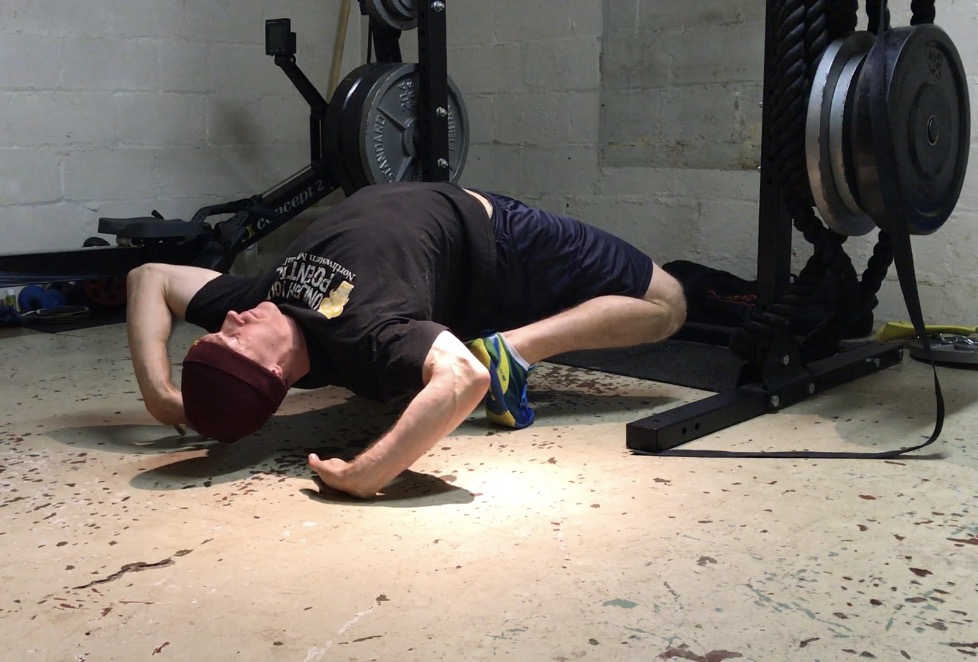
Dangerous? Or progressive?
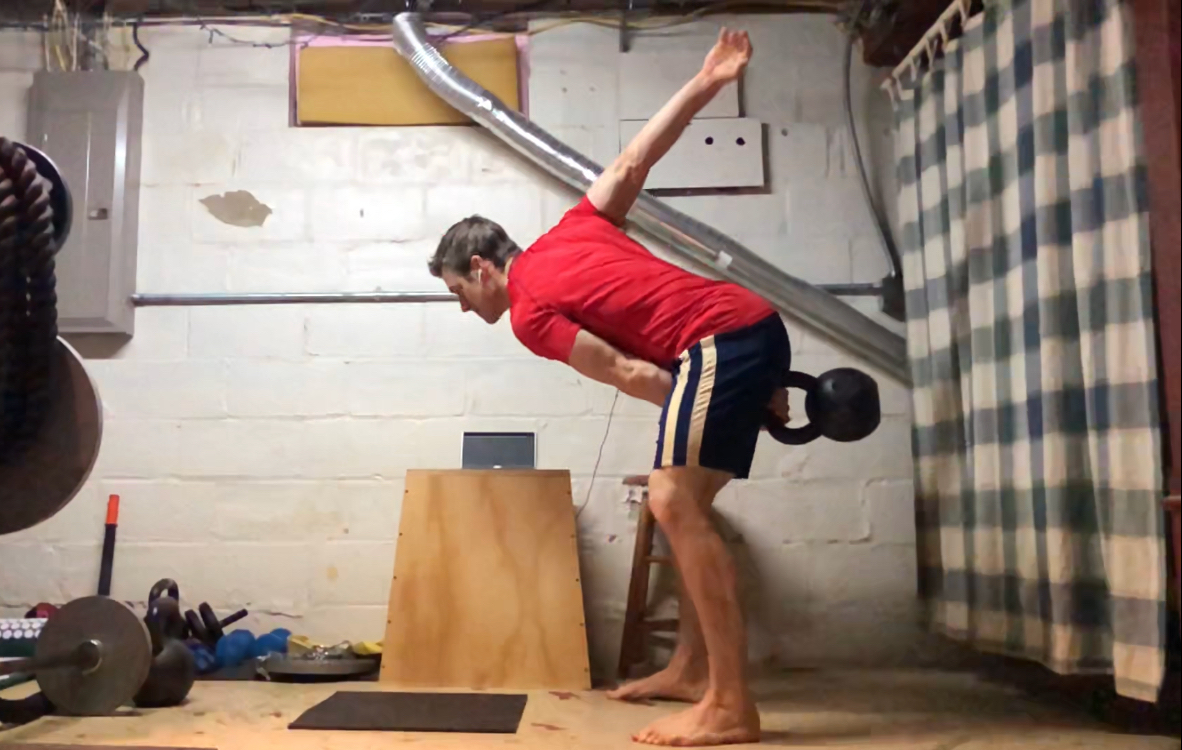
Single Arm Kettlebell Swings
Social Media…




Cheers to getting after it,
Kyle

 M(eaux)tion Fitness
Hi Kyle,
I met your date the other day. He shared your site and very proud. I will say its quite impressive. Use to bodybuild in college. Been about 7 years since Ihave lifted. Back gives me some grief down by the sciatic nerve with some minor degeneration forming. Interesting in core strenghting and eventual getting back in to nautilus.
Drop me a line some time if you like.
Kyle Klein
Hey!
Nice name! I appreciate you stopping by. I have a lot of work to do with regard to content and information on here, but it is a start. I have been putting my thoughts into a book that I have had the drive to write, so that is starting to take shape. I did speak with my Dad, and he said that you might be checking out the site.
I have always been blessed to have a pretty strong network of individuals in other specialities, so those guys and gals will be contributing articles on a regular basis also. I don’t want anyone to get “mother deaf” with just me writing, so it helps to have great information coming from other people.
Whatever gets people moving, eating better, and thinking bigger is what I am after. The creation of change.
How were you training in the past? Heavy? More hypertrophy based for show?
I bet I can learn some things from you…
Yes, core strengthening is key. You should check some of your movement patterns. Overhead deep squat, rotational core stability, etc. When their are gaps in movement quality, chronic aches and pains can arise. Everyone deals with it, but those who stay dedicated to checking and re-checking their movement patterns can stay pain free. Gray Cook is a phenomenal resource. The Functional Movement Screen is a tool that may work wonders for you, assuming you had someone to screen you sometime.
How often do you get soft tissue therapy done? (massage) Do you have a foam roller, lacrosse ball? Trigger points and other restrictions can create havoc, so eliminating those restrictions (assuming you have any) could give you significant relief.
I have your email now… shoot me a reply back whenever you get an opportunity!
Kyle G.
Inspiring, easy to follow blog. Will be following Kyle 🙂